What hiring managers actually look for
Hospital recruiters scanning resumes look for three things immediately:
-
1
EHR proficiency and compliance credentials. Epic, Cerner, BLS, and HIPAA are the keywords that get you past the ATS. If you have them, they need to be visible in the first third of your resume.
-
2
Volume metrics and pace indicators. Patient admissions per week, calls per day, records processed per shift. Hospitals are high-volume environments and managers need to see you can keep up.
-
3
Facility context. Bed count, trauma level, number of departments. This tells the recruiter instantly whether your experience matches their environment.
If your resume communicates these things in the first 7-second scan, you'll make it to the detailed read. Everything below is about making that happen.
How to structure your resume, section by section
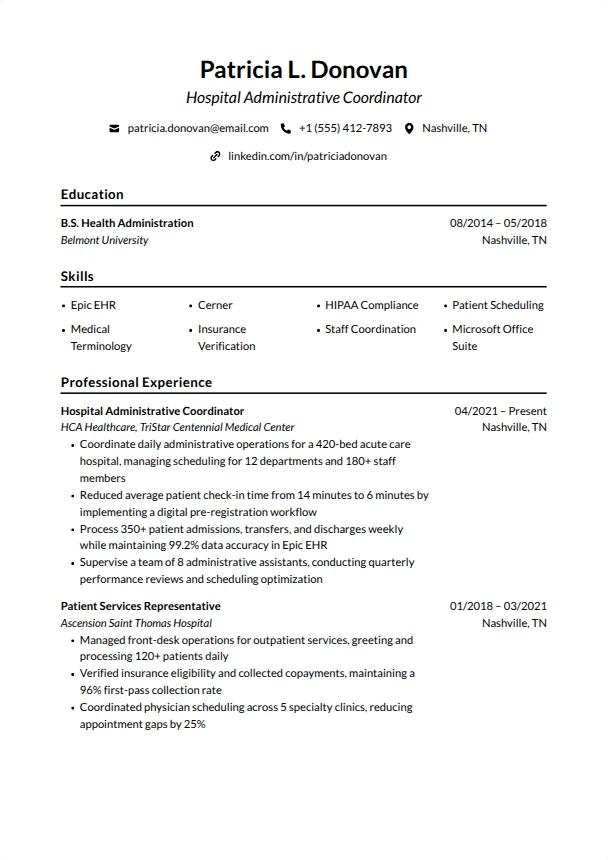
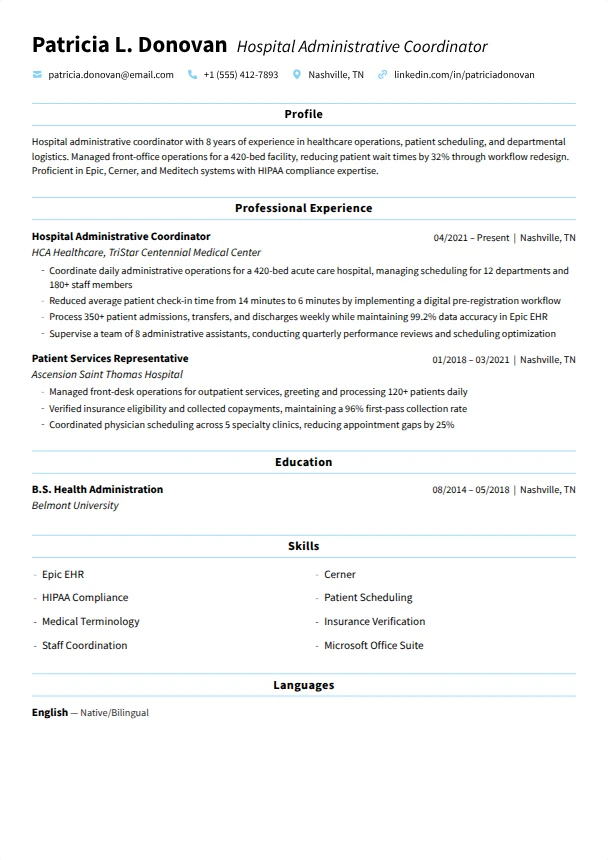
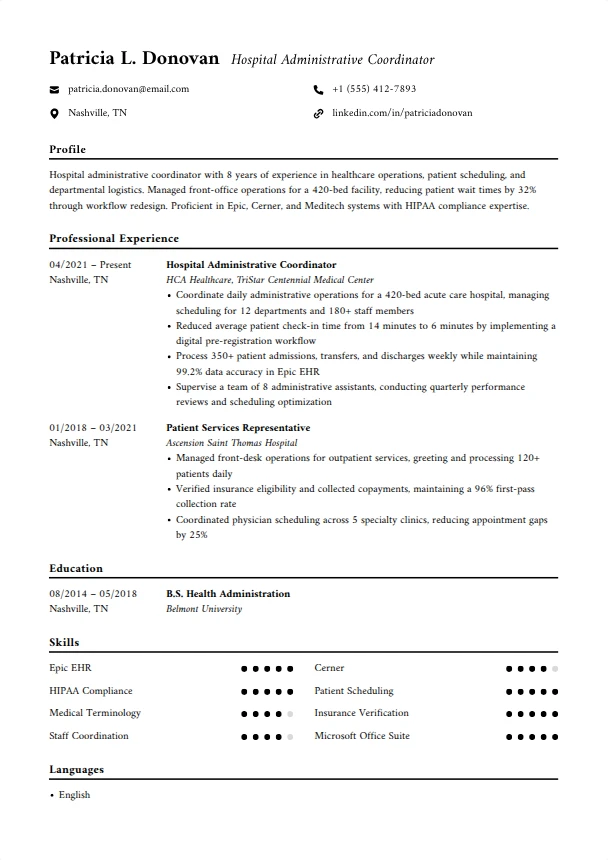
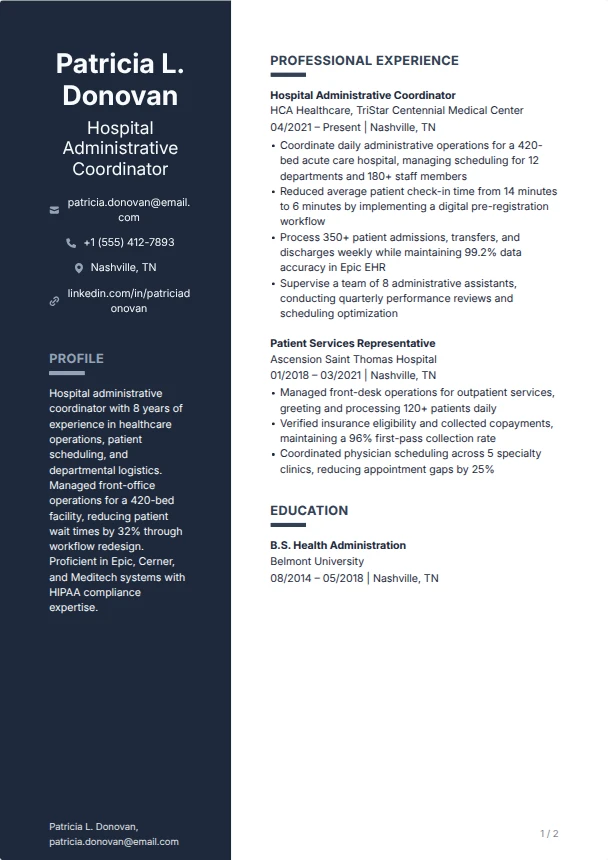
The order matters. Here's what a strong hospital resume examples looks like from top to bottom:
1. Contact header
Keep it clean: name, email, phone, city/state, LinkedIn.
2. Summary examples by role
Pick the summary closest to your background and customize the numbers.
Strong: "Hospital administrative coordinator with 8 years of experience managing front-office operations for a 420-bed acute care facility. Reduced patient check-in time by 53% through digital pre-registration. Proficient in Epic, Cerner, and HIPAA compliance."
3. Certifications
List everything relevant: BLS, HIPAA, Epic certification, medical coding credentials.
BLS/CPR (AHA, 2025) · Epic Certified (2024) · HIPAA Compliance (2025)
4. Skills section
Group by category for easy scanning.
EHR: Epic, Cerner, Meditech
Administrative: Patient registration, insurance verification, ICD-10 coding
Compliance: HIPAA, Joint Commission, infection control
5. Experience bullets
Use the formula: action verb + what you did + metric. Every bullet should have a number.
Strong: "Processed 350+ patient admissions, transfers, and discharges weekly in Epic EHR, maintaining 99.2% data accuracy across a 420-bed facility."
Key skills to include
Copy the skills that match your experience. Remove any you could not demonstrate in an interview.
Tip: Mirror the job posting. If they say 'patient access,' use 'patient access' not 'front desk' or 'reception.'
Resume summary examples you can steal
Use one as a starting point, then swap in your own technologies, numbers, and achievements.
"Patient access representative with 3 years of experience at a 350-bed community hospital. Register 60+ patients daily, verify insurance eligibility, and collect copayments with a 97% first-pass collection rate. Proficient in Epic and bilingual in English and Spanish."
Why it works: Daily volume, collection metric, EHR, and bilingual advantage.
"Unit secretary with 4 years of experience on a 36-bed telemetry unit at a teaching hospital. Manage physician orders, coordinate patient transport, and maintain unit census boards for 24/7 operations. Process 50+ order entries per shift in Cerner with 99% accuracy."
Why it works: Unit type, order volume, accuracy rate, and 24/7 operations context.
"Health information specialist with 5 years of experience managing medical records for a 200-bed hospital. Process 300+ chart requests per week, maintain 99.5% coding accuracy, and ensure Joint Commission compliance on all documentation standards."
Why it works: Weekly volume, accuracy rate, and compliance expertise.
"Hospital operations manager with 10 years of experience overseeing patient access, HIM, and environmental services across a 600-bed Level I trauma center. Manage a $4.2M annual budget and 45 staff members. Led EMR migration from Cerner to Epic for 2,000+ users."
Why it works: Budget, staff count, multi-department scope, and a major technology project.
Writing strong experience bullets
Every bullet point should answer: "What did you do, and why did it matter?" Use this formula:
Before and after examples:
Checked in patients at the front desk.
Registered 60+ patients daily in Epic, verifying demographics, insurance eligibility, and advance directives while maintaining a 97% first-pass collection rate on copayments and deductibles.
Entered orders for the doctors.
Processed 50+ physician orders per shift in Cerner, coordinating lab draws, radiology requests, and dietary changes for a 36-bed telemetry unit with 99% order entry accuracy.
Managed medical records.
Processed 300+ medical record requests per week, maintained 99.5% ICD-10 coding accuracy, and led quarterly audits ensuring 100% compliance with Joint Commission documentation standards.
Strong action verbs for hospital resume examples resumes:
Registered · Processed · Verified · Collected · Coordinated · Managed · Maintained · Documented · Audited · Scheduled · Trained · Supervised · Implemented · Led · Reduced · Streamlined
5 mistakes that get hospital resume examples resumes rejected
Copying examples without customizing the numbers
These examples are starting points. Replace the patient counts, bed sizes, and accuracy rates with your actual numbers. Hiring managers can spot generic copy-paste resumes.
Listing every possible skill
Only include skills you can confidently discuss in an interview. If you have never used Cerner, do not list it just because it appears in the examples above.
Forgetting to match the job posting language
If the posting says 'patient access representative,' use that exact title, not 'front desk clerk' or 'receptionist.' ATS systems match on exact phrases.
Using the same bullets for every application
Adjust your top 2 to 3 bullets to match each job posting's requirements. The effort is minimal but the impact on callback rates is significant.
Not proofreading after copying
After copying and customizing, read through your entire resume once. Check that company names, dates, and numbers are consistent and accurate.
What to do if you have no professional experience
If you have no hospital experience, use these entry-level examples:
Use the transferable skills examples above
The Patient Access Representative summary works well for anyone with customer service experience. Swap in your retail or call center metrics.
Lead with certifications
BLS, HIPAA, and medical terminology coursework go at the top. These are the credentials that qualify you for entry-level hospital roles.
Copy the skills section format
Even without hospital experience, you can list many of the transferable skills shown above. Focus on data entry speed, phone skills, and compliance training.
Customize the summary for your target role
Pick the example closest to your background, replace the numbers with your own, and adjust the language to match the specific job posting you are applying to.
Frequently asked questions
Can I really just copy these examples?
Use them as templates, not word-for-word copies. Replace the specific numbers, facility details, and EHR systems with your own. The structure and phrasing are what matter most.
Which example should I start with?
Pick the one closest to your target role and experience level. If you are entry-level, start with the Patient Access Representative example. If you are mid-career, the Unit Secretary or Medical Records examples may be better fits.
How do I know what numbers to include?
Think about your daily, weekly, and monthly workload: patients registered, calls handled, records processed, orders entered. If you do not know exact numbers, estimate conservatively.
Should I include all the skills listed?
No. Only include skills you can discuss confidently in an interview. It is better to list 8 genuine skills than 15 that include some you have never used.
How often should I update my resume?
Update it every time you change jobs, earn a new certification, or achieve a significant metric. At minimum, review it every 6 months to keep the numbers current.
Skip the blank page
Open a complete, filled-in CNA resume in our free builder. Swap in your own details, keep the wording that fits, and download as PDF, free.
Build your hospital resume now
Pick a template, paste in your customized examples, and download a polished PDF in minutes. Free, no account required.
Start Building, It's FreeRelated resume guides
Complete hospital resume guide with section-by-section writing instructions.
Guide for getting into hospital work with no prior healthcare experience.
Copy-paste examples for clinical coordinators, patient care techs, and health services roles.
More resume examples: