What hiring managers actually look for
Cloud hiring managers evaluating no-experience candidates look past certifications to find three signals of genuine readiness:
-
1
AWS certifications that match the role level. Cloud Practitioner shows interest. Solutions Architect Associate shows competence. For entry-level cloud roles, SAA is the targetit tells a manager you understand core AWS services, networking, security, and cost optimization at a practical level.
-
2
Hands-on projects using real AWS services. A candidate who built a serverless API with Lambda, API Gateway, and DynamoDB has more credibility than one who only passed a certification exam. Managers want to see that you've navigated the AWS console, written IAM policies, and debugged real deployment issues.
-
3
Understanding of infrastructure concepts, not just service names. Listing ' EC2, S3, Lambda, RDS'means nothing if you can't explain VPC networking, security groups, or why you'd choose one database over another. Managers interview for conceptual understanding your resume should hint that you have it.
If your resume communicates these things in the first 7-second scan, you'll make it to the detailed read. Everything below is about making that happen.
How to structure your resume, section by section
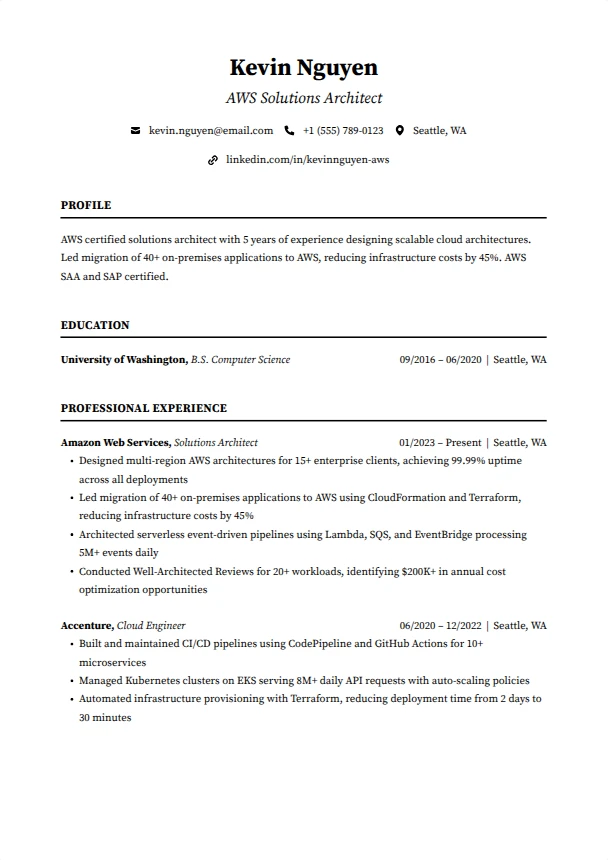
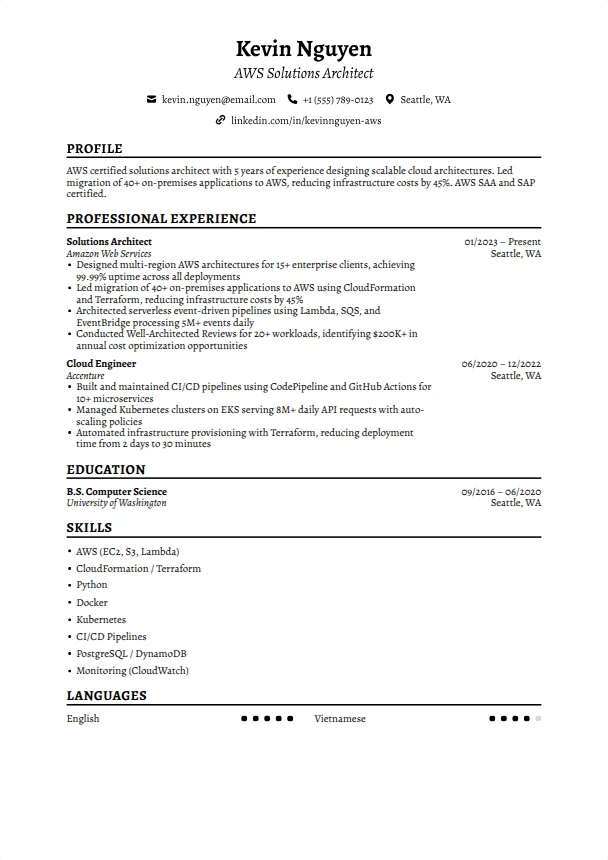
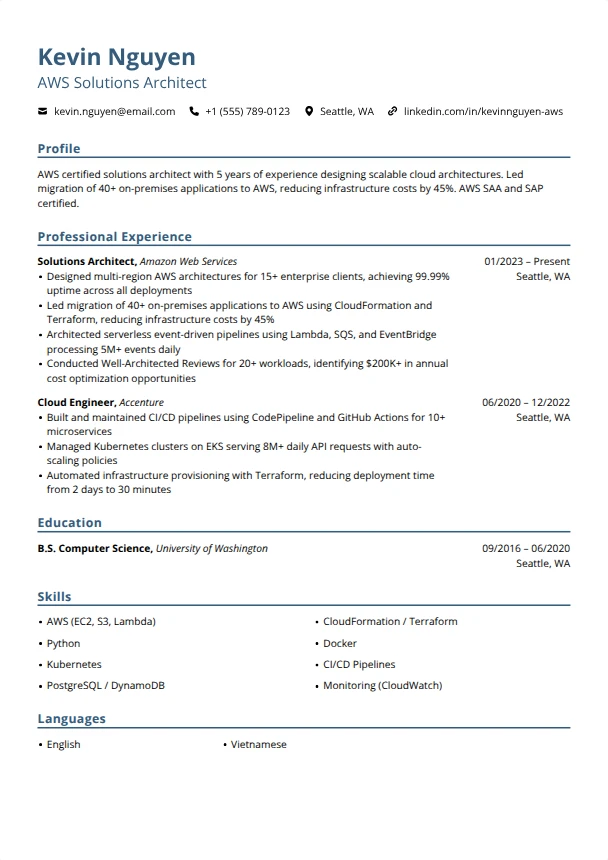
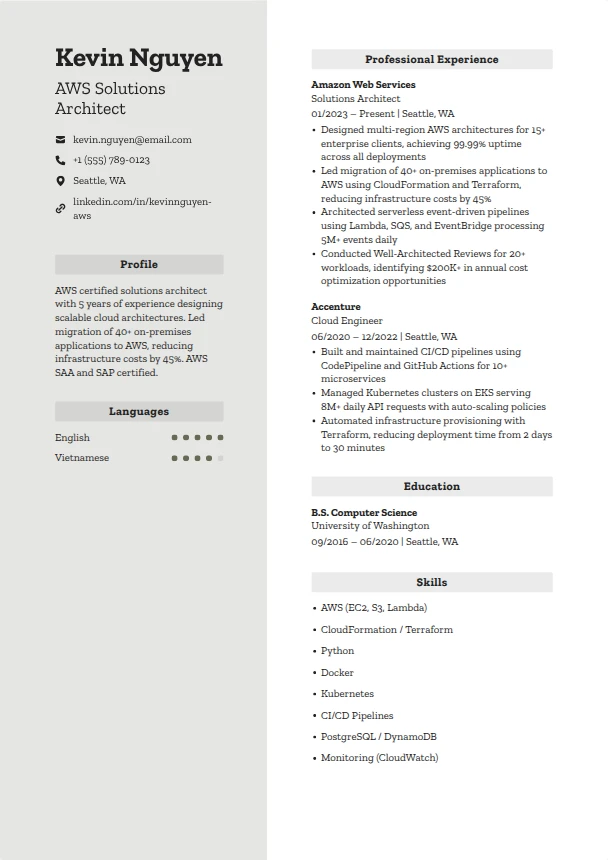
The order matters. Here's what a strong aws resume (no experience) looks like from top to bottom:
1. Contact header
Name, email, phone, city and state, LinkedIn, and GitHub. If you have a tech blog where you document your AWS projects (highly recommended), include that URL. Cloud hiring managers love candidates who write about what they build.
Alex Chen · [email protected] · (555) 667-4420 · Seattle, WA
linkedin.com/in/alexchen-cloud · github.com/alexchen-aws · alexchen.cloud/blog
2. Professional summary (2-3 sentences)
Lead with your highest AWS certification, your strongest cloud project, and the role you're targeting. If you're transitioning from traditional IT, mention your existing infrastructure backgroundit's a significant advantage for cloud roles.
Strong: "AWS Solutions Architect Associate certified IT professional with hands-on experience building serverless applications and multi-tier architectures on AWS Free Tier. Deployed a 3-tier web application using EC2, RDS, and S3 with CloudFront CDN, achieving sub-200ms page loads. Transitioning from 2 years of on-premises systems administration with a focus on cloud migration and infrastructure-as-code."
3. Certifications
AWS certifications are the currency of cloud hiring. List them prominently. Cloud Practitioner is the baseline; Solutions Architect Associate is the target for most entry-level cloud roles. Include the validation number if space allows.
AWS Solutions Architect - Associate (2025) · AWS Cloud Practitioner (2025) · CompTIA Network+ (2024) · Hashi Corp Terraform Associate (in progress)
4. Technical skills
Organize by category: AWS Services, Infrastructure-as-Code, Networking, Scripting, and Monitoring. Be specific about which AWS services you've actually useddon't list services you only read about.
AWS: EC2, S3, RDS, Lambda, API Gateway, CloudFront, IAM, VPC, Route 53, CloudWatch
Ia C: Terraform (basic), CloudFormation, AWS CLI
Scripting: Python (Boto3), Bash, PowerShell
Networking: VPC design, security groups, NACLs, subnets, NAT gateways
Monitoring: CloudWatch, CloudTrail, AWS Config
5. Cloud projects (your most important section)
List 2-4 AWS projects. For each: project name, services used, a description of the architecture, and what you learned or achieved. Include architecture diagrams in your blog if possible. These projects are your substitute for professional experience.
Strong: "<strong class="text-slate-700">Serverless URL Shortener</strong><br>Lambda, API Gateway, DynamoDB, CloudFront, Route 53<br>• Built a fully serverless URL shortening service handling 1,000+ requests/day during testing<br>• Configured API Gateway with custom domain, SSL certificate via ACM, and CloudFront caching<br>• Implemented DynamoDB TTL for automatic link expiration and CloudWatch alarms for error monitoring<br>• Documented full architecture and deployment process in a blog post (800+ views)"
6. Education & prior IT experience
List your degree and any prior IT roles. If you're transitioning from on-prem IT, briefly mention your systems administration or networking background cloud managers value candidates who understand the infrastructure that cloud services abstract away.
Key skills to include
These are the most requested skills in entry-level AWS and cloud engineering job postings. Focus on the ones you've used in real projects or labs.
Tip: Cloud job postings often specify ' hands-on experience with'rather than just ' knowledge of.' For every AWS service on your resume, be ready to describe a project where you actually configured and deployed it.
Resume summary examples you can steal
Use one as a starting point, then swap in your own technologies, numbers, and achievements.
"AWS Solutions Architect Associate certified IT graduate with 3 deployed cloud projects on AWS Free Tier. Built a serverless API handling 1,000+ daily requests, a multi-AZ web application with auto-scaling, and a static site with CloudFront CDN. Strong foundation in networking, Linux, and Python scripting from a B. S.in Information Technology."
Why it works: Leads with the target certification, quantifies project complexity, ties academic foundation to cloud skills.
"Systems administrator with 2 years of on-prem experience transitioning to cloud engineering. AWS Solutions Architect Associate certified. Migrated a personal project from a physical server to a 3-tier AWS architecture (EC2, RDS, S3), reducing hosting costs by 60%. Brings strong fundamentals in networking, Active Directory, and Linux administration."
Why it works: Frames IT background as a cloud advantage, demonstrates a real migration project, shows cost awareness.
"Self-taught cloud practitioner with AWS Cloud Practitioner and Solutions Architect Associate certifications earned in 6 months. Built 4 AWS projects including a serverless URL shortener, a static website with CI/CD pipeline, and a VPC-based multi-tier application. Documented all architectures in a technical blog with 2,000+ total views."
Why it works: Shows rapid learning trajectory, stacks certifications, uses blog as proof of deep understanding.
"Cloud engineering intern at a managed services provider, supporting 15 client AWS accounts. Assisted with EC2 instance provisioning, S3 bucket policy configuration, and CloudWatch alarm setup. AWS Cloud Practitioner certified with Solutions Architect Associate in progress. Completed a capstone project deploying a serverless application with Lambda and DynamoDB."
Why it works: Real internship experience with specific tasks, certification trajectory, and a tangible capstone project.
Writing strong experience bullets
Every bullet point should answer: "What did you do, and why did it matter?" Use this formula:
Before and after examples:
Set up an AWS account and deployed some services to learn cloud computing.
Architected and deployed a 3-tier web application on AWS (EC2, Application Load Balancer, RDS PostgreSQL, S3) with auto-scaling configured for 2-6 instances based on CPU utilization, achieving 99.9% uptime over 3 months.
Got AWS certified and studied cloud architecture.
Earned AWS Solutions Architect Associate certification and applied the knowledge by building 4 distinct AWS projects: a serverless API, a multi-AZ web app, a static site with CI/CD, and a VPC peering demonstration across 2 regions.
Used Lambda and API Gateway to build a serverless application.
Built a serverless URL shortening service using Lambda (Python), API Gateway, and DynamoDB, handling 1,000+ test requests daily with <100ms average response time and automatic TTL-based link expiration.
Strong action verbs for aws resume (no experience) resumes:
Architected · Automated · Built · Configured · Deployed · Designed · Documented · Implemented · Launched · Migrated · Monitored · Optimized · Provisioned · Scripted · Secured · Scaled · Templated · Tested
7 mistakes that get aws resume (no experience) resumes rejected
Listing AWS services you've only read about
If you put ' ECS, EKS, Redshift, Sage Maker'on your resume but have never launched them, you'll be exposed in the first technical interview. Only list services you've configured, deployed, or troubleshot in a real project.
Stopping at Cloud Practitioner certification
CCP shows interest but not competence. For cloud engineering and solutions architect roles, Solutions Architect Associate is the minimum expectation. If you only have CCP, at least list SAA as ' in progress'to show you're working toward it.
Building only hello-world projects
Launching a single EC2 instance with a static page doesn't demonstrate cloud skills. Build projects that use multiple services together: a Lambda function triggered by S3 events, a VPC with public and private subnets, or an auto-scaling web application with a load balancer.
Ignoring cost optimization on your resume
Every cloud role involves cost management. If your projects show you understand reserved instances, right-sizing, or S3 lifecycle policies, mention it. ' Configured S3 lifecycle rules to move infrequently accessed data to Glacier, projecting 40% storage cost reduction'is a strong bullet.
Not documenting your projects publicly
A blog post or GitHub README that walks through your architecture, design decisions, and lessons learned is worth more than the project itself. It proves you can communicate technical conceptsa critical skill for cloud roles that involve stakeholder communication.
Applying to senior cloud architect roles with no experience
Target junior cloud engineer, cloud support associate, or cloud operations roles. AWS also has specific entry-level positions (Cloud Support Associate) designed for certified candidates without deep professional experience. Match your applications to your actual level.
Forgetting to mention your on-prem IT background
If you have systems administration, networking, or infrastructure experience, lead with it. Cloud is built on the same fundamentals and managers strongly prefer candidates who understand what's happening under the abstraction layer.
What to do if you have no professional experience
AWS and cloud roles are more accessible than they look. Here's how to build a cloud resume from scratch:
Earn AWS certifications in the right order
Start with Cloud Practitioner to learn the landscape, then go straight to Solutions Architect Associatethis is the certification that opens doors. Use free resources: Stephane Maarek's Udemy course, Tutorials Dojo practice exams, and AWS Skill Builder. Budget 2-3 months per certification with 1-2 hours of daily study.
Build real projects on AWS Free Tier
AWS Free Tier gives you 12 months of access to core services. Build at least 3 projects: a serverless application (Lambda + API Gateway + DynamoDB), a multi-tier web app (EC2 + RDS + S3), and a static site with CloudFront and CI/CD. Each project should use 3+ services and involve real networking and security configuration.
Document everything in a technical blog
For every project, write a blog post covering: the problem you solved, the architecture you designed (include a diagram), the services you used, challenges you hit, and what you'd do differently. Host it on a static S3 site with CloudFrontthe blog itself becomes a project. This documentation is often what tips a hiring decision in your favor.
Leverage existing IT experience for the cloud transition
If you've worked in IT support, systems administration, or networking, you already understand the infrastructure that cloud abstracts. Frame your on-prem experience as cloud-adjacent: ' Managed Windows Server and Active Directory for 500+ users'becomes the foundation for understanding EC2, IAM, and AWS Directory Service. The transition story is compelling to hiring managers.
Frequently asked questions
Can I get an AWS job with just certifications and no work experience?
Yes, but certifications alone aren't enough. You need hands-on projects that demonstrate you can actually use AWS services. The winning combination is: Solutions Architect Associate + 2-3 deployed projects + a blog documenting your work. This package is competitive for junior cloud engineer and cloud support associate roles.
Which AWS certification should I get first?
Cloud Practitioner if you're brand new to cloud and IT. Solutions Architect Associate if you have any IT background (even basic). SAA is the most recognized and requested certification in cloud job postingsit covers the breadth of AWS services that entry-level roles require.
How do I list AWS Free Tier projects on my resume?
Create a ' Cloud Projects'section. For each project: name, AWS services used, date, and 2-4 bullet points describing the architecture, what you configured, and any metrics (requests handled, uptime, response time). Include a link to your blog writeup or GitHub repo. Don't mention ' Free Tier'just describe what you built.
Is it worth transitioning from IT support to cloud?
Absolutely. IT support gives you foundational knowledge of networking, operating systems, and troubleshooting that many cloud-only candidates lack. Cloud managers often prefer ex-IT-support candidates because they understand what happens when the abstraction breaks. Get your SAA certification and build projects to bridge the gap.
Should I learn Terraform or CloudFormation first?
Learn CloudFormation firstit's AWS-native, covered on AWS exams, and expected in AWS-focused roles. Then learn Terraform basics, as it's the industry standard for multi-cloud infrastructure-as-code. Having both on your resume signals versatility, but CloudFormation is the priority for AWS-specific positions.
Skip the blank page
Open a complete, filled-in DevOps / cloud engineer resume in our free builder. Swap in your own details, keep the wording that fits, and download as PDF, free.
Build your AWS resume now
Pick a clean, ATS-friendly template, showcase your AWS certifications and cloud projects, and download a polished PDF in minutes. Free, no account required.
Start Building, It's FreeRelated resume guides
Full AWS resume guide for cloud engineers, architects, and DevOps professionals.
General IT resume guide for candidates breaking into the field.
Full-stack, backend, and frontend engineering roles with code-focused bullets.
Security certifications, threat analysis, incident response, and compliance.
More resume examples: