What hiring managers actually look for
Engineering hiring managers reviewing a no-experience resume focus on three things to separate serious candidates from tutorial-followers:
-
1
Portfolio projects that solve real problems. A to-do app doesn't impress anyone. A budgeting tool that pulls live bank data via Plaid, or a CLI that automates a tedious workflowthose show you can think beyond tutorials. Managers want to see projects with real users or real complexity.
-
2
Clean, readable code on GitHub. Your GitHub profile is your second resume. Managers will click through your pinned repos, scan for clean commit messages, readable code structure, and whether you write tests. An active contribution graph matters more than star counts.
-
3
Technical depth in at least one area. Entry-level candidates who claim to know React, Node, Python, Java, Go, and Rust raise red flags. Pick one stack, go deep, and demonstrate mastery through your projects. Breadth comes laterdepth gets you hired now.
If your resume communicates these things in the first 7-second scan, you'll make it to the detailed read. Everything below is about making that happen.
How to structure your resume, section by section
The order matters. Here's what a strong software engineer resume (no experience) looks like from top to bottom:
1. Contact header
Name, email, phone, city and state, LinkedIn, GitHub, and portfolio URL if you have one. Your GitHub link is non-negotiable for a software engineering resume it's the first thing most reviewers click.
Jordan Kim · [email protected] · (555) 901-3344 · Austin, TX
linkedin.com/in/jordankim-dev · github.com/jordankim · jordankim.dev
2. Professional summary (2-3 sentences)
Without job experience, your summary should name your primary language/framework, your strongest project, and what makes you different from other bootcamp grads or CS students. Be specificvague summaries get skipped.
Strong: "Full-stack developer specializing in React and Node.js with 3 deployed portfolio projects, including a real-time collaboration tool used by 50+ beta testers. Contributed bug fixes and documentation to 2 open-source projects (Express.js, React Query). CS graduate from UT Austin with strong foundations in data structures, algorithms, and system design."
3. Technical skills
Organize by category: Languages, Frameworks, Databases, Tools, and Cloud/DevOps. Only list technologies you've built something with. If your only experience with a language is a ' Hello World,' leave it off.
Languages: JavaScript, TypeScript, Python, SQL
Frameworks: React, Node.js, Express, Next.js, Tailwind CSS
Databases: PostgreSQL, MongoDB, Redis
Tools: Git, GitHub Actions, Docker, VS Code, Postman
Cloud: AWS (EC2, S3, Lambda), Vercel, Netlify
4. Projects (your most important section)
List 2-4 projects. For each: project name, tech stack, date, a one-line description, live link or GitHub URL, and 2-4 bullet points. Focus on what the project does, what architectural decisions you made, and any metrics (users, response times, test coverage).
Strong: "<strong class="text-slate-700">Collab Board Real-Time Collaboration Tool</strong><br>React, Node.js, Socket.io, PostgreSQL · <a href="#">Live demo</a> · <a href="#">GitHub</a><br>• Built a collaborative whiteboard supporting real-time drawing, text, and cursor sharing across 10+ simultaneous users<br>• Implemented Web Socket connections with Socket.io, handling 500+ messages/second with <50ms latency<br>• Designed a PostgreSQL schema for session persistence with automatic cleanup of stale sessions after 24 hours"
5. Open-source contributions & hackathons
Even small contributions count: bug fixes, documentation improvements, or test coverage. List the project name, your contribution, and whether it was merged. Hackathon projects are also worth listing especially if you won or placed.
Express.jsFixed middleware ordering bug in error-handling chain (PR #4821, merged)
Hack TX 2025Built a food-waste reduction app with 3 teammates in 24 hours; won 2nd place out of 85 teams
6. Education
CS degree, bootcamp certificate, or relevant coursework. Include GPA if it's 3.5+ and recent. List relevant courses only if they add depth: ' Operating Systems, Distributed Systems, Machine Learning'tells a reviewer more than ' Intro to Programming.'
Key skills to include
These are the most in-demand skills for entry-level software engineering roles in 2026. Don't list all of themfocus on the ones you've actually used in projects.
Tip: Match the exact tech stack in the job posting. If they say ' TypeScript'and ' Next.js,' don't list ' JavaScript'and ' React'use their exact terms. ATS systems match literally.
Resume summary examples you can steal
Use one as a starting point, then swap in your own technologies, numbers, and achievements.
"Computer science graduate from Georgia Tech with a focus on full-stack web development. Built 4 portfolio projects using React, Node.js, and PostgreSQL, including a deployed task management app with 100+ weekly active users. Strong foundation in data structures, algorithms, and software design patterns."
Why it works: Names the school, quantifies project impact, identifies specific technologies and CS fundamentals.
"Full-stack web developer and career changer with a certificate from App Academy. Shipped 3 production-quality projects in React and Python/Flask during a 16-week intensive program. Former financial analyst with 5 years of experience in data analysis and stakeholder communication skills that translate directly to cross-functional engineering teams."
Why it works: Positions the career change as an advantage, quantifies bootcamp output, connects prior career to engineering soft skills.
"Self-taught software developer with 18 months of focused study in JavaScript, React, and Node.js. Contributed merged pull requests to 3 open-source projects (Express, React Query, Chakra UI). Built and deployed a real-time chat application handling 200+ concurrent connections with Socket.io and Redis."
Why it works: Proves consistency and depth through open-source contributions and technically impressive project metrics.
"Computer science junior at UC Berkeley with one completed software engineering internship at a Series B startup. Built an internal dashboard that reduced customer support ticket triage time by 35%. Proficient in TypeScript, React, and PostgreSQL, with additional experience in Python for data scripting."
Why it works: Leads with a real internship metric, names specific technologies, and shows academic and practical balance.
Writing strong experience bullets
Every bullet point should answer: "What did you do, and why did it matter?" Use this formula:
Before and after examples:
Created a web application for managing tasks.
Built a full-stack task management app (React, Node.js, PostgreSQL) with user authentication, real-time updates via WebSockets, and 100+ weekly active users after launch on Product Hunt.
Contributed to open-source projects on GitHub.
Submitted 8 merged pull requests across 3 open-source libraries (Express.js, React Query, Chakra UI), including a performance fix that reduced bundle size by 12%.
Participated in a hackathon and built a project with my team.
Architected and built the backend (Python/Flask, PostgreSQL) for a food-waste reduction app at Hack TX 2025, winning 2nd place out of 85 teams with a functional MVP in 24 hours.
Strong action verbs for software engineer resume (no experience) resumes:
Architected · Built · Configured · Containerized · Debugged · Deployed · Designed · Developed · Implemented · Integrated · Launched · Optimized · Refactored · Shipped · Styled · Tested · Wrote
6 mistakes that get software engineer resume (no experience) resumes rejected
Listing tutorial projects as portfolio work
Every bootcamp grad has a to-do app and a weather widget. These signal that you followed instructions, not that you can build software. Create at least one original project that solves a problem you personally encountered.
Claiming too many languages and frameworks
Listing 8+ languages tells a reviewer you're shallow in all of them. Pick your primary stack (e.g., TypeScript + React + Node.js) and go deep. You can mention secondary languages, but make it clear where your expertise is.
Having an empty or messy GitHub profile
If your GitHub has no pinned repos, no README files, and commit messages like ' fixed stuff,' it's hurting you. Clean up your top 3 repos: add READMEs, use clear commit messages, and pin them to your profile.
Not including live links to deployed projects
A project without a live demo or a working GitHub link is invisible. Deploy your projects on Vercel, Netlify, or Railwayfree tiers are sufficient. If a reviewer can't see it running, they'll assume it doesn't work.
Writing ' familiar with'or ' exposure to'in your skills section
These phrases signal you barely know the technology. Either you've built something with it and can list it confidently, or you leave it off. There's no middle ground on a resume.
Sending a two-page resume as a new grad or bootcamp graduate
One page. No exceptions. If you can't fill one page with relevant content, the answer is to build more projects not to pad with coursework descriptions or soft skills lists.
What to do if you have no professional experience
Software engineering is uniquely meritocratic your code speaks for itself. Here's how to build a resume that proves you can ship:
Build 2-3 portfolio projects that go beyond tutorials
Pick problems you actually care about and build real solutions. A personal finance tracker with Plaid integration, a CLI tool that automates something in your workflow, or a multiplayer game with WebSockets. Original projects with real complexity are what separate your resume from thousands of tutorial clones.
Contribute to open-source projects
Find projects on GitHub tagged ' good first issue'and start small: documentation fixes, test coverage, or minor bug fixes. Once you get a feel for the codebase, tackle larger issues. Even 3-5 merged pull requests show you can read others'code, follow contribution guidelines, and collaborate with a team.
Compete in hackathons and coding challenges
Hackathons force you to build under pressure and work with a teamboth things employers care about. Winning isn't required; finishing a working MVP in 24-48 hours is impressive on its own. List the event, your project, your role, and the tech stack.
Make your GitHub profile your portfolio
Pin your 3 best repos. Each should have a detailed README with screenshots, a tech stack overview, setup instructions, and a live demo link. Use clear commit messages and branch names. Your GitHub contribution graph should show consistent activityeven a few commits per week signals dedication.
Frequently asked questions
Do I need a CS degree to get a software engineering job?
No. Many companies especially startups and mid-size firmshire based on skills and portfolio. A strong GitHub profile with 2-3 deployed projects can outweigh a degree. That said, some larger companies still filter for degrees in their ATS, so having one helps widen your options.
How do I list bootcamp experience on my resume?
Put it in your Education section: bootcamp name, program title (e.g., ' Full-Stack Web Development'), and completion date. Then list your bootcamp projects separately in a Projects section with full technical details. Don't just say ' completed bootcamp'show what you built during it.
What projects actually impress hiring managers?
Projects that solve real problems, have real users, or demonstrate technical depth. A real-time app with WebSockets, an API that handles authentication and rate limiting, or a tool that automates a complex workflow. The bar is originality and complexitynot polished UI.
Should I apply to jobs that say '2+ years of experience required'?
Yes. Many companies write aspirational job descriptions. If you match 60-70% of the requirements and have strong projects, apply anyway. The worst outcome is no responseand many entry-level engineers got their first role by applying to postings that technically asked for more experience.
Is it worth listing freelance or personal projects?
Absolutely. If you built a website for a friend's business, automated a task for a family member, or created a tool that people actually use, it belongs on your resume. Frame it professionally: client name (or ' Personal Project'), tech stack, and 2-3 bullet points describing what you built and its impact.
Skip the blank page
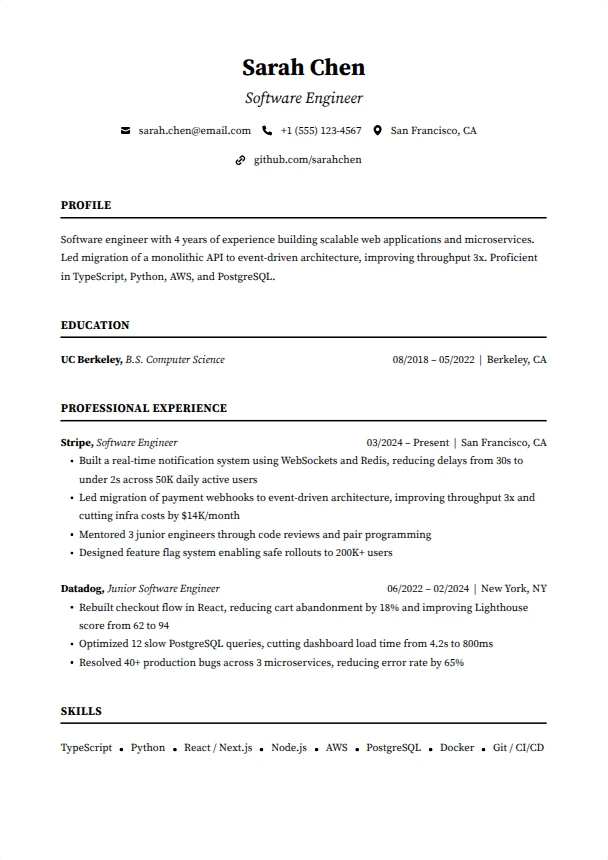
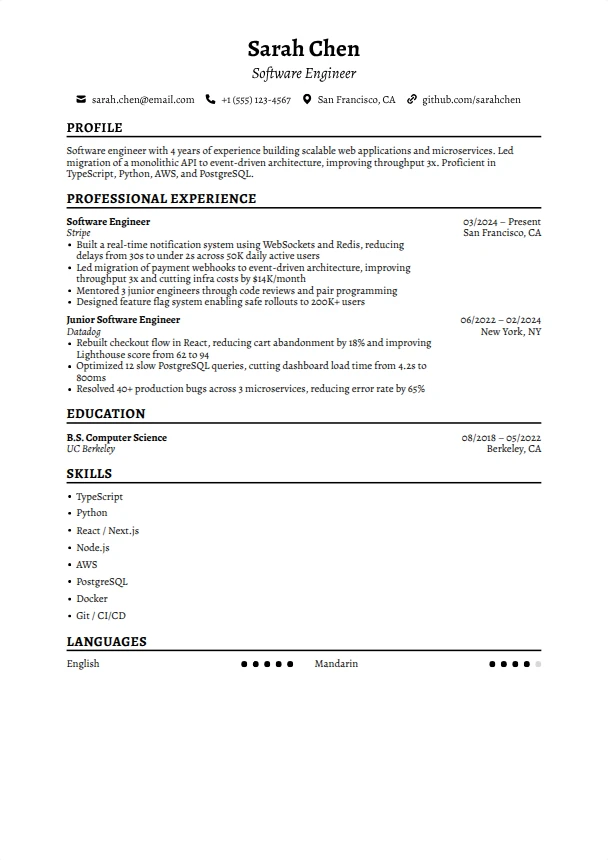
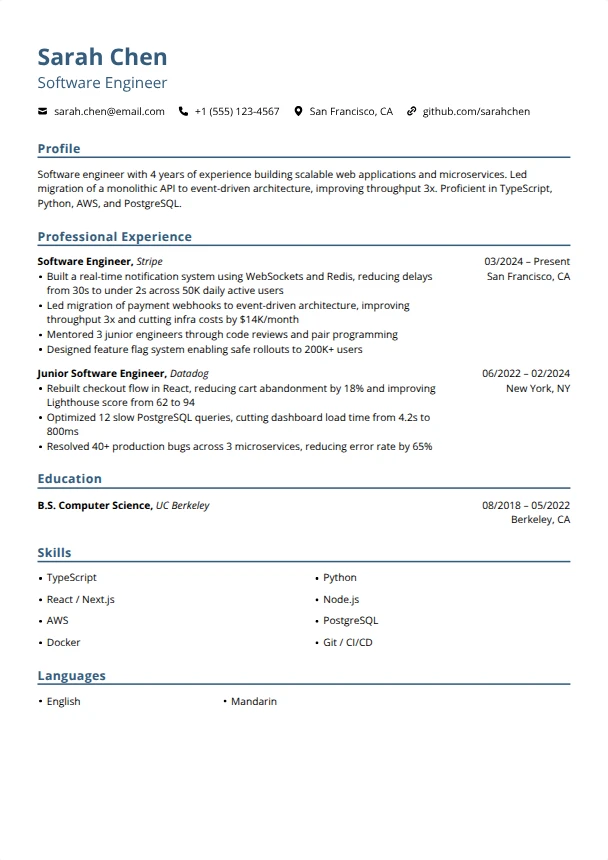
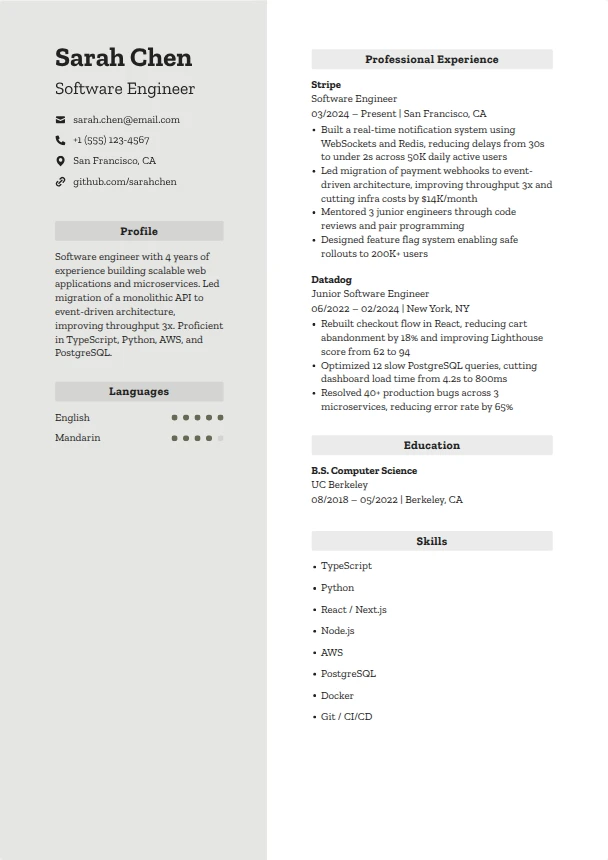
Open a complete, filled-in software engineer resume in our free builder. Swap in your own details, keep the wording that fits, and download as PDF, free.
Build your software engineer resume now
Grab a developer-friendly template, showcase your projects and GitHub contributions, and download a polished PDF in minutes. Free, no account required.
Start Building, It's FreeRelated resume guides
HTML, CSS, JavaScript, responsive design, and portfolio presentation.
Full-stack, backend, and frontend engineering roles with code-focused bullets.
SQL, Python, dashboards, and data storytelling for business stakeholders.
Comprehensive guide to IT resumes covering support, sysadmin, and infrastructure roles.
More resume examples: