What hiring managers actually look for
Web development hiring managers evaluating candidates without professional experience focus on three tangible signals:
-
1
Deployed projects with real URLs. A GitHub repo is good. A live, deployed application with a working URL is dramatically better. Managers click links. If your portfolio site loads fast, looks professional, and the code is clean, you've passed the first test.
-
2
Clean, readable code on GitHub. Hiring managers and senior developers will look at your code. Consistent formatting, clear variable names, meaningful commit messages, and a well-structured README signal that you write code like a professional, not a student.
-
3
Responsive design and modern tooling. In 2026, every web developer is expected to build mobile-first. If your portfolio projects only work on desktop, or use outdated patterns (j Query, Bootstrap 3, vanilla CSS without methodology), the resume feels dated regardless of when you built it.
If your resume communicates these things in the first 7-second scan, you'll make it to the detailed read. Everything below is about making that happen.
How to structure your resume, section by section
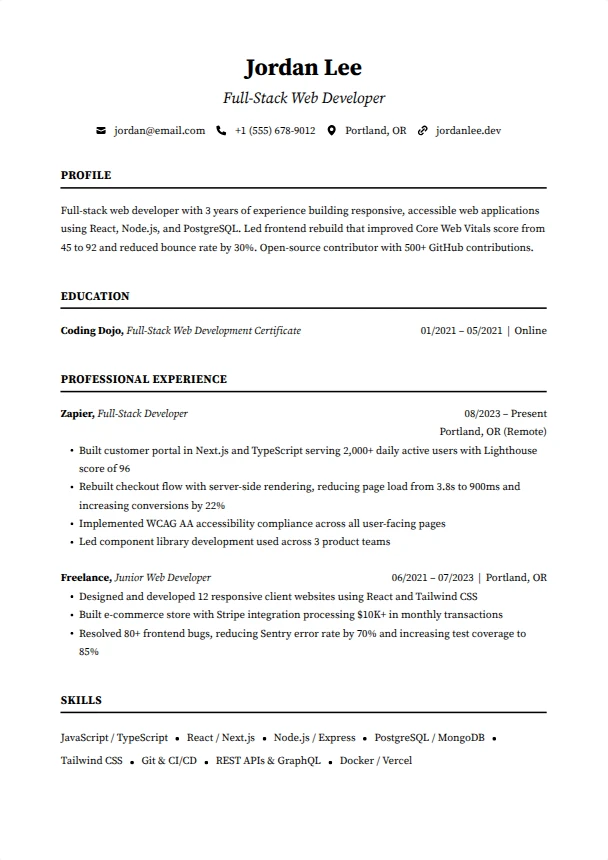
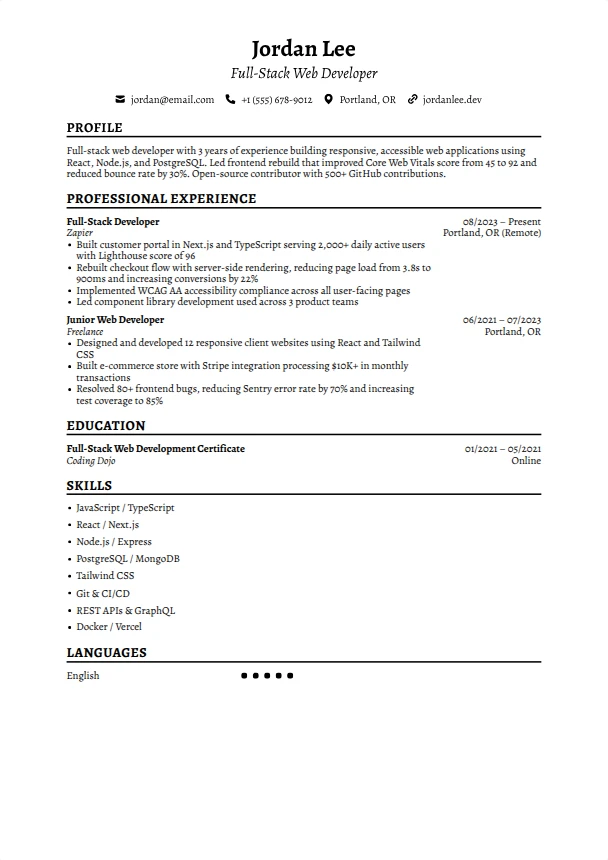
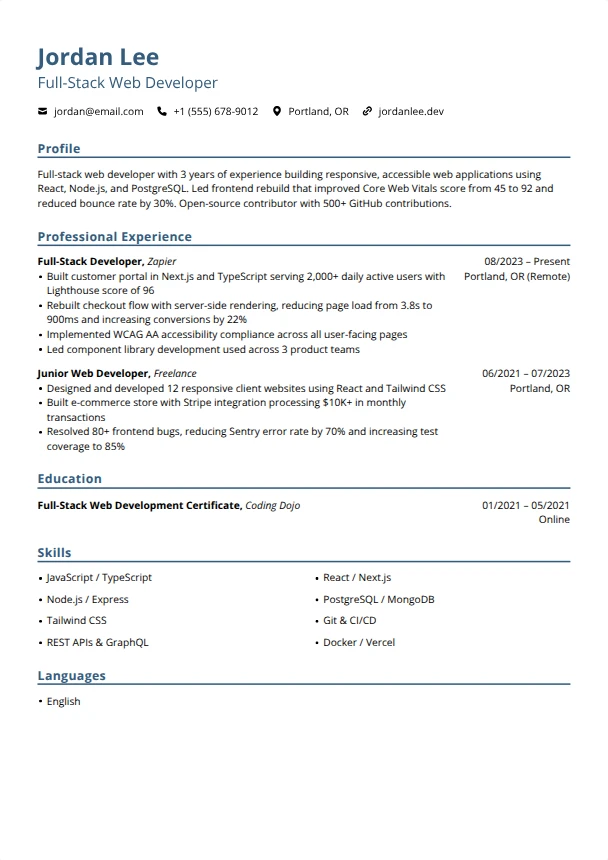
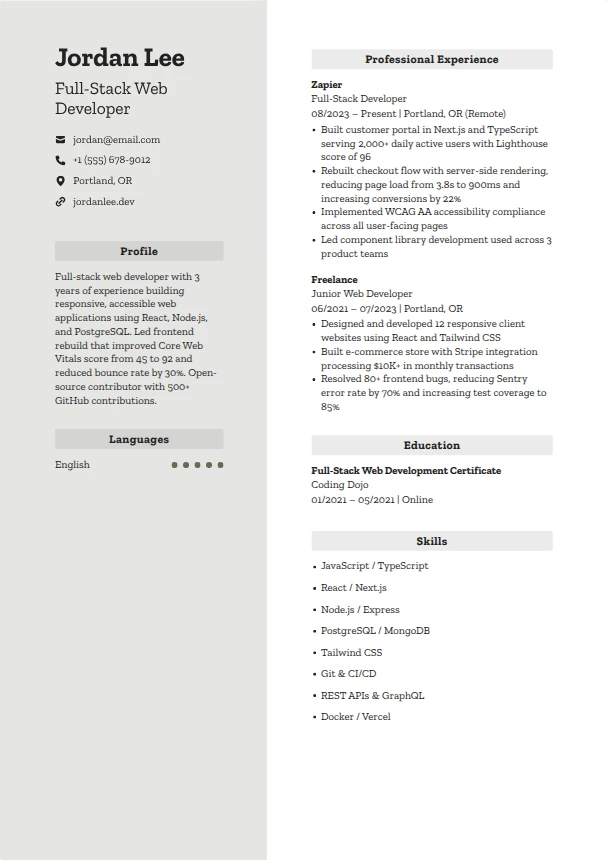
The order matters. Here's what a strong web developer resume (no experience) looks like from top to bottom:
1. Contact header
Name, email, phone, city/state, LinkedIn, GitHub, and your portfolio site URL. The portfolio link is the most important element on a web developer resume it's your live proof of ability.
Jordan Rivera · [email protected] · (555) 678-9012 · Portland, OR
linkedin.com/in/jordanrivera-dev · github.com/jrivera · jordanrivera.dev
2. Professional summary (2-3 sentences)
Lead with your technical stack, number of deployed projects, and any freelance or bootcamp experience. Avoid calling yourself ' junior'or ' aspiring'let your portfolio speak to your level.
Strong: "Front-end developer with 4 deployed web applications built using React, TypeScript, and Tailwind CSS. Completed a 16-week full-stack bootcamp (600+ hours of curriculum) and built a freelance portfolio site for a local restaurant that increased their online orders by 35%. Active open-source contributor with 3 merged pull requests to established projects."
3. Technical skills
Group by layer: Languages, Frameworks, Styling, Tools, and Deployment. Web development stacks change fastmake sure your skills reflect 2026 standards, not 2020 tutorials.
Languages: HTML5, CSS3, JavaScript (ES6+), TypeScript
Frameworks: React, Next.js, Node.js, Express
Styling: Tailwind CSS, CSS Modules, Responsive Design
Tools: Git, GitHub, VS Code, Figma, Chrome Dev Tools
Deployment: Vercel, Netlify, AWS S3, GitHub Actions
4. Portfolio projects
This is the most important section on a no-experience web developer resume. Each project needs: name, live URL, tech stack, description of what it does, and one metric or outcome (users, performance, client impact).
Strong: "<strong class="text-slate-700">Bella's Kitchen Restaurant Website</strong> (bellaskitchen.com)<br>Built a responsive restaurant website with React, Tailwind CSS, and a Node.js backend for online ordering. Integrated Stripe for payments and built an admin dashboard for menu management. Client reported 35% increase in online orders within the first month of launch. Lighthouse performance score: 95+."
5. Education & training
List your bootcamp with total hours and capstone project, or your degree with relevant coursework. For self-taught developers, list structured courses completed (free Code Camp certifications, The Odin Project, etc.).
General Assembly Software Engineering Immersive (2025)
600-hour full-stack program covering JavaScript, React, Node.js, PostgreSQL, and Git. Built 4 full-stack projects with deployed demos.
6. Previous work experience
Include non-dev roles only if they demonstrate transferable skills: client communication, project management, design thinking, or analytical problem-solving. Keep it briefyour projects section is the star.
Key skills to include
These skills appear most frequently in entry-level and junior web developer job postings in 2026. Only list technologies you can demonstrate in a technical interview or portfolio project.
Tip: If the posting asks for ' Next.js experience,' make sure at least one of your portfolio projects uses Next.jsand mention it by name in both your skills section and project description. Tool alignment between your resume and the posting is critical.
Resume summary examples you can steal
Use one as a starting point, then swap in your own technologies, numbers, and achievements.
"Full-stack web developer and General Assembly graduate (600+ hours) with 4 deployed web applications built using React, Node.js, and PostgreSQL. Capstone projecta task management app with real-time collaboration has 200+ registered users. Experienced in agile development, code review, and pair programming from bootcamp team projects."
Why it works: Quantified bootcamp hours, deployed projects with real users, team development experience.
"Self-taught front-end developer with 3 deployed portfolio projects built using React, TypeScript, and Tailwind CSS over 10 months of intensive self-study. Completed free Code Camp Responsive Web Design and JavaScript certifications. Built a freelance project for a local business that improved their mobile conversion rate by 45%. Active contributor to 2 open-source React component libraries."
Why it works: Self-taught timeline shows dedication, freelance project proves professional capability, open source adds collaboration credibility.
"Former graphic designer transitioning to front-end development with a strong eye for UI/UX and 3 deployed React applications. Brings 4 years of design experience using Figma, Adobe Creative Suite, and responsive design principles. Built a custom portfolio site (95+ Lighthouse score) and a client booking app handling 50+ weekly appointments for a yoga studio."
Why it works: Design background positions as a unique advantage, deployed projects with real client usage, performance metrics included.
"Computer Science graduate with a focus on web technologies. Built 3 full-stack applications during coursework and a senior capstone e-commerce platform (React, Express, PostgreSQL) with search, cart, checkout, and admin dashboard. Completed summer internship building internal tools for a 50-person marketing agency. Experienced in Git workflows, code review, and agile sprints."
Why it works: Degree + real projects + internship + professional development practices strong for a new grad without full-time experience.
Writing strong experience bullets
Every bullet point should answer: "What did you do, and why did it matter?" Use this formula:
Before and after examples:
Built a website for a local business.
Designed and developed a responsive restaurant website using React, Tailwind CSS, and Node.js with Stripe payment integration. Client reported 35% increase in online orders and 60% mobile traffic within the first month of launch.
Made a to-do app for my bootcamp capstone project.
Built a real-time task management application with React, Socket.io, and PostgreSQL supporting collaborative boards, drag-and-drop task organization, and role-based permissions. Acquired 200+ registered users within 3 months of deployment.
Contributed to an open-source project.
Contributed 3 merged pull requests to a React component library (1.5K GitHub stars), fixing accessibility issues in the modal and dropdown components that improved WCAG 2.1 AA compliance across 12 components.
Strong action verbs for web developer resume (no experience) resumes:
Built · Designed · Developed · Deployed · Implemented · Integrated · Created · Styled · Optimized · Refactored · Contributed · Launched · Shipped · Tested · Configured · Responsive · Accessible · Maintained
6 mistakes that get web developer resume (no experience) resumes rejected
Portfolio projects that are only on GitHub, not deployed
A GitHub repo is incomplete proof. Deploy every project on Vercel, Netlify, or a similar platform. A live URL that a hiring manager can click and interact with is 10x more convincing than a code repository alone.
Building only tutorial follow-along projects
If every project on your resume is a well-known tutorial (Twitter clone, Netflix clone, weather app), it signals you can follow instructions but not solve problems. Build at least one original project that solves a real problem for a real user.
Ignoring mobile responsiveness in portfolio sites
If your personal portfolio site doesn't work on mobile, that's an immediate red flag. Web development in 2026 is mobile-first. Every project including your own portfoliomust be responsive.
Messy GitHub profiles with no READMEs
Hiring managers judge your GitHub like a portfolio gallery. Pinned repos should have clear READMEs with: project description, screenshots, tech stack, and live demo link. Delete or archive incomplete projects.
Listing technologies you've only used in tutorials
If you did one Docker tutorial, don't list Docker as a skill. Only include technologies you could use in a technical challenge or discuss in depth. Three strong skills beat fifteen superficial ones.
Writing a two-page resume as an entry-level developer
One page. Period. If your projects are strong, they don't need a full page of explanation. If your previous career experience isn't dev-relevant, compress it to 2-3 lines max.
What to do if you have no professional experience
This guide is written specifically for you. Here's the fastest path to a competitive web developer resume:
Build your portfolio with 3 deployed projects
Project 1: a personal portfolio site (your digital resume). Project 2: a full-stack app with user auth and database. Project 3: a freelance or volunteer project for a real client. Deploy all three on Vercel or Netlify.
Do one freelance or volunteer project
Build a website for a local business, nonprofit, or friend's side project. A real client project even unpaid demonstrates professional communication, requirement gathering, and delivery skills that personal projects can't.
Contribute to open source for team experience
Find a project on GitHub with ' good first issue'labels, fix a bug or improve documentation, and submit a PR. This proves you can read existing code, follow contribution guidelines, and collaborate with other developers.
Create a polished GitHub profile
Pin your 3 best repositories. Add detailed READMEs with screenshots, tech stack descriptions, and live demo links. Write meaningful commit messages. A well-maintained GitHub profile is a continuous portfolio that hiring managers check before interviews.
Frequently asked questions
Can I get a web developer job without a CS degree?
Yes. Web development is one of the most accessible tech careers without a traditional degree. Bootcamp graduates, self-taught developers, and career changers all get hired regularly. What matters is your portfolio: deployed projects, clean code, and evidence you can build for the web.
How many portfolio projects do I need?
Three is the minimum for a competitive resume. One should be your personal portfolio site. One should be a full-stack app demonstrating backend skills. One should be a freelance or real-world project showing you can deliver for a client. Quality over quantitythree polished projects beat ten half-finished ones.
Should I learn React or just vanilla JavaScript first?
Learn vanilla JavaScript fundamentals first (DOM manipulation, async/await, ES6+), then move to React. Most job postings require React or a similar framework, but interviewers test JavaScript fundamentals. You need both, but start with the foundation.
Is freelance work worth listing on my resume?
Absolutely. Building a website for a real clienteven a free one demonstrates skills that personal projects don't: requirement gathering, client communication, revision handling, and delivery under real constraints. Frame it professionally with the client name, project scope, and measurable outcome.
How do I stand out against bootcamp graduates?
Bootcamp graduates all have similar portfolios. Stand out by: building an original project (not a tutorial clone), contributing to open source, doing freelance work for real clients, and writing about your code on a blog. Unique projects and real-world impact differentiate you.
Skip the blank page
Open a complete, filled-in web developer resume in our free builder. Swap in your own details, keep the wording that fits, and download as PDF, free.
Build your web developer resume now
Pick a developer-focused template, showcase your portfolio projects, and download a polished PDF in minutes. Free, no account required.
Start Building, It's FreeRelated resume guides
Complete web developer resume guide for all experience levels.
Broader software engineering resume guide for career changers.
Resume templates for developers at every career stage.
General IT resume guide for anyone breaking into tech.
More resume examples: