What hiring managers actually look for
Recruiters evaluating inexperienced college students focus on these signals:
-
1
Academic performance reflects work ethic. A strong GPA, Dean's List appearances, and challenging coursework tell recruiters that you can handle demanding workloads and meet deadlines consistently. This is especially impactful in technical fields where course difficulty is well understood by industry professionals.
-
2
Project work reveals practical skills. Class projects, capstone assignments, and independent research show that you can apply theoretical knowledge to real problems. Recruiters increasingly treat well documented academic projects as equivalent to junior level work experience.
-
3
Self directed learning signals ambition. Online certifications, personal coding projects, a professional blog, or self taught design skills tell recruiters that you go beyond the minimum requirements. This kind of initiative is a strong predictor of performance in a professional setting.
If your resume communicates these things in the first 7-second scan, you'll make it to the detailed read. Everything below is about making that happen.
How to structure your resume, section by section
The order matters. Here's what a strong college student resume with no experience looks like from top to bottom:
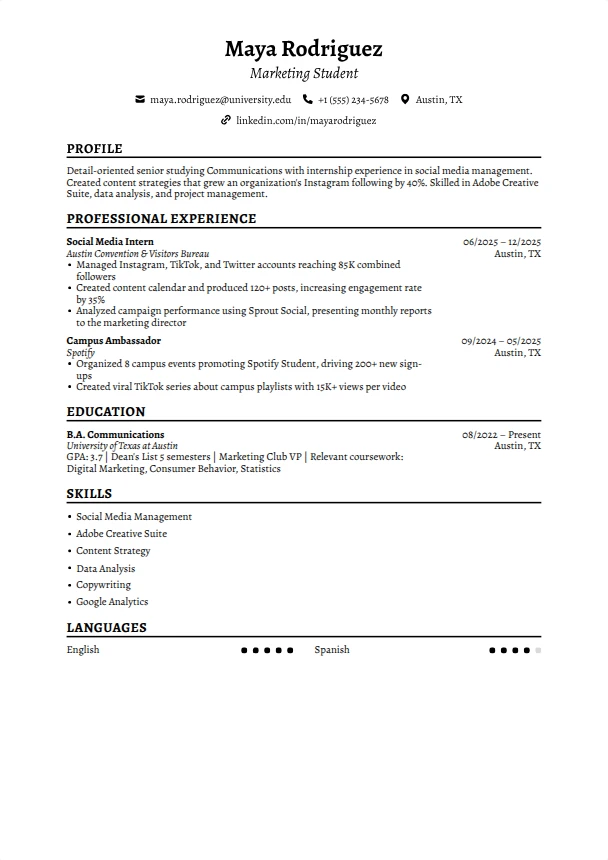
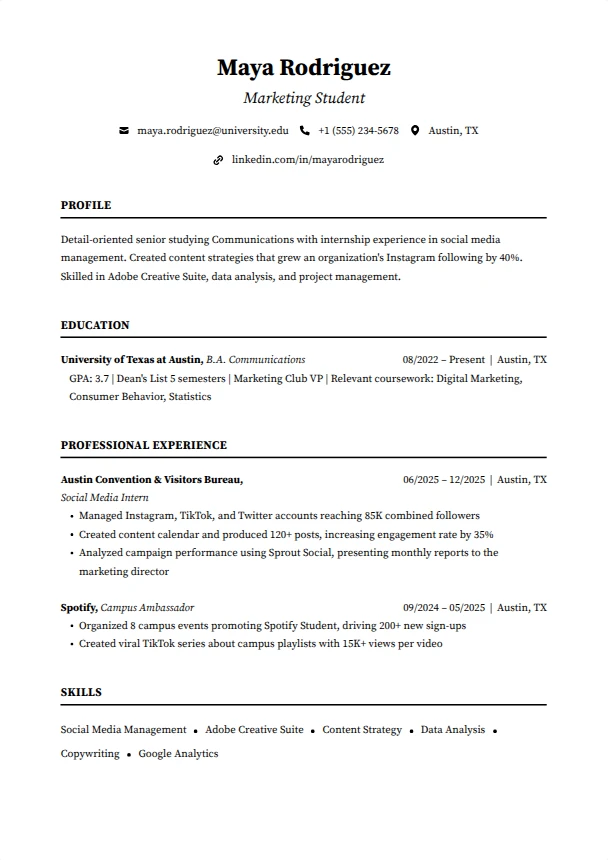
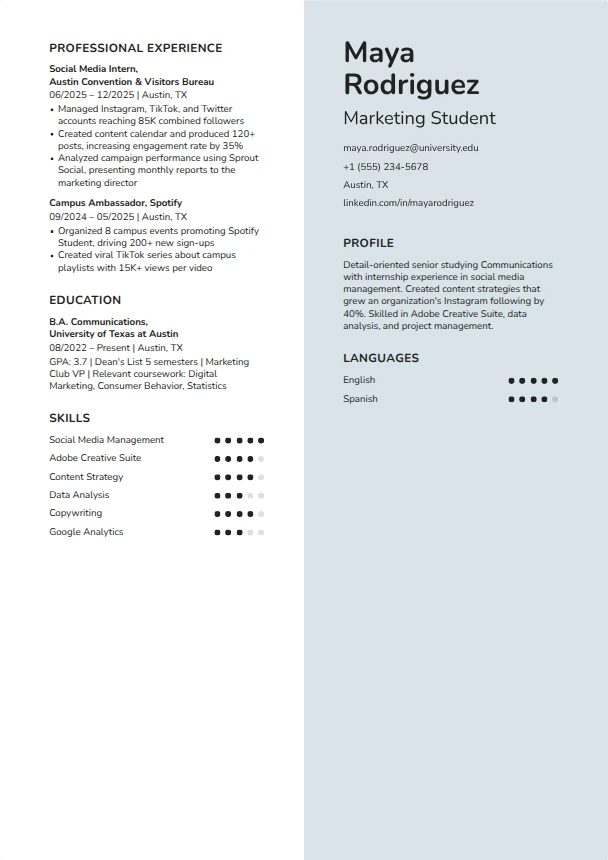
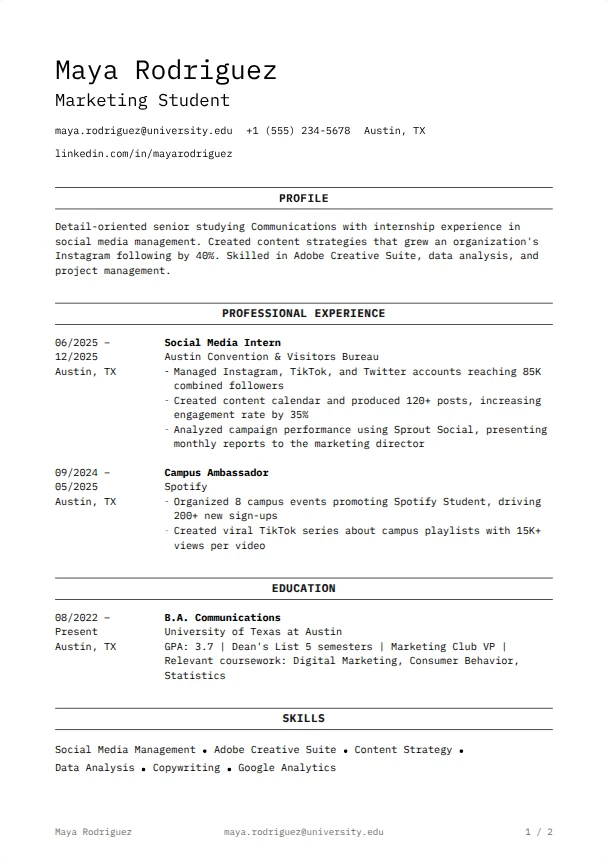
1. Contact header
Name, phone, email (university email is fine), city, and one professional link (LinkedIn or portfolio). Keep it to a single clean line.
Marcus Chen · (555) 413-7720 · [email protected] · San Diego, CA · linkedin.com/in/marcuschen
2. Summary or objective
Write a focused objective that names your target role and connects your academic strengths to the position. Avoid filler words and generic statements.
Strong: "Detail oriented junior majoring in Information Systems with a 3.7 GPA, proficient in SQL, Python, and Tableau through coursework and two self directed data analysis projects. Seeking a data analytics internship to apply classroom skills in a business environment."
3. Education
This should be the most detailed section on your resume. Include university name, degree and major (with minor if applicable), expected graduation, GPA, Dean's List, honors program, relevant courses, and any academic awards.
4. Skills
List 10 to 14 skills organized by category. Technical skills first, then analytical skills, then interpersonal skills. Each should be verifiable through your coursework or projects.
Programming: Python · SQL · R | Tools: Tableau · Excel · Google Analytics | Methods: Statistical Analysis · A/B Testing · Survey Design
5. Experience / Activities / Projects
Create a Projects section and a Campus Involvement section instead of a traditional work experience section. Format each entry with a title, organization, dates, and 2 to 4 bullet points describing what you did and what resulted from your work.
Strong: "Customer Churn Analysis Project, Business Analytics Course (Jan to Apr 2026). Analyzed a 25,000 record telecom dataset using Python and Tableau to identify key churn predictors. Built a logistic regression model achieving 82% prediction accuracy. Presented findings and retention strategy recommendations to a panel of three professors and two industry guests."
6. Additional sections
Add certifications (Google Data Analytics Certificate, AWS Cloud Practitioner), languages spoken, technical tools mastered through self study, or volunteer experiences. Each additional section should strengthen the narrative that you are ready to contribute professionally.
Key skills to include
Without work experience, your skills section needs to be thorough and specific. These are commonly sought skills for students applying across business, STEM, and liberal arts fields.
Tip: For each skill you list, be prepared to describe a specific instance where you used it. If you cannot point to a class project, assignment, or personal project where you applied the skill, it probably should not be on your resume.
Resume summary examples you can steal
Use one as a starting point, then swap in your own technologies, numbers, and achievements.
"Dean's List accounting major at Penn State with a 3.8 GPA, completed 15 credit hours in advanced accounting topics including auditing, tax, and forensic accounting. Proficient in QuickBooks and Excel financial modeling. Seeking a public accounting internship to apply classroom knowledge in a client facing environment."
Why it works: The specific credit hours and course names prove depth of knowledge, and naming QuickBooks shows practical tool familiarity.
"Computer science sophomore with hands on experience building three full stack web applications using React and Node.js through coursework and personal projects. Active member of the campus coding club, contributing to an open source accessibility tool. Pursuing a software engineering internship focused on front end development."
Why it works: Three applications and an open source contribution demonstrate skill beyond the classroom, even without paid experience.
"Communications major with a business minor, skilled in content strategy, audience analysis, and campaign measurement. Created a social media audit report for a local nonprofit as part of a capstone project, delivering actionable recommendations that the organization implemented. Seeking a marketing or communications internship."
Why it works: The capstone project with a real client shows practical application, and mentioning implementation proves the work had real impact.
"Sophomore political science major and active campus leader serving as president of the Debate Society, where I manage a 40 member organization, coordinate weekly practice sessions, and organized a regional tournament hosting six universities. Looking for a legislative or policy research internship."
Why it works: Leading a 40 member organization and hosting a multi university event shows significant management and logistical skills.
Writing strong experience bullets
Every bullet point should answer: "What did you do, and why did it matter?" Use this formula:
Before and after examples:
Worked on a group presentation in my marketing class.
Led a four person team in developing a comprehensive marketing plan for a simulated product launch, conducting competitor analysis across five brands and delivering a 20 minute presentation that received the highest score in a class of 35 students.
Helped organize events for the cultural club.
Planned and promoted four cultural awareness events as programming chair for the Asian Student Association, securing $1,200 in funding from the student government and averaging 90 attendees per event.
Did research for a professor.
Conducted a literature review of 35 peer reviewed articles on urban housing policy for a faculty research project, synthesized findings into a 15 page annotated bibliography, and co-authored a conference abstract submitted to the National Policy Studies Association.
Strong action verbs for college student resume with no experience resumes:
Led · Analyzed · Developed · Planned · Conducted · Synthesized · Presented · Designed · Implemented · Coordinated · Authored · Built · Evaluated · Organized · Secured · Managed · Facilitated · Researched
7 mistakes that get college student resume with no experience resumes rejected
Downplaying class projects
A well executed class project with real data, tools, and deliverables is a valid experience entry. Do not bury it under a vague 'Coursework' label. Give it its own section with full bullet point details.
Listing every organization without depth
Naming eight clubs where you only attended meetings wastes resume space. Pick two or three where you had meaningful involvement and describe your contributions in detail.
Using a two page resume
College students without work experience should always use a single page. If your resume spills to a second page, you are either including unnecessary information or using inefficient formatting.
Omitting technical skills learned in class
If your statistics course taught you SPSS, list it. If your design course covered Figma, list it. Recruiters cannot guess what tools your courses covered, so spell them out explicitly.
Writing in paragraph form instead of bullets
Dense paragraphs make your resume hard to skim. Use concise bullet points starting with action verbs. Recruiters spend 6 to 8 seconds on an initial scan, and bullets help them find key information fast.
Forgetting to quantify your impact
Numbers transform vague activities into impressive achievements. Count the people you led, the budget you managed, the hours you contributed, the records you analyzed, or the events you organized.
Not including a summary or objective
Without an experience section to anchor your resume, the summary or objective becomes essential for framing who you are and what you are seeking. Skipping it leaves the recruiter to guess your intentions.
What to do if you have no professional experience
No internships, no part time jobs, no campus employment. Here is how to build a full, compelling one page resume from scratch:
Mine your coursework for project material
Go through your syllabi from the past two semesters. Any assignment that involved research, analysis, presentations, group work, or deliverables can become a resume entry. A marketing plan, a database design, a policy analysis paper. These are all legitimate project experiences when described properly.
Take on a leadership role this semester
It is not too late. Volunteer for a committee chair position, start a new student organization, or offer to manage social media for an existing club. Even one semester of leadership provides enough material for three to four strong bullet points.
Complete a free professional certification
Google, HubSpot, Coursera, and edX offer free certificates that take 20 to 40 hours. A Google Data Analytics Certificate, HubSpot Content Marketing Certification, or a Coursera specialization in your field adds instant credibility and shows self motivation.
Launch a one week personal project
Analyze a publicly available dataset and write up your findings. Build a personal website. Design a mock marketing campaign for a brand you admire. Create a short documentary. These projects take less time than you think and produce tangible results you can link to on your resume.
Frequently asked questions
Can I get an internship with no prior experience at all?
Yes. Many internship programs are designed for students with no professional experience. They evaluate you on academic performance, skills, enthusiasm, and the quality of your application materials. A strong resume and cover letter can absolutely land you an internship without any previous jobs.
Should I include high school achievements on my college resume?
Generally no. Once you have completed two or more semesters of college, your university achievements replace high school ones. The only exception is a truly exceptional accomplishment, like a national competition win or significant publication, that remains relevant to your target role.
How do I list a group project when I only did part of it?
Focus specifically on your contribution. Instead of describing the whole project generically, state your role and what you delivered. For example, 'Led the data collection and analysis phase of a five person team project' is specific and honest about your individual contribution.
Is a 3.0 GPA good enough to include on a resume?
Yes, 3.0 is a common threshold for listing your GPA. If your major GPA is higher than your cumulative GPA, you can list your major GPA instead, just label it clearly. If both are below 3.0, focus on other strengths and leave GPA off the resume.
What if I am a sophomore with almost nothing to put on my resume?
Start with your education section and make it detailed. Add relevant coursework, skills learned in class, and any academic achievements. Then add one or two entries for campus involvement or a personal project. Even a sophomore resume with four well described entries beats a blank page. Start building now and add to it each semester.
Skip the blank page
Open a complete, filled-in entry-level resume in our free builder. Swap in your own details, keep the wording that fits, and download as PDF, free.
Build your college student resume now
Choose a student friendly template, highlight your coursework and campus involvement, and create a polished resume that proves you are ready for your first professional opportunity.
Start Building, It's FreeRelated resume guides
Complete guide for current college students building resumes for internships and campus jobs.
General strategies for building a resume when you have no formal work history.
Broader resume writing guide for all college students and recent graduates.
Step by step instructions for creating your very first resume from scratch.
More resume examples: