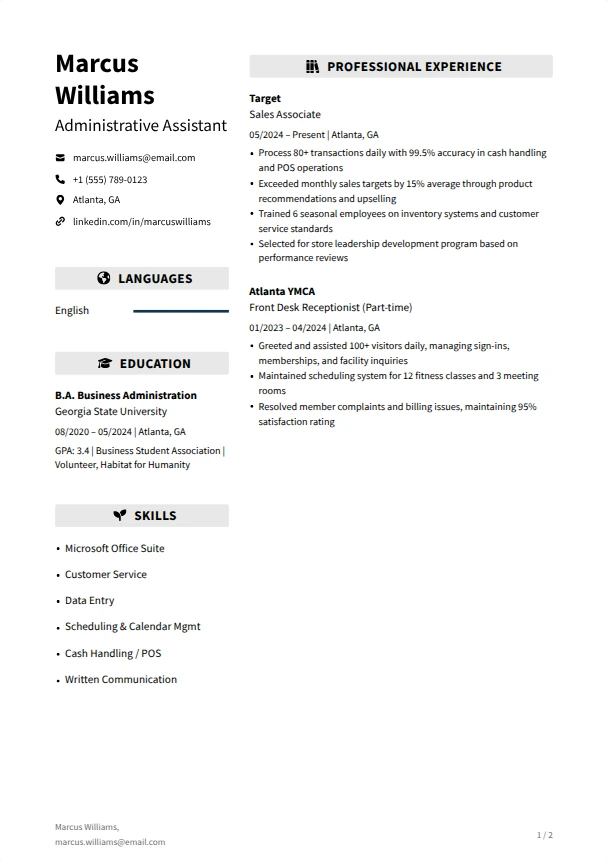
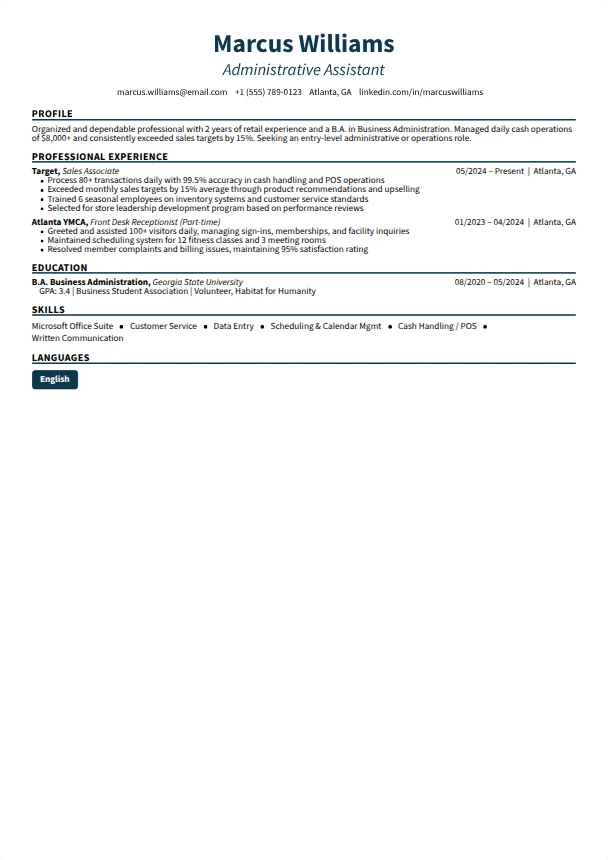
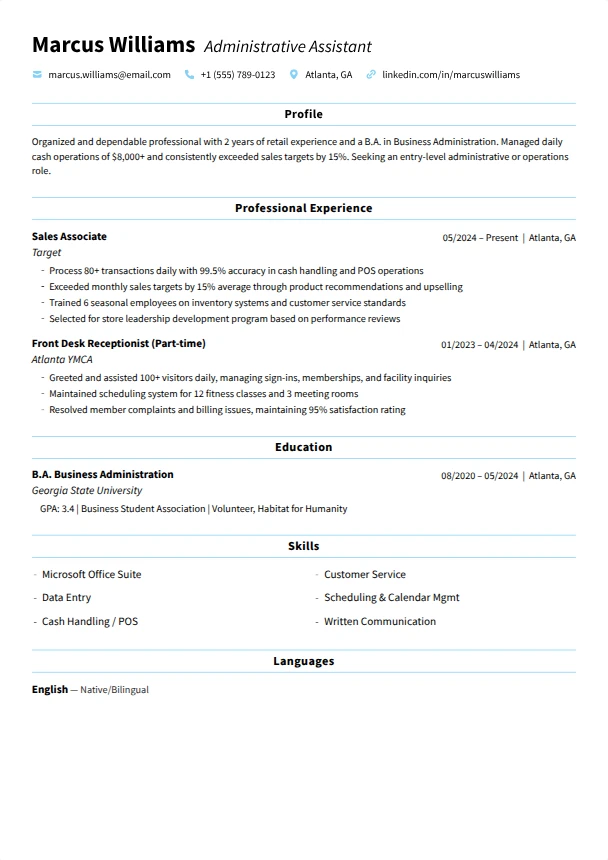
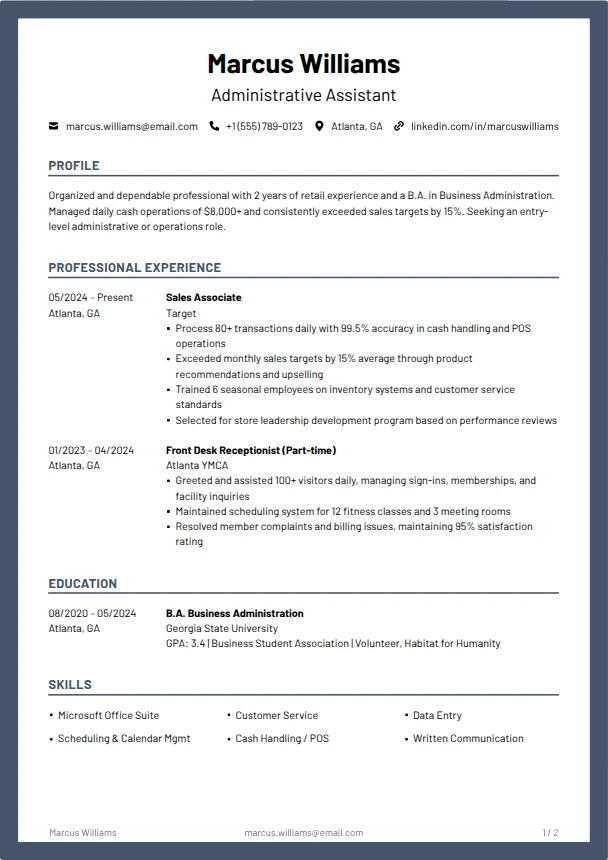
What hiring managers actually look for
These examples are built around what hiring managers actually prioritize when reviewing first-time applicants:
-
1
Consistency signals competence. Uniform formatting, matching fonts, and aligned dates make a strong first impression. These details suggest the candidate is careful and methodical, qualities every employer values.
-
2
Specificity creates credibility. Vague claims like 'great communicator' carry no weight. The examples below use concrete details and numbers to demonstrate skills rather than simply stating them.
-
3
Layout guides the reader's eye. Recruiters scan resumes in an F-shaped pattern, reading the top and left side first. These examples place the most important information where it will be seen immediately.
If your resume communicates these things in the first 7-second scan, you'll make it to the detailed read. Everything below is about making that happen.
How to structure your resume, section by section
The order matters. Here's what a strong first resume examples looks like from top to bottom:
1. Contact header
A simple, centered or left-aligned header with your essential contact details. Do not include a full address; just your city and state.
2. Summary or objective
These examples use a two sentence objective that identifies the candidate, highlights one or two strengths, and names the target role. Customize each objective to match the job you are applying for.
Strong: "Enthusiastic high school senior with strong math skills and experience tutoring classmates in algebra and geometry. Seeking a part-time cashier position at a local retail store to build customer service experience."
3. Education
For first-time resume writers, education is often the most substantial section. Include your school, degree or program, graduation date, GPA, relevant courses, and any academic recognition.
4. Skills
These examples feature 8 to 10 targeted skills. Notice that each skill connects to something the candidate can discuss with evidence during an interview.
Cash Register Operation · Microsoft Word · Google Sheets · Customer Greeting · Inventory Counting · Phone Communication · Team Coordination · Scheduling
5. Experience / Activities / Projects
When you have limited formal experience, treat any responsibility-bearing activity like a job. The examples below show how to format volunteer work, club involvement, and informal jobs professionally.
Strong: "Neighborhood Lawn Care Service, Self Employed (May 2024 to Sep 2025). Built and maintained a client base of 12 regular households, earning $400+ monthly through reliable service, scheduling coordination, and quality workmanship."
6. Additional sections
These examples round out the resume with certifications, volunteer hours, or language skills. Pick one or two additional sections that strengthen your candidacy for the specific role.
Key skills to include
The skills below work well across common first-time job categories including retail, food service, tutoring, and general office support.
Tip: Before listing a skill, ask yourself: can I give a specific example of when I used this? If the answer is no, either gain that experience quickly or remove the skill.
Resume summary examples you can steal
Use one as a starting point, then swap in your own technologies, numbers, and achievements.
"Dependable high school junior with a 3.5 GPA and two years of experience volunteering at the local animal shelter, handling adoption inquiries and organizing supply drives. Seeking a part-time sales associate position at Pet World."
Why it works: It connects volunteer experience at an animal shelter directly to a pet store role, showing genuine interest and relevant skills.
"First year computer science student with foundational programming skills in Python and Java and experience building a personal portfolio website. Applying for a student IT help desk position to develop technical support expertise."
Why it works: It demonstrates self-directed learning through the portfolio project and ties it to the campus job.
"Organized and resourceful community member with eight years of experience managing household logistics, volunteer event planning, and school PTA coordination for a 500 student elementary school. Seeking an entry level office assistant role."
Why it works: It validates unpaid organizational experience with a scale reference (500 students) and positions it as office-ready skill.
"Self motivated gap year traveler with experience managing personal budgets across 6 countries, freelance photography for travel blogs, and conversational proficiency in Spanish. Looking for an entry level marketing assistant role at a travel or hospitality company."
Why it works: It turns gap year experiences into concrete, marketable skills and targets a fitting industry.
Writing strong experience bullets
Every bullet point should answer: "What did you do, and why did it matter?" Use this formula:
Before and after examples:
Walked dogs at the animal shelter.
Walked and socialized 8 to 12 shelter dogs daily, contributing to a 25% increase in positive behavioral assessments that supported faster adoption placement.
Tutored other students after school.
Tutored 5 peers in algebra twice weekly, helping 4 of them raise their grades from C to B or higher within one semester.
Sold cookies for a school fundraiser.
Led cookie sale operations for a 40 member Girl Scout troop, coordinating orders, inventory, and deliveries that generated $3,800 in total revenue.
Strong action verbs for first resume examples resumes:
Assisted · Built · Calculated · Coordinated · Created · Delivered · Designed · Handled · Led · Maintained · Managed · Organized · Planned · Resolved · Sold · Tutored · Volunteered
7 mistakes that get first resume examples resumes rejected
Using a generic template without any changes
Templates are frameworks, not finished products. Employers can tell when content is boilerplate. Personalize every section with your own details and language.
Listing hobbies instead of skills
Watching movies and playing video games are hobbies, not resume content. Only include interests that demonstrate skills relevant to the job, like competitive sports or creative projects.
Writing in first person
Resumes should not include 'I,' 'me,' or 'my.' Start bullet points with action verbs and let the structure speak for itself.
Choosing a decorative or hard to read font
Stick with professional fonts like Arial, Calibri, or Garamond at 10 to 12 points. Decorative fonts look unprofessional and may not render correctly on all systems.
Including every class you have ever taken
Only list coursework that relates to the job you want. Two to four relevant courses are more effective than a full transcript.
Forgetting to save as PDF
Formatting can shift when Word documents open on different devices. Always convert to PDF before sending.
Neglecting to tailor for each application
A resume built for a retail job will not work for an office position. Adjust your skills, objective, and bullet points for each job you apply to.
What to do if you have no professional experience
Many of these examples were written for candidates with no work history. Here are additional ways to fill your resume:
Document any responsibility you have held
Babysitting, pet sitting, tutoring, running errands for neighbors, or managing a social media page all count as experience when presented professionally.
Create a project to showcase
Start a blog, build a simple website, organize a neighborhood cleanup, or launch a small craft business. Even a short-term project gives you bullet points and demonstrates initiative.
Use class assignments strategically
Presentations, research projects, group work, and lab experiments all involve skills employers value. Describe your role and the outcome.
Volunteer this weekend
Food banks, animal shelters, community gardens, and nonprofit events all welcome volunteers. A single weekend of volunteering can produce two or three solid resume entries.
Frequently asked questions
How do I know which example to start with?
Pick the example that most closely matches your current situation: high school student, college student, adult entering the workforce, or career changer. Then customize it for the specific job you want.
Is it okay to have a resume with no work experience?
Yes. Many people write their first resume before they have held a formal job. Use education, skills, projects, and volunteer work to demonstrate your qualifications.
Should my first resume be one page or two?
Always one page. You will not have enough relevant content for two pages, and hiring managers prefer concise documents for entry level and first-time candidates.
Can I use color or graphics on my first resume?
Minimal color, like a dark blue or gray for section headers, is acceptable. Avoid graphics, icons, charts, and photos, as they can cause problems with applicant tracking systems.
How often should I update my first resume?
Update it every time you gain new experience, complete a course, or earn a certification. Keep a master copy that includes everything, then create targeted versions for each application.
Skip the blank page
Open a complete, filled-in entry-level resume in our free builder. Swap in your own details, keep the wording that fits, and download as PDF, free.
Build your first resume now
Choose an example that fits your situation, customize it with our builder, and download a professional resume today. No design skills needed.
Start Building, It's FreeRelated resume guides
Step by step instructions for writing your first resume from scratch.
Resume guidance tailored for high school students and recent graduates.
Additional examples focused on building a resume with zero work history.
Focused tips for getting hired at your very first job.
More resume examples: