What hiring managers actually look for
When hiring managers review resumes from graduates without work experience, they focus on these indicators:
-
1
Academic projects demonstrate applied skills better than a course list. A capstone project where you built a data dashboard proves more than listing 'Data Analytics 301' in your coursework. Frame projects with the same rigor you would use for a job description, including scope, tools used, and outcomes.
-
2
Initiative outside the classroom signals self-direction. Volunteering, personal projects, hackathons, and open-source contributions show that you pursue learning beyond what is required. Hiring managers see this as a strong predictor of on-the-job performance.
-
3
A targeted resume beats a broad one every time. Graduates often send the same generic resume to 50 companies. Customizing your summary and skills section to match each job posting takes minimal effort and makes you look far more intentional than other applicants.
If your resume communicates these things in the first 7-second scan, you'll make it to the detailed read. Everything below is about making that happen.
How to structure your resume, section by section
The order matters. Here's what a strong graduate resume with no experience looks like from top to bottom:
1. Contact header
Include your name, professional email, phone number, city and state, and LinkedIn profile. Add a portfolio link if you have one.
Marcus Rivera · [email protected] · (555) 876-1234 · Denver, CO · linkedin.com/in/marcusrivera
2. Professional summary or objective (2-3 sentences)
When you lack experience, your summary needs to work harder. Lead with your degree and area of expertise, then mention a specific project or skill that makes you stand out. Close with the type of role you are seeking.
Strong: "Psychology graduate from the University of Colorado with a specialization in behavioral research and proficiency in SPSS and Qualtrics. Designed and conducted an independent study on consumer decision-making with 200 survey participants. Seeking a research assistant or market research analyst position."
3. Education
This is your strongest section. Place it immediately after your summary. Include your degree, school, graduation date, GPA (if 3.3+), dean's list, honors thesis title, and four to six relevant courses.
4. Skills
Pull skill requirements directly from job postings and match them with tools and techniques you learned in class, labs, or personal projects. Be specific: 'SPSS statistical analysis' is better than 'statistics.'
Research: SPSS, Qualtrics, survey design, qualitative coding
Technical: Python (pandas, matplotlib), Excel (pivot tables), Google Sheets
Communication: Technical writing, presentation design, APA formatting
5. Projects, research, and volunteer work
Rename this section based on your strongest content. If you have research, call it 'Research Experience.' If you have class projects, call it 'Academic Projects.' Describe each entry with the same structure you would use for a job: your role, what you did, tools you used, and the result.
Strong: "Led a four-person team in developing a go-to-market strategy for a local startup as part of a semester-long marketing practicum. Conducted competitive analysis, built customer personas, and presented a 30-page strategic plan that the client adopted for their Q3 launch."
6. Additional sections
Certifications, languages, student organization leadership, hackathon participation, and relevant hobbies (like maintaining a technical blog) can all strengthen a thin resume.
Key skills to include
Even without job experience, you have built skills through coursework, labs, and personal projects. These are the skills employers frequently seek from recent graduates:
Tip: If you have used a tool in a class project, you can list it as a skill. You do not need years of professional use to claim proficiency. Be honest about your level, but do not undersell classroom experience.
Resume summary examples you can steal
Use one as a starting point, then swap in your own technologies, numbers, and achievements.
"Elementary education graduate from Arizona State University with 120 hours of student teaching across grades K through 5. Developed and delivered 15 lesson plans aligned with state standards, earning a 95% mentor evaluation score. Seeking a full-time teaching position in a public school district."
Why it works: Student teaching counts as hands-on experience. The specific hours, grade range, and evaluation score make this tangible and credible.
"Biology graduate from the University of Florida with 200 hours of wet lab experience in organic chemistry and microbiology coursework. Proficient in PCR, gel electrophoresis, spectrophotometry, and aseptic technique. Seeking a laboratory technician role in pharmaceutical or clinical research."
Why it works: Quantifies lab hours and lists specific techniques that employers search for. The coursework labs are framed as relevant experience rather than dismissed as 'just classes.'
"Communications graduate from NYU with a concentration in public relations and a portfolio of five press releases, two media kits, and a crisis communication plan completed during coursework. Managed social media for the university's student newspaper, growing Instagram followers from 800 to 2,100 in one semester."
Why it works: The portfolio items are concrete deliverables. The social media growth metric proves the candidate can produce measurable results even without a formal PR job.
"Computer science graduate from Virginia Tech with a focus on web development and three deployed applications built with React, Node.js, and MongoDB. Senior project was a real-time collaboration tool used by 150 classmates during beta testing. Seeking a junior full-stack developer role."
Why it works: Deployed applications and user counts demonstrate real-world capability. The tech stack is named explicitly, making this resume easy for ATS systems to match.
Writing strong experience bullets
Every bullet point should answer: "What did you do, and why did it matter?" Use this formula:
Before and after examples:
Did a research project for my psychology class.
Designed and administered a 40-question survey to 200 participants for an independent psychology study, then analyzed results using SPSS to identify three statistically significant behavioral patterns.
Volunteered at a nonprofit.
Organized weekly food distribution events for a community nonprofit, coordinating 12 volunteers and serving an average of 150 families per week over a six-month period.
Worked on a group coding project in my CS class.
Built the front-end interface for a team project using React and Tailwind CSS, implementing responsive design that passed accessibility audits and supported 150 concurrent users during testing.
Strong action verbs for graduate resume with no experience resumes:
Designed · Conducted · Organized · Built · Analyzed · Coordinated · Developed · Presented · Authored · Implemented · Created · Led · Produced · Evaluated · Researched · Compiled · Facilitated
7 mistakes that get graduate resume with no experience resumes rejected
Apologizing for lack of experience in your summary.
Never write 'Despite having no experience' or 'Although I lack professional background.' Lead with what you do have. Confidence in your academic credentials sets the right tone.
Leaving large blank spaces on the page.
A half-empty resume signals that you did not try hard enough. Add a projects section, relevant coursework, certifications, or volunteer work to fill the page properly.
Listing responsibilities instead of accomplishments.
Even in a class project, you achieved something. Replace 'Responsible for research' with 'Researched and compiled data from 50 sources to produce a 20-page competitive analysis.'
Including irrelevant personal hobbies.
Reading, hiking, and cooking do not belong on a resume unless they directly connect to the job. A hobby blog about data visualization is relevant for an analyst role. A love of travel is not.
Using a two-page format.
Without work experience, you should not need more than one page. If your resume spills onto a second page, you are including content that does not belong.
Forgetting to include soft skills with evidence.
Listing 'leadership' means nothing on its own. Instead, mention that you led a five-person team for a class project or served as president of a student organization.
Skipping the skills section entirely.
Your skills section is one of the most scannable parts of your resume. Even if your skills are from coursework, listing them helps ATS systems match your resume to job postings.
What to do if you have no professional experience
When your degree is your primary asset, here is how to build a resume that still competes:
Treat every class project like a job.
Describe the scope, your specific role, the tools you used, and the deliverable. A marketing plan for a class is still a marketing plan. Frame it that way.
Stack free certifications quickly.
Google, HubSpot, and Coursera offer certifications you can complete in a weekend. Even one or two relevant certifications show initiative and add concrete credentials to your resume.
Volunteer strategically in your field.
Offer to manage social media for a nonprofit, build a website for a local business, or tutor students in your subject area. A few weeks of targeted volunteering gives you real bullet points.
Create a personal project with a public result.
Build a website, publish an analysis on Medium, start a relevant blog, or contribute to an open-source project. Anything with a URL that a recruiter can visit counts as evidence of your skills.
Frequently asked questions
Can I get hired with no work experience at all?
Yes. Many entry-level roles are designed specifically for recent graduates. Employers posting these positions expect applicants without traditional work history. Your degree, projects, and skills are what they evaluate.
Should I include high school activities?
Only if you have absolutely nothing else to fill the page. Once you hold a college degree, high school achievements lose relevance. Replace them with college projects, volunteer work, or certifications as soon as possible.
How do I address the experience gap in a cover letter?
Do not draw attention to it. Instead, focus your cover letter on what you accomplished in school, what excites you about the company, and how your specific skills apply to the role. Let your qualifications speak for themselves.
Is it better to use a functional or chronological format?
Use a hybrid format that leads with skills and projects but still includes a chronological education section. Purely functional resumes can raise red flags because they appear to hide gaps.
Should I include an unpaid internship?
Absolutely. Unpaid internships provide real experience and belong on your resume just like any other role. List the company, your title, dates, and accomplishments the same way you would for a paid position.
Skip the blank page
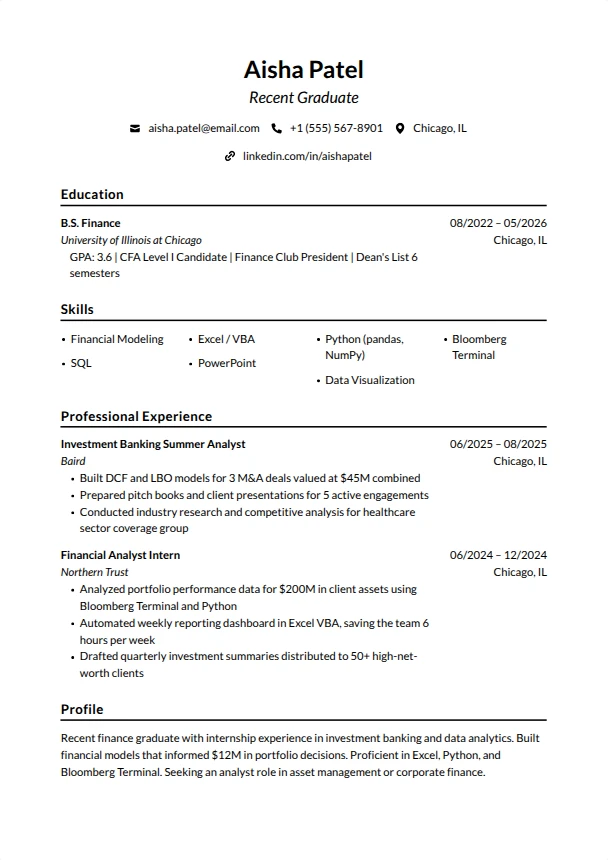
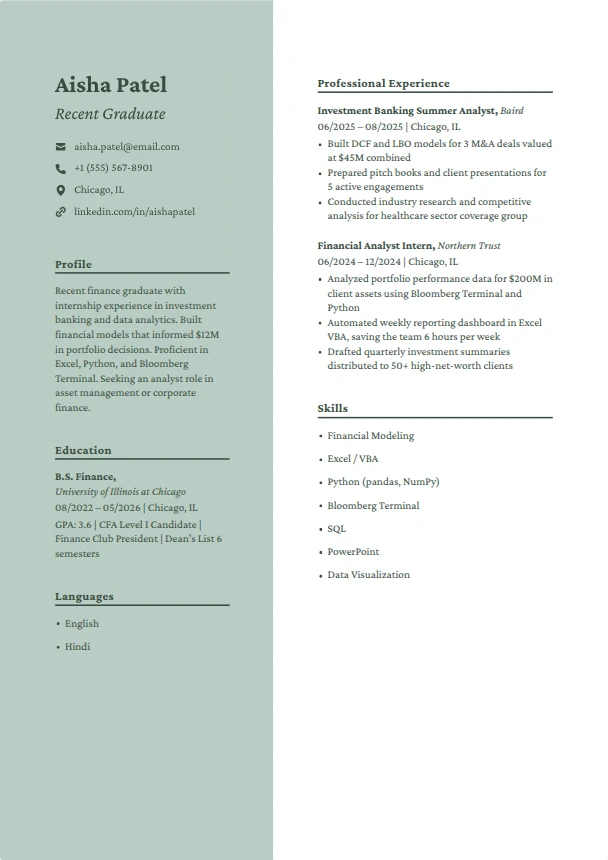
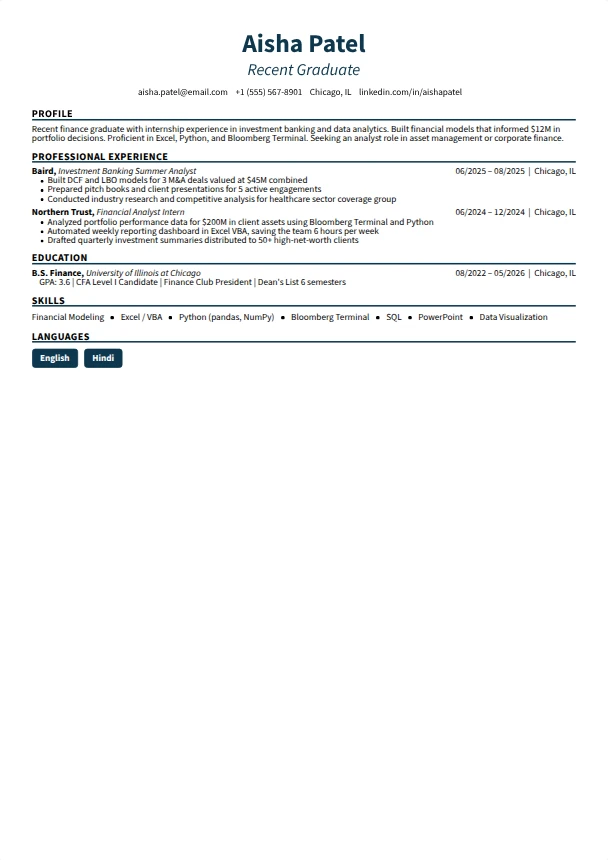
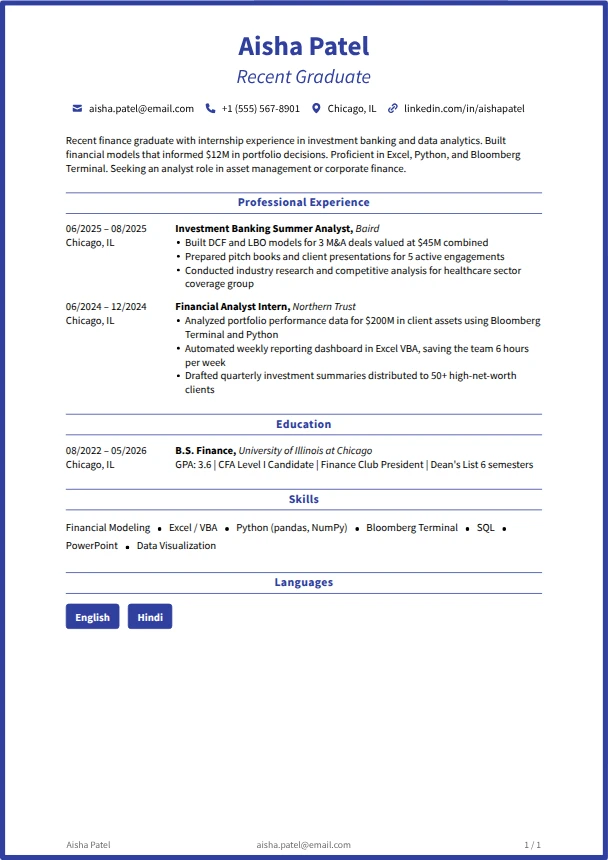
Open a complete, filled-in entry-level resume in our free builder. Swap in your own details, keep the wording that fits, and download as PDF, free.
Build your graduate resume now
Pick a template, add your details, and download a polished PDF in minutes. Free, no account required.
Start Building, It's FreeRelated resume guides
Complete guide for writing a resume after earning your degree.
General strategies for building a resume when you have no work history.
Step-by-step help for writing the very first resume of your career.
Resume advice tailored for students still completing their degree.
More resume examples: