What hiring managers actually look for
Hiring managers for entry-level teen positions care about three things above all else:
-
1
Attitude and coachability. Managers know they will train you from scratch. What they want to see is evidence that you learn quickly and take feedback well. Academic improvement, mastering a new sport, or earning a certification on your own all signal coachability.
-
2
Consistency over intensity. Sticking with one club for three years impresses more than joining five clubs for one semester each. Long-term commitment tells a manager you will not quit after two weeks.
-
3
Written communication quality. Your resume is a writing sample. If it is clear, specific, and free of typos, managers assume you will communicate well with customers and coworkers too.
If your resume communicates these things in the first 7-second scan, you'll make it to the detailed read. Everything below is about making that happen.
How to structure your resume, section by section
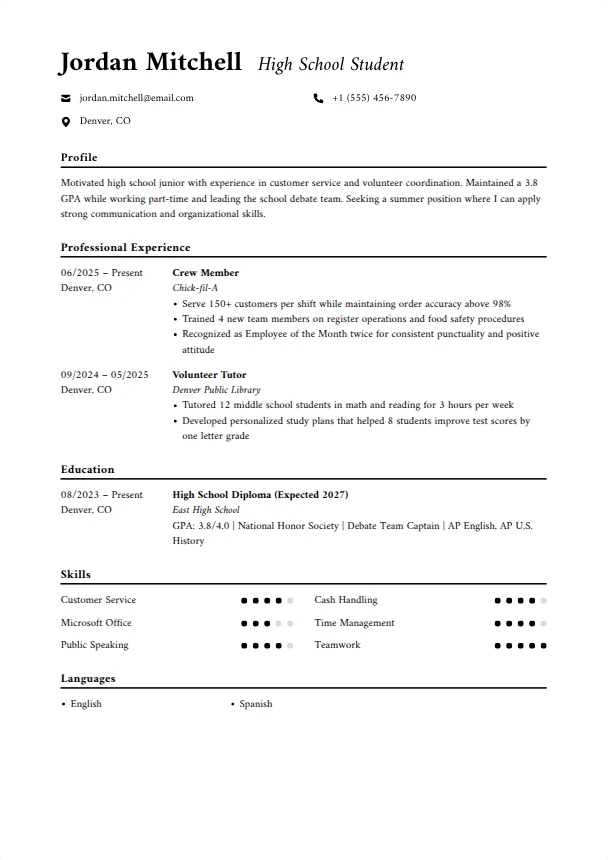
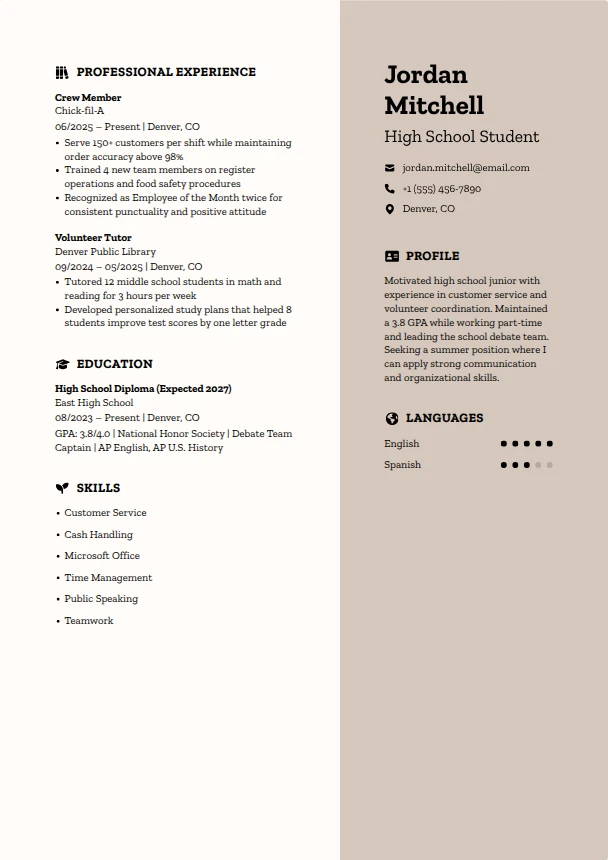
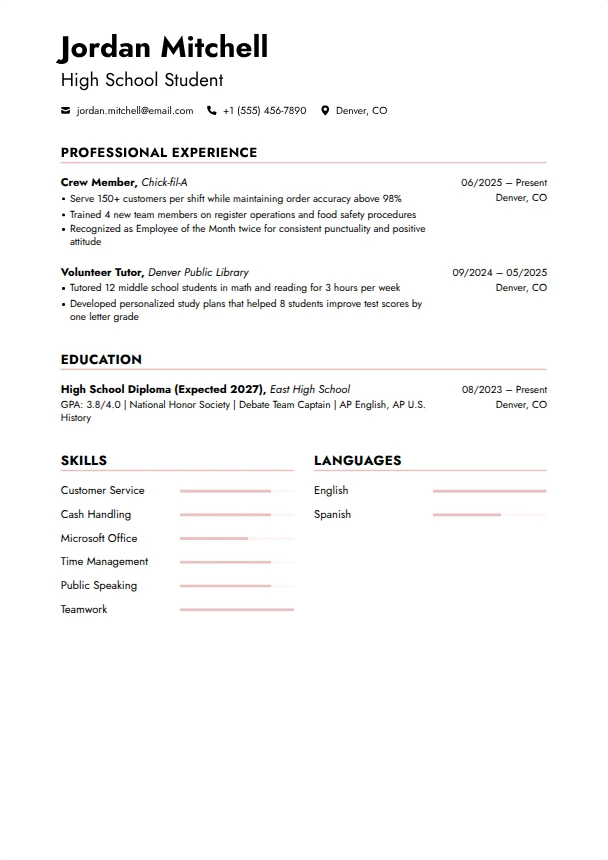
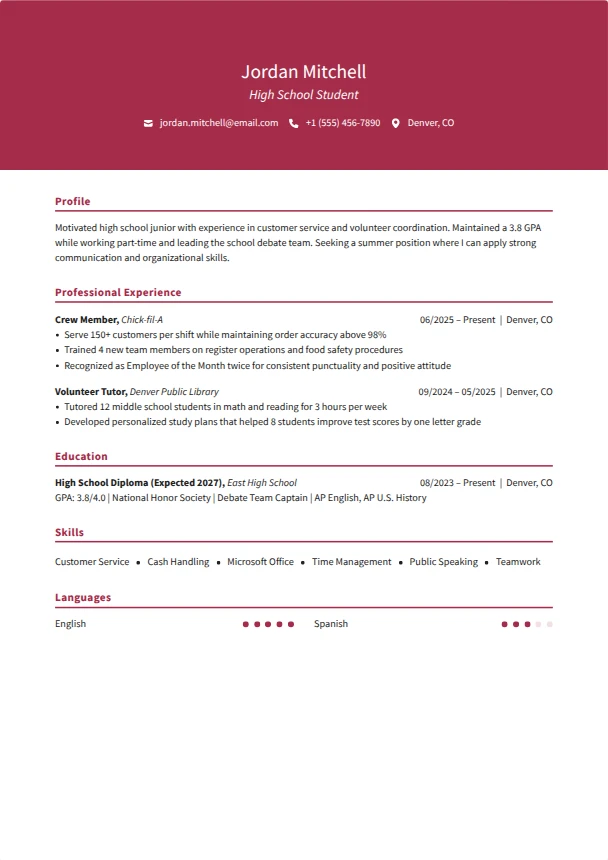
The order matters. Here's what a strong high school resume with no experience looks like from top to bottom:
1. Contact header
Full name, a professional email, phone number, and your city. Skip your street address for privacy. If you have a portfolio or project website, add that too.
2. Resume objective (2-3 sentences)
When you have no experience, your objective needs to work harder. Name the role, highlight one or two personal strengths, and tie them to something concrete you have accomplished in school or activities.
Strong: "Organized and detail-focused sophomore seeking a part-time library assistant role. Maintained a 3.7 GPA while serving as secretary of the student council, where I managed meeting notes and event schedules for 15 council members."
3. Education
This is your strongest section when you lack work experience. List your school, expected graduation year, GPA (if 3.0+), honors, AP or dual enrollment courses, and any academic awards. Put this section immediately after your objective.
4. Skills
Build this section by reviewing 5 to 10 job postings for roles you want. Pull out every skill you genuinely have and organize them into categories.
Interpersonal: Active listening, conflict resolution, teamwork
Technical: Microsoft Word, Excel, Google Slides, Canva
Certifications: CPR/First Aid certified (American Red Cross, 2025)
5. Activities, volunteering, and projects
This section replaces the traditional experience section. Treat every activity like a job: give it a title, date range, organization name, and achievement-focused bullets. Quantify everything you can.
Strong: "Environmental Club Treasurer (2024-2026): Managed a $400 annual budget, organized 3 campus cleanup events with 25+ participants each, and secured a $200 donation from a local business."
6. Additional sections
Certifications, languages, awards, and relevant hobbies can all fill space meaningfully. A food handler's permit, a babysitting certification, or fluency in a second language are all assets employers value.
Key skills to include
Even without a job, you have developed skills through school, activities, and daily life. These are the ones employers care about most for teen hires.
Tip: Do not list a skill you cannot demonstrate. If an interviewer asks 'Tell me about a time you used time management,' you need a real story ready. Choose skills you can back up with specific examples from school or personal life.
Resume summary examples you can steal
Use one as a starting point, then swap in your own technologies, numbers, and achievements.
"Friendly and punctual junior at Oak Park High with a 3.5 GPA and perfect attendance for two consecutive years. Active volunteer at the local food bank, logging 80+ hours of sorting, stocking, and customer interaction. Seeking a weekend cashier position."
Why it works: Perfect attendance is a powerful signal for reliability. The food bank work directly parallels retail tasks like stocking and customer service.
"Energetic sophomore with a food handler's permit and experience preparing meals for a family of six. Organized school bake sales generating $600+ in revenue across three events. Eager to contribute to a fast-paced kitchen team."
Why it works: The food handler's permit shows initiative, and cooking for a large family is legitimate food prep experience that restaurant managers understand.
"Patient and creative sophomore with 2 years of experience tutoring younger students in after-school reading programs. CPR certified through the Red Cross. Looking for a summer camp counselor position working with ages 6 to 12."
Why it works: Tutoring younger students demonstrates patience and responsibility, which are the core requirements for a camp counselor role.
"Detail-oriented senior with advanced proficiency in Google Sheets and Docs, developed through managing the debate team's tournament schedules and travel logistics for 20 members. Seeking a part-time administrative assistant role."
Why it works: It translates a school activity into office-relevant skills (scheduling, logistics, document management) that an employer can immediately picture using.
Writing strong experience bullets
Every bullet point should answer: "What did you do, and why did it matter?" Use this formula:
Before and after examples:
Volunteered at an animal shelter.
Cared for 15+ dogs and cats weekly at Riverside Animal Shelter, including feeding schedules, kennel cleaning, and behavior logging for adoption profiles.
Was on the student council.
Planned and executed 4 student council events per semester, coordinating with 8 committee members and managing budgets up to $500.
Tutored other students.
Tutored 5 freshmen in algebra twice a week for one semester, helping 4 of them raise their grades by at least one letter.
Strong action verbs for high school resume with no experience resumes:
Organized · Planned · Managed · Tutored · Coordinated · Led · Created · Maintained · Prepared · Collected · Trained · Designed · Scheduled · Resolved · Supervised · Tracked
7 mistakes that get high school resume with no experience resumes rejected
Leaving the resume nearly empty
A resume with just your name and education looks like you did not try. Fill it with activities, volunteer work, coursework, certifications, and skills. Every student has more content than they realize.
Writing 'No experience' anywhere on the resume
Never draw attention to what you lack. Instead, rename the section 'Activities and Involvement' or 'Relevant Experience' and fill it with your strongest non-work accomplishments.
Listing responsibilities instead of achievements
'Responsible for cleaning tables' tells a manager what the job was. 'Cleaned and sanitized 20 tables per shift, maintaining health code compliance' tells them what you accomplished.
Using a resume template with huge margins to hide short content
Employers notice when you are trying to make a half-page of content look like a full page. Instead, add more substance: skills categories, relevant coursework, certifications, volunteer work.
Including middle school activities
Once you are in 10th grade or above, middle school achievements are too dated. Focus on the last two to three years of activities and accomplishments.
Copying a friend's resume and changing the name
Hiring managers in small towns and local businesses often see the same templates and phrasing from multiple applicants. A personalized resume, even a simple one, always stands out.
Forgetting to include availability
For teen hires, availability is one of the top decision factors. Mention your available hours in your objective or add a one-line availability note near your contact info.
What to do if you have no professional experience
Here are four strategies that turn 'I have nothing to put on my resume' into a full, impressive page:
Audit your last two years
Write down every club, team, class project, volunteer shift, and informal job (babysitting, pet sitting, yard work) from the last two years. Most students discover 8 to 12 items they had forgotten about. Each one is resume material.
Get a quick certification
A CPR certification takes one afternoon. A food handler's permit takes about 2 hours online. Google offers free digital skills certificates. These fill your resume and show initiative.
Start a micro-project this week
Offer to redesign a club's social media page, organize a neighborhood cleanup, or tutor a younger student. Within a few weeks you will have a bullet point with real numbers and a tangible result.
Reframe school as work experience
Managing a group project is project management. Giving a class presentation is public speaking. Writing a research paper is data analysis and written communication. Use professional language to describe academic work.
Frequently asked questions
Is it okay to submit a resume with zero work experience?
Absolutely. Employers hiring teens expect most applicants to have no work history. They are looking for potential, reliability, and a willingness to learn. A well-organized resume full of activities and skills proves all three.
What should I put in the experience section if I have never had a job?
Rename it 'Activities and Involvement' or 'Relevant Experience.' Include volunteer work, club leadership, informal jobs like babysitting or tutoring, and significant school projects with measurable outcomes.
Should I include my age on my resume?
No. Your age is not necessary and can lead to bias. Your expected graduation year on the education section gives employers enough context about your age range.
How do I explain gaps in my resume when I am only 16?
You do not need to. No one expects a 16-year-old to have continuous employment. Focus on what you have done, not on time gaps. If you spent a summer studying for SATs, that is a legitimate use of time.
Can volunteer hours count as experience on a resume?
Yes, and they absolutely should. Volunteer work develops the same skills as paid work. Treat it identically: list the organization, your role, the dates, and specific accomplishments with numbers.
Skip the blank page
Open a complete, filled-in entry-level resume in our free builder. Swap in your own details, keep the wording that fits, and download as PDF, free.
Build your high school resume now
Pick a template, add your details, and download a polished PDF in minutes. Free, no account required.
Start Building, It's FreeRelated resume guides
The complete guide to writing a high school resume, including structure, skills, and examples.
Step-by-step instructions for building a resume from scratch with no prior experience.
General strategies for building a strong resume when your work history is empty.
Focused tips for landing your very first paid position as a young applicant.
More resume examples: