What hiring managers actually look for
When reviewing new grads without internships, hiring managers focus on these areas:
-
1
Academic depth substitutes for work depth. Managers hiring entry level candidates understand that not everyone completes internships. A graduate with a strong GPA, a rigorous course load, and a well executed capstone project can still demonstrate the intellectual capacity and discipline needed for the role. The key is presenting academic work with professional framing.
-
2
Self initiated work reveals character. Personal projects, freelance work, blog writing, open source contributions, or independent research show that you are driven by more than course requirements. Managers read this as intrinsic motivation, which is one of the hardest qualities to train and one of the most valued.
-
3
Speed of learning is more important than years of experience. For true entry level roles, managers care about how quickly you can ramp up and start contributing. Demonstrating rapid skill acquisition through certifications, self taught tools, or compressed project timelines tells them you will get up to speed fast.
If your resume communicates these things in the first 7-second scan, you'll make it to the detailed read. Everything below is about making that happen.
How to structure your resume, section by section
The order matters. Here's what a strong new grad resume with no experience looks like from top to bottom:
1. Contact header
Professional email, phone number, city, and LinkedIn. If you have a portfolio, GitHub, or personal website relevant to your field, include it. Make sure all links are active and up to date.
Taylor Nguyen · (555) 741-3298 · [email protected] · Seattle, WA · linkedin.com/in/taylornguyen · github.com/taylornguyen
2. Summary or objective
Write a professional summary that leads with your degree and strongest academic accomplishment. Avoid mentioning what you lack. Instead, position what you have accomplished as evidence of readiness.
Strong: "B.A. in Economics from the University of Washington, graduated with a 3.5 GPA and a senior thesis that analyzed housing affordability trends across 12 metropolitan areas using regression modeling in R. Proficient in data analysis, policy writing, and stakeholder presentations. Seeking an economic research analyst role."
3. Education
As your primary credential, education should be thorough. List your degree, university, graduation date, GPA, honors, thesis or capstone title, and 5 to 7 courses most relevant to your target position.
4. Skills
Dedicate more space to skills than a typical resume. Organize into categories and include every tool, language, methodology, and platform you used during your degree and personal projects.
Analysis: R · SPSS · Excel (Pivot Tables, Regression) | Visualization: Tableau · ggplot2 | Writing: Policy Briefs · Research Reports · Grant Proposals | Languages: English (native) · Vietnamese (conversational)
5. Experience / Activities / Projects
Build this section entirely from academic projects, campus leadership, volunteer work, and any personal or freelance projects. Format each entry professionally with a clear title, organization name, dates, and achievement oriented bullet points.
Strong: "Senior Thesis, Department of Economics, University of Washington (Sep 2025 to May 2026). Collected and cleaned housing data from Census Bureau and Zillow APIs spanning 12 metropolitan areas and 10 years. Built multivariate regression models in R to identify key affordability predictors. Presented findings to a thesis committee of three faculty members and one external industry reviewer, receiving distinction honors."
6. Additional sections
Certifications, publications, conference presentations, professional memberships, language proficiencies, and notable coursework all belong here. This section helps fill your resume and demonstrates breadth beyond your major requirements.
Key skills to include
Without professional experience, your skills section needs to be comprehensive and precisely targeted. Include every tool, method, and platform you can confidently use.
Tip: Cross reference your skills with 10 to 15 job postings in your target role. The skills that appear most frequently should sit at the top of your list. This alignment dramatically increases your chances of passing automated resume screening.
Resume summary examples you can steal
Use one as a starting point, then swap in your own technologies, numbers, and achievements.
"B.S. in Computer Science from Arizona State University, graduated with a 3.6 GPA and completed a capstone project building a real time weather data pipeline using Python, Apache Kafka, and PostgreSQL. Active contributor to two open source projects on GitHub with a combined 45 merged pull requests. Seeking a software engineering role focused on backend development."
Why it works: The capstone project demonstrates real technical execution, and the open source contributions prove ongoing coding activity beyond the classroom.
"B.B.A. in Marketing from the University of Oregon, Dean's List for five semesters. Created a comprehensive digital marketing strategy for a local nonprofit as a senior capstone, including SEO audit, content calendar, and paid advertising plan that the organization implemented. Certified in Google Analytics and HubSpot Inbound Marketing. Pursuing a digital marketing coordinator position."
Why it works: The capstone with a real nonprofit client, combined with two industry certifications, compensates for the lack of a corporate internship.
"B.A. in Sociology from the University of Minnesota with a minor in data science. Senior thesis analyzed racial disparities in Minneapolis policing data using Python and GIS mapping, presented at the Midwest Sociological Society conference. Skilled in qualitative and quantitative research, survey design, and data storytelling. Seeking a research analyst or social impact analyst role."
Why it works: The conference presentation elevates the thesis beyond a class assignment, and the data science minor bridges humanities and technical skills.
"B.S. in Environmental Science from Colorado State University, served as president of the Environmental Action Coalition for two years, growing membership from 25 to 80 students and securing $5,000 in university funding for campus sustainability projects. Proficient in GIS, water quality testing, and environmental impact assessment. Seeking an entry level environmental consultant role."
Why it works: Growing an organization from 25 to 80 members and securing funding demonstrates real leadership and resource acquisition skills.
Writing strong experience bullets
Every bullet point should answer: "What did you do, and why did it matter?" Use this formula:
Before and after examples:
Did my senior thesis on something related to my major.
Authored a 75 page senior thesis investigating the relationship between urban green space and mental health outcomes, analyzing survey data from 400 respondents using SPSS and presenting findings to a committee of four faculty reviewers.
Was president of a student club for a while.
Served as president of the Finance Society for two academic years, growing membership from 30 to 95 students, establishing partnerships with three local financial firms for guest speaker events, and managing an annual operating budget of $4,200.
Made a website as a personal project.
Designed and developed a full stack job board web application using React, Node.js, and MongoDB, implementing user authentication, search filtering, and automated email notifications. Deployed on AWS with CI/CD pipeline and attracted 200 registered users in the first month.
Strong action verbs for new grad resume with no experience resumes:
Authored · Investigated · Analyzed · Developed · Designed · Implemented · Established · Deployed · Presented · Managed · Grew · Secured · Coordinated · Launched · Evaluated · Documented · Architected
7 mistakes that get new grad resume with no experience resumes rejected
Apologizing for your lack of experience
Never write 'although I lack professional experience' or 'despite having no internships' on your resume. These phrases draw attention to weaknesses instead of strengths. Let your projects and skills speak for themselves.
Padding with irrelevant content
Adding hobbies like hiking, cooking, or gaming to fill space signals that you ran out of meaningful content. Instead, add a projects section, list additional relevant coursework, or include certifications. Every line should strengthen your candidacy.
Submitting the same resume to every application
Without internship experience, customization matters even more. Tailor your summary and skills to each posting. Rearrange your projects to lead with the most relevant one. Small adjustments in keyword alignment can mean the difference between a callback and silence.
Keeping your capstone project description vague
Your capstone or thesis is your primary evidence of professional capability. Give it 3 to 5 detailed bullet points that describe the problem, methodology, tools, deliverables, and results. Vague descriptions waste your strongest asset.
Omitting technical tools and platforms
Recruiters and applicant tracking systems search for specific tool names. Writing 'data analysis' when you should write 'Python, pandas, scikit-learn' costs you matches. Be explicit about every tool, language, and platform you know.
Not updating your resume after graduation
Change 'Expected May 2026' to 'May 2026.' Remove references to being a current student. Update your email if your .edu account will expire. These small details affect whether you are perceived as a professional or still a student.
Ignoring the cover letter
When you lack experience, a cover letter becomes essential for explaining your story and demonstrating writing skills. A resume without a cover letter forces the recruiter to guess why you have no internship experience. A good letter provides that context proactively.
What to do if you have no professional experience
You graduated without internships, and now you need to compete with classmates who have professional experience on their resumes. Here is how to level the playing field:
Treat your capstone or thesis as your flagship experience
This is your most significant academic achievement. Write it up like a consulting engagement or research project. Name the problem, describe your approach, list every tool and method you used, quantify results, and mention any presentations or reviews. A well described capstone can carry as much weight as a summer internship.
Build professional experience in the next 30 days
While job searching, volunteer your skills to a nonprofit, take on a freelance project through a platform like Upwork, or contribute to open source projects. Even 20 hours of professional work gives you an experience entry that did not exist before and shows employers you are actively engaged in your field.
Stack certifications in your target area
Completing two to three industry certifications (Google Analytics, AWS Cloud Practitioner, HubSpot Marketing, Salesforce Administrator) within a few weeks of graduation shows hiring managers that you are serious about professional development and reduces concerns about your ramp up time.
Target companies and roles that value potential over experience
Startups, rotational programs, training intensive companies, and government agencies often hire based on aptitude rather than existing experience. Research organizations that advertise 'no experience required' or 'training provided' and focus your applications there initially.
Frequently asked questions
Can I get hired for a professional role with absolutely no work experience?
Yes. Many entry level positions, rotational programs, and government roles are specifically designed for recent graduates without professional experience. Focus on roles that emphasize 'training provided' or '0 to 1 years of experience' and compensate with strong academic work, certifications, and a tailored resume.
How do I compete against graduates who had internships?
Compete on depth rather than breadth. A deeply described capstone project with real data, real tools, and measurable results can rival a generic internship where someone mostly observed. Supplement with certifications, personal projects, and campus leadership to round out your profile.
Should I take an unrelated job while searching for a career role?
If you need income, absolutely take a job even if it is unrelated. Frame it positively on your resume by highlighting transferable skills. A retail or service job shows employers that you are responsible, can manage schedules, and interact professionally with people. Just continue applying for career roles simultaneously.
How long after graduation is it normal to not have a job?
The average job search for new graduates takes 3 to 6 months. Some fields are faster, some are slower. If you are past the 6 month mark, consider broadening your search criteria, gaining additional certifications, or taking on freelance or volunteer projects to keep your resume current.
Is graduate school a good option if I cannot find a job?
Only pursue graduate school if it aligns with your career goals and the degree is necessary for the roles you want. Going to grad school solely to avoid the job market adds debt without guaranteed outcomes. If you are considering it, research employment rates and starting salaries for graduates of the specific program.
Skip the blank page
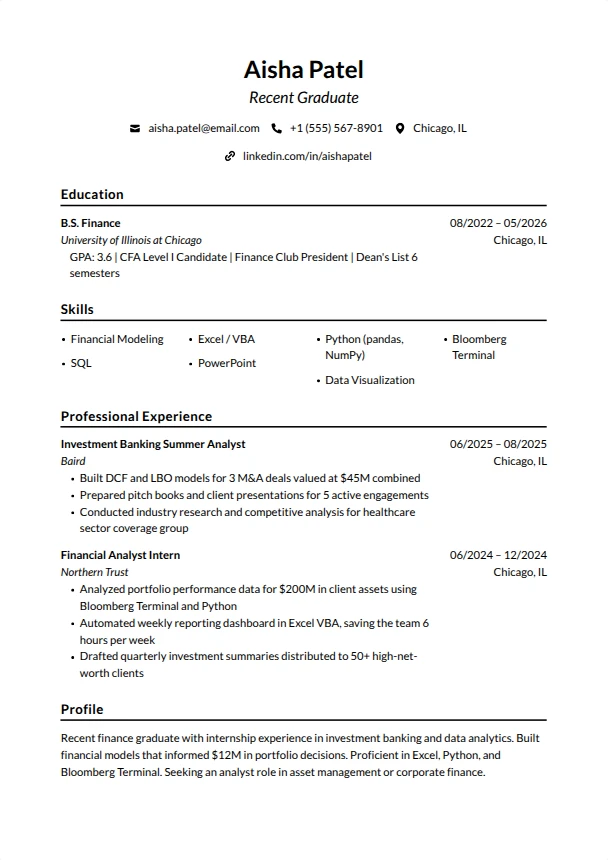
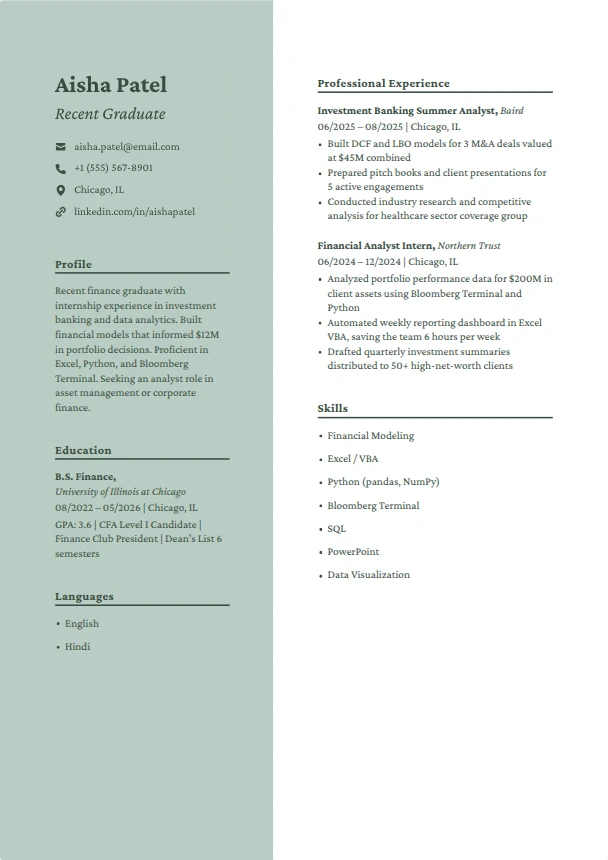
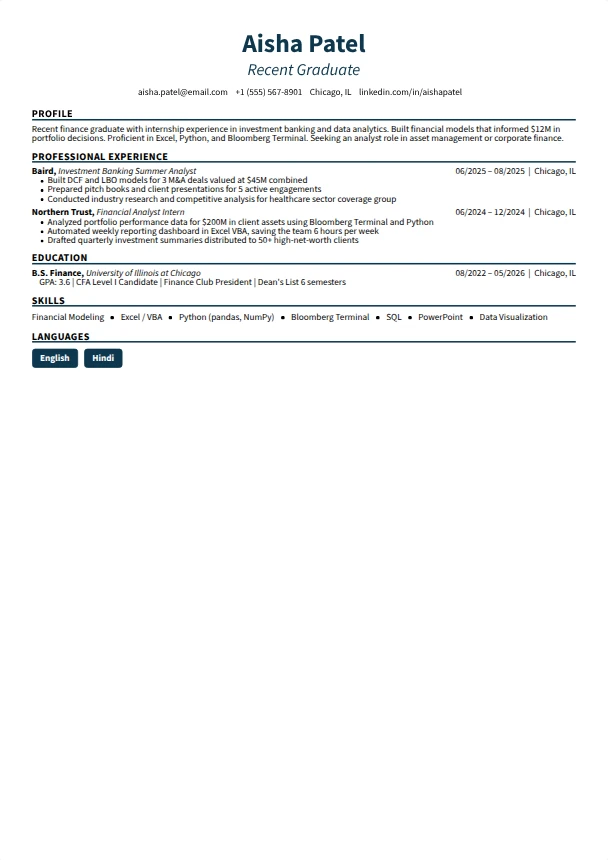
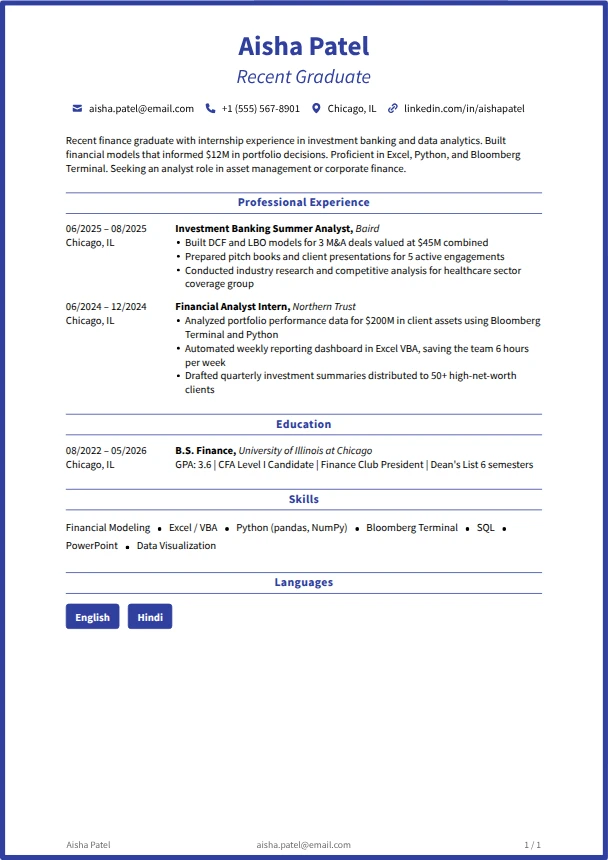
Open a complete, filled-in entry-level resume in our free builder. Swap in your own details, keep the wording that fits, and download as PDF, free.
Build your new grad resume now
Select a professional template, showcase your degree and academic projects, and create a polished resume that proves you are ready to contribute, even without traditional work experience.
Start Building, It's FreeRelated resume guides
Complete guide for recent graduates building resumes for the professional job market.
Broader resume writing strategies for all recent college graduates.
General strategies for anyone building a resume without formal work history.
Resume advice for current students pursuing internships and campus positions.
More resume examples: