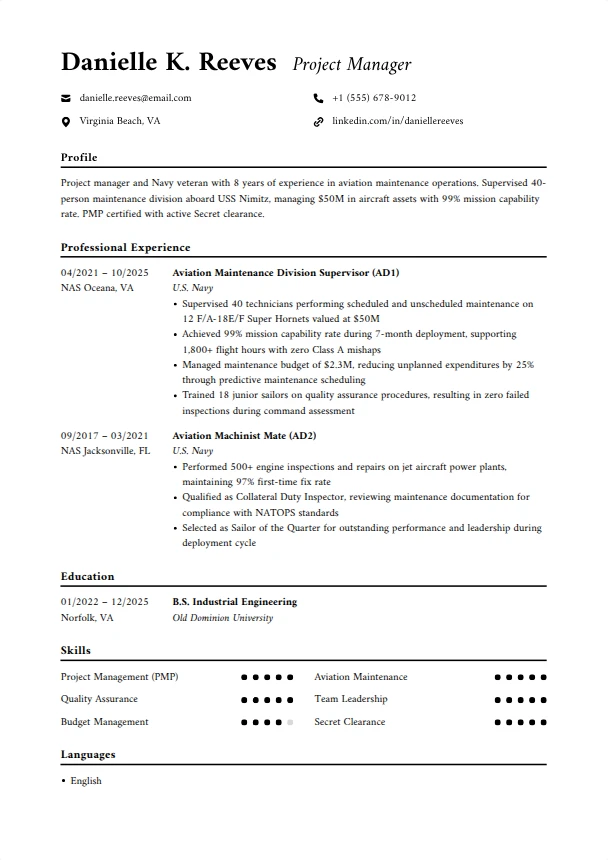
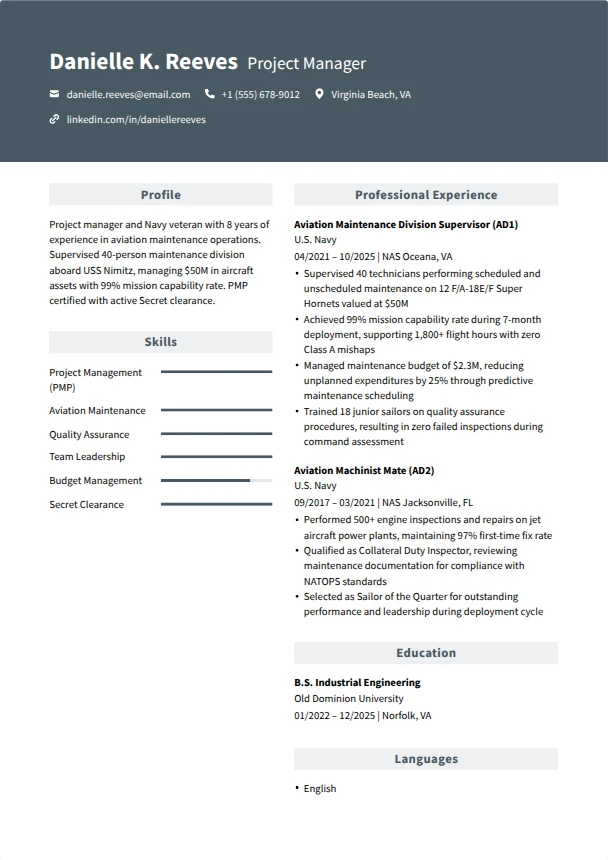
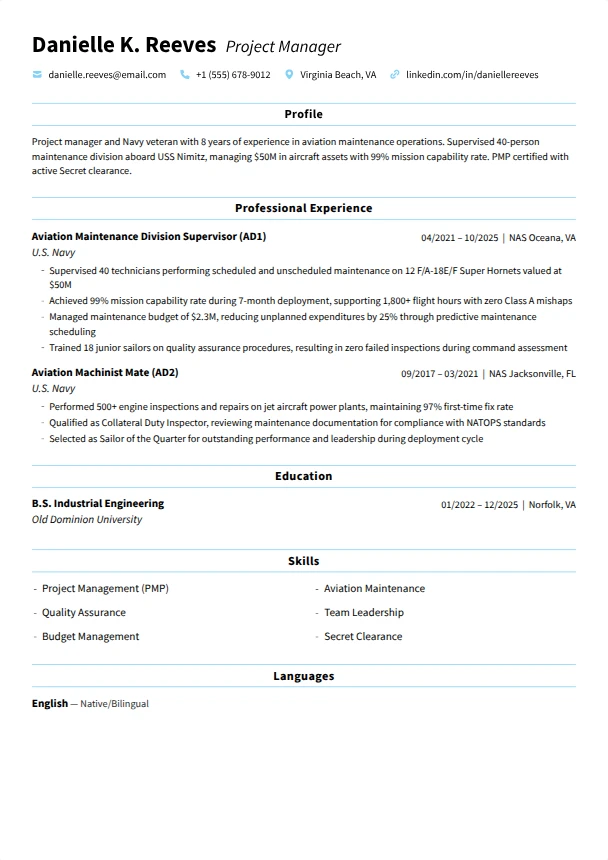
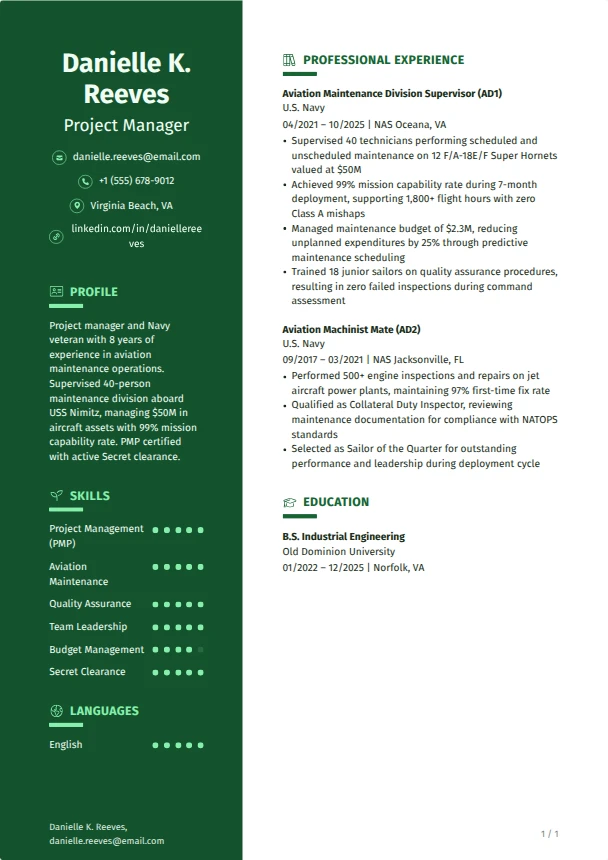
What hiring managers actually look for
Civilian hiring managers reviewing Navy resumes face an immediate comprehension problem. Navy job titles (rates) are completely opaque to outsiders. Here is what they actually look for once the jargon is cleared:
-
1
Technical depth in systems they recognize. Navy rates like ET (Electronics Technician), IT (Information Systems Technician), and MM (Machinist's Mate) involve highly technical work. But a recruiter reading 'ET2' has no idea what that means. Translate it: 'Electronics Technician responsible for maintaining $15M in radar and communications systems for a 300-person crew.' Now they understand your depth.
-
2
Leadership and team size in civilian terms. A Petty Officer Second Class (E-5) who leads a 6-person work center is a team lead. A Chief Petty Officer (E-7) who manages a 25-person division is a department manager. Translate the rank structure into supervisory scope that civilian managers understand: how many people, what budget, what were the outcomes.
-
3
Operational environment and reliability metrics. Shipboard operations run 24/7 in environments where equipment failure is not an option. Translate that into reliability metrics: uptime percentages, zero-defect inspection results, equipment readiness rates. A civilian employer reading '99.8% equipment readiness for a $45M weapons system' immediately understands your level of responsibility.
If your resume communicates these things in the first 7-second scan, you'll make it to the detailed read. Everything below is about making that happen.
How to structure your resume, section by section
The order matters. Here's what a strong navy resume (no civilian experience) looks like from top to bottom:
1. Contact information
Full name, city and state (not your ship or base), phone, email, LinkedIn. Include your security clearance if active. Do not include your rate or rank in the header.
Jasmine Nguyen · [email protected] · (555) 641-8203 · Virginia Beach, VA
linkedin.com/in/jasminenguyen · Security Clearance: Secret (active, granted 2022)
2. Professional summary
Lead with your years of experience, the civilian equivalent of your rate, team size, and one strong accomplishment. Drop all Navy jargon. Name the type of civilian role you are targeting.
Strong: "IT professional with 5 years of U.S. Navy experience administering networks for 200+ users aboard a guided-missile destroyer. Maintained 99.5% uptime for classified and unclassified systems, resolved 20+ daily support tickets, and led cybersecurity compliance inspections with zero findings across 3 annual reviews. CompTIA Security+ certified, active Secret clearance. Seeking network administration and IT support roles."
3. Military experience (translated)
Use a civilian job title, list your ship or command as the employer, and write 4-6 accomplishment bullets. Every bullet needs a number: users supported, systems maintained, dollar value, or percentage improvement.
Strong: "Network Administrator / IT Support Specialist, U.S. Navy (IT2, Information Systems Technician)<br>USS Arleigh Burke (DDG-51), Norfolk, VA · June 2020 to May 2025<br><br>• Administered a secure shipboard network supporting 220 users across classified (SIPRNet) and unclassified (NIPRNet) environments, maintaining 99.5% system availability during 2 deployment cycles.<br>• Installed, configured, and maintained 80+ workstations, 6 servers, and shipboard communications equipment including SATCOM and HF radio systems.<br>• Resolved an average of 20+ help desk tickets daily for hardware, software, and connectivity issues, achieving 88% first-contact resolution rate.<br>• Led the ship's cybersecurity program, conducting quarterly vulnerability assessments and training 220 crew members on information security practices, resulting in zero findings across 3 consecutive CYBERSAFE inspections."
4. Certifications and training
List civilian certifications earned through Navy COOL or on your own, plus military training with civilian equivalents. Navy COOL covers hundreds of certifications. Use it before you separate.
Certifications: CompTIA Security+ (2023) · CompTIA Network+ (2024) · ITIL Foundation (in progress)
Navy Training: Information Systems Technician 'A' School (equivalent to IT technical diploma, 26 weeks) · Navy Cybersecurity Operator (equivalent to cybersecurity analyst training) · Enlisted Information Warfare Specialist (EIWS)
5. Skills section
Translate Navy-specific systems into civilian equivalents. Group by category. Match the language from the job posting exactly.
Networking: TCP/IP, DNS, DHCP, Windows Server, Active Directory, Cisco switches and routers
Security: Vulnerability scanning (Nessus, ACAS), STIG compliance, incident response, CYBERSAFE inspections
Systems: Windows 10/11, Linux (RHEL), VMware, SATCOM, HF/UHF communications
Clearance: Secret (active, granted 2022)
Key skills to include
These skills translate directly from common Navy rates to civilian job postings. Choose the ones that match your rating background and the position you are targeting.
Tip: Navy COOL (cool.osd.mil/navy) maps every Navy rating to civilian certifications and job titles. Use this tool before you write your resume. If your rate maps to CompTIA, PMP, APICS, or a healthcare certification, earn it while the Navy pays for it.
Resume summary examples you can steal
Use one as a starting point, then swap in your own technologies, numbers, and achievements.
"Network administrator with 5 years of U.S. Navy experience managing classified and unclassified networks for 220 users aboard a deployed warship. Maintained 99.5% system availability, resolved 20+ daily support tickets, and led cybersecurity compliance programs with zero findings across 3 annual inspections. CompTIA Security+ and Network+ certified, active Secret clearance. Seeking network administration and cybersecurity roles."
Why it works: Translates Navy IT into standard network admin language, quantifies uptime and ticket volume, highlights clearance and certifications.
"Electronics technician with 6 years of U.S. Navy experience maintaining and repairing $18M in radar, communications, and navigation systems aboard a cruiser. Diagnosed and resolved 150+ equipment malfunctions annually with a 98% first-time fix rate, reducing equipment downtime by 25%. Supervised a 4-person maintenance team. Seeking field service engineer, electronics technician, and maintenance technician roles."
Why it works: Maps Navy electronics work to civilian field service, quantifies system value and fix rates, translates shipboard maintenance to industry terms.
"Healthcare professional with 4 years of U.S. Navy hospital corpsman experience providing emergency and primary care for 300+ Marines in garrison and deployed settings. Treated 800+ patients, maintained medical supply accountability for $90K in equipment, and trained 50 personnel in tactical combat casualty care. NREMT-Paramedic certified. Targeting paramedic, medical assistant, and clinical support positions."
Why it works: Positions corpsman as healthcare professional, quantifies patient volume, highlights the paramedic certification that matters to civilian employers.
"Supply chain professional with 5 years of U.S. Navy logistics experience managing $6M in ship parts and consumables. Processed 200+ requisitions per week through the Navy's supply management system, maintained 99.1% inventory accuracy, and reduced expedited shipping costs by 30% through a demand forecasting process. Seeking supply chain coordinator, procurement analyst, and inventory management roles."
Why it works: Translates Navy logistics into supply chain language, quantifies transaction volume and accuracy, shows a cost-saving process improvement.
Writing strong experience bullets
Every bullet point should answer: "What did you do, and why did it matter?" Use this formula:
Before and after examples:
Maintained shipboard IT systems and provided user support to the crew.
Administered a secure network supporting 220 users across classified and unclassified environments aboard a deployed warship, maintaining 99.5% system availability and resolving 20+ support requests daily with an 88% first-contact resolution rate.
Performed preventive and corrective maintenance on electronics equipment.
Diagnosed and repaired 150+ equipment malfunctions annually across $18M in radar, navigation, and communications systems, achieving a 98% first-time fix rate and reducing system downtime by 25% compared to the previous maintenance cycle.
Handled supply ordering and inventory for the ship.
Managed a $6M inventory of ship parts, consumables, and equipment using the Navy's R-Supply system, processing 200+ requisitions weekly with 99.1% accuracy and reducing expedited shipping costs by 30% through demand analysis and pre-positioning.
Strong action verbs for navy resume (no civilian experience) resumes:
Administered · Calibrated · Configured · Coordinated · Diagnosed · Directed · Installed · Led · Maintained · Managed · Monitored · Operated · Processed · Repaired · Supervised · Trained · Troubleshot · Upgraded
5 mistakes that get navy resume (no civilian experience) resumes rejected
Using Navy rate abbreviations as job titles
IT2, ET3, HM1, LS2. None of these mean anything to civilian recruiters. Always lead with the translated civilian title: 'Network Administrator (U.S. Navy, IT2 Information Systems Technician).' The civilian title is what ATS software and recruiters search for.
Describing shipboard life instead of job accomplishments
Civilian employers do not care about watch rotations, general quarters drills, or underway replenishments unless you can translate them into transferable skills. 'Stood 12-hour watches' means nothing. 'Monitored network security across a 24/7 operational environment, detecting and responding to 15+ security events per deployment' does.
Omitting your security clearance
Many Navy rates require Secret or Top Secret clearance. This is a significant hiring advantage for defense contractors, government agencies, and cybersecurity firms. List your clearance level, status, and grant date. Reinvestigation scope lasts 5 years for Top Secret and 10 years for Secret.
Not using Navy COOL before separating
Navy COOL (Credentialing Opportunities On-Line) pays for industry certifications that map to your rating. An IT who separates without CompTIA Security+ or an ET who leaves without a recognized electronics certification is leaving free credentials on the table. Use this benefit while it is available.
Writing a one-page resume with 6+ years of technical experience
If you served for 6 or more years in a technical rate with multiple qualifications and accomplishments, one page is not enough for the civilian market. Two pages is appropriate. Use the extra space for detailed accomplishment bullets, certifications, and technical skills rather than padding with filler.
What to do if you have no professional experience
Separating from the Navy with no civilian work history is completely normal. Here is how to build a competitive civilian resume using what you already have:
Apply for SkillBridge 6 months before your EAOS
The DoD SkillBridge program lets you work with a civilian employer for up to 180 days before separation while still receiving Navy pay and benefits. Major employers like Amazon, Microsoft, Boeing, and Northrop Grumman participate. This gives you a real civilian work experience entry for your resume. Start the application through your command's career counselor at least 6 months before your EAOS.
Earn civilian certifications through Navy COOL
Navy COOL covers the full cost of industry certifications that map to your rating. ITs should earn CompTIA Security+ and Network+. ETs should pursue electronics or manufacturing certifications. HMs should get NREMT. LSs should look at APICS. These certifications translate your Navy training into credentials civilian employers recognize and value.
Translate your rate using the Navy COOL crosswalk
Every Navy rating has a civilian occupational equivalent listed on the Navy COOL website and the O*NET Military Crosswalk tool. Use these to find the exact civilian job titles, skill names, and certification requirements for your target career. Then rewrite your entire Navy experience using those civilian terms.
Connect with veteran employment programs immediately
Hire Heroes USA provides free resume writing assistance and job placement for transitioning sailors. American Corporate Partners assigns you a civilian mentor in your target industry. The VA's Veteran Readiness and Employment (VR&E) program offers career counseling and training funding. Start using these resources 12 months before your EAOS, not after.
Frequently asked questions
How do I translate my Navy rate into a civilian job title?
Use Navy COOL (cool.osd.mil/navy) or the O*NET Military Crosswalk tool. Enter your rating and it will show matching civilian job titles and certifications. For example, IT (Information Systems Technician) maps to Network Administrator and Cybersecurity Analyst. ET (Electronics Technician) maps to Field Service Engineer and Electronics Maintenance Technician. HM (Hospital Corpsman) maps to EMT, Paramedic, or Medical Assistant.
Should I include my ship name and hull number on my resume?
Include the ship name as your employer (e.g., 'USS Arleigh Burke (DDG-51)') for context, but do not assume the recruiter knows what type of ship it is. Add a brief descriptor if helpful: 'a guided-missile destroyer with a crew of 300.' The ship name adds credibility and specificity, but the translated job details matter more.
What is Navy COOL and should I use it before separating?
Navy COOL (Credentialing Opportunities On-Line) is a DoD program that pays for industry certifications mapped to your Navy rating. It covers exam fees, study materials, and sometimes preparatory courses. Yes, you should absolutely use it before separating. Once you leave active duty, you lose access. Check which certifications map to your rate and earn as many as your remaining service time allows.
Do civilian employers value Navy experience?
Yes, especially in technical fields. Nuclear-trained sailors are recruited heavily by power companies and defense contractors. ITs and ETs are competitive for civilian IT and engineering roles. HMs transition well into healthcare. The challenge is not the value of the experience, it is communicating that value in civilian language. Translate your rate, quantify your results, and you become a strong candidate.
Can I use my Navy experience for federal government jobs?
Yes, and you have a significant advantage through Veterans' Preference (5 or 10 extra points on your application score) and the Veterans Recruitment Appointment (VRA) hiring authority. Federal resumes are 3-5 pages and require more detail than civilian ones, including hours per week and supervisor contact information. Check our federal resume guide for the full USAJOBS formatting requirements.
Skip the blank page
Open a complete, filled-in veteran-to-civilian resume in our free builder. Swap in your own details, keep the wording that fits, and download as PDF, free.
Build your navy resume (no civilian experience) in minutes
Pick a template, fill in your details, and download a polished navy resume (no civilian experience) ready to submit.
Start Building, It's FreeRelated resume guides
Complete guide to translating Navy service into a civilian resume, covering all ratings and career fields.
Resume examples covering all military branches with translated experience bullets and civilian summary statements.
Guide for any veteran entering the civilian workforce, covering Veterans' Preference, VRA, and transition programs.
More resume examples: