What hiring managers actually look for
Hiring managers reviewing data analyst candidates with no formal experience look for three things that signal you're ready to contribute from day one:
-
1
SQL proficiency demonstrated through projects. SQL is the most used tool in data analysis. If your resume doesn't include evidence of SQL workeven from personal projects or Kaggle competitions most hiring managers will move on. A portfolio project querying a real dataset in SQL says more than listing ' SQL'in your skills.
-
2
Data storytelling ability. Analysis is only valuable if you can communicate findings. Managers look for evidence that you can build dashboards, write insight summaries, or present data to non-technical stakeholders. A Tableau dashboard or a well-structured report excerpt on your portfolio signals this.
-
3
Business context from any background. Data analysis exists to serve business decisions. If you've worked in finance, marketing, operations, or customer service, you already understand business problems. Managers hiring junior analysts often prefer candidates with domain knowledge who are learning SQL over pure SQL learners with no business sense.
If your resume communicates these things in the first 7-second scan, you'll make it to the detailed read. Everything below is about making that happen.
How to structure your resume, section by section
The order matters. Here's what a strong data analyst resume (no experience) looks like from top to bottom:
1. Contact header
Name, email, phone, city/state, LinkedIn. Include links to your Kaggle profile, Tableau Public portfolio, or GitHub with data analysis projects. These links are how you prove your skills without work history.
Emily Torres · [email protected] · (555) 567-8901 · Denver, CO
linkedin.com/in/emilytorres-data · kaggle.com/emilytorres · public.tableau.com/emilytorres
2. Professional summary (2-3 sentences)
Without analyst job titles, lead with your analytical training, tools you've used, and one concrete project outcome. Connect your previous career to data skills wherever possible.
Strong: "Google Data Analytics Certificate holder with portfolio projects analyzing real-world datasets using SQL, Python, and Tableau. Built a customer churn analysis dashboard that identified 3 key retention drivers from a 50,000-record dataset. Former marketing coordinator with 3 years of experience using data to optimize campaign performance and track KPIs."
3. Certifications & training
For no-experience data analysts, structured certificates validate your skills. Google Data Analytics Certificate is the gold standard for entry-level. IBM Data Analyst Certificate and DataCamp career tracks also carry weight.
Google Data Analytics Professional Certificate (2025) · IBM Data Analyst Professional Certificate (2026) · Tableau Desktop Specialist (in progress)
4. Technical skills
Group by function: Data Analysis, Visualization, Programming, and Tools. For entry-level, the core stack is SQL + Python (or R) + Tableau (or Power BI) + Excel.
Analysis: SQL (PostgreSQL, BigQuery), Advanced Excel (VLOOKUP, Pivot Tables, Power Query)
Visualization: Tableau, Power BI, Google Data Studio
Programming: Python (pandas, matplotlib, seaborn), R basics
Tools: Jupyter Notebook, Google Sheets, BigQuery, Git
5. Portfolio projects
This section carries your resume. Each project should answer a business question using real data. Include: the dataset source, tools used, analysis approach, and the key finding or recommendation.
Strong: "Analyzed 50,000 e-commerce transaction records (Kaggle dataset) to identify customer churn patterns. Used SQL for data extraction and cleaning, Python (pandas) for feature analysis, and Tableau for dashboard creation. Identified that customers with 30+ day gaps between purchases had 3.5x higher churn probabilitya finding that would justify a targeted re-engagement email campaign."
6. Previous experience & education
List prior roles with data-relevant bullet points emphasized: reporting, KPI tracking, spreadsheet analysis, process improvement. Any time you used data to make a decision, that's an analyst skill.
Key skills to include
These are the core skills that appear most frequently in entry-level data analyst job postings. Focus on building depth in SQL and visualization firstthey're the two skills hiring managers test most in interviews.
Tip: If the job posting says ' Tableau'don't write ' data visualization tools.' If it says ' BigQuery'don't write ' SQL.' Use the exact tool names from the posting. ATS systems match keywords literally, and specificity signals real experience.
Resume summary examples you can steal
Use one as a starting point, then swap in your own technologies, numbers, and achievements.
"Marketing coordinator transitioning to data analysis with Google Data Analytics Certificate and portfolio projects using SQL, Python, and Tableau. Analyzed 50,000+ record datasets to identify customer behavior patterns and build interactive dashboards. Brings 3 years of experience tracking campaign KPIs, building performance reports in Google Sheets, and presenting data insights to stakeholders."
Why it works: Certificate + portfolio projects + marketing data experience = strong career change story with analytical foundation.
"Business Administration graduate with a concentration in analytics and Google Data Analytics Certificate. Completed 3 portfolio projects analyzing real-world datasets (e-commerce, healthcare, and urban transit) using SQL, Python, and Tableau. Published all analyses on Kaggle with combined 500+ views. Interned at a nonprofit where I built weekly donor engagement reports that increased follow-up efficiency by 25%."
Why it works: Degree + certificate + 3 published projects + internship with measurable impact maximizes limited experience.
"Former financial analyst transitioning to data analytics with IBM Data Analyst Certificate and advanced SQL skills. Built 4 portfolio projects analyzing financial and operational datasets, including a profitability analysis dashboard used by a small business owner to optimize pricing. Brings 4 years of experience in financial modeling, variance analysis, and stakeholder reporting using Excel and SAP."
Why it works: Finance background is a natural fit for analytics, certificate adds data-specific credibility, portfolio project has real-world client impact.
"Self-taught data analyst with Google Data Analytics Certificate and 6 months of intensive independent study (SQL, Python, Tableau). Completed 200+ SQL practice problems on Leet Code and Hacker Rank. Built 3 end-to-end analysis projects published on GitHub, including a public health dataset analysis featured in a Kaggle community discussion with 300+ upvotes."
Why it works: Quantified study hours, SQL practice volume, published projects, and community recognition proves dedication and capability.
Writing strong experience bullets
Every bullet point should answer: "What did you do, and why did it matter?" Use this formula:
Before and after examples:
Analyzed data for a portfolio project.
Analyzed 50,000 e-commerce transactions using SQL and Python (pandas) to identify customer churn patterns. Built a Tableau dashboard visualizing 3 key churn predictors, projecting $120K annual revenue recovery if addressed through targeted retention campaigns.
Created reports at my previous marketing job.
Built automated weekly campaign performance reports in Google Sheets (VLOOKUP, pivot tables, conditional formatting) tracking 8 KPIs across 5 marketing channels. Reports reduced executive briefing prep time from 3 hours to 30 minutes.
Used Excel a lot in my finance role.
Developed financial forecasting models in Excel (Power Query, VLOOKUP, scenario analysis) processing 10,000+ monthly transactions. Identified $85K in billing discrepancies over 6 months through automated variance detection formulas.
Strong action verbs for data analyst resume (no experience) resumes:
Analyzed · Built · Calculated · Cleaned · Created · Designed · Developed · Discovered · Extracted · Forecasted · Identified · Modeled · Optimized · Queried · Reported · Transformed · Visualized · Automated
6 mistakes that get data analyst resume (no experience) resumes rejected
Listing tools without showing projects that used them
Writing ' SQL, Python, Tableau'in your skills section means nothing without a projects section that shows what you built with them. Every tool on your resume must be backed by a project or work experience bullet.
Building portfolio projects without business questions
Analyzing a dataset ' because it was on Kaggle'is not a project. Frame every analysis around a business question: ' What drives customer churn?' or ' Which product categories are underperforming?' This mirrors real analyst work.
Ignoring your domain expertise from prior careers
If you worked in finance, you understand financial metrics. If you worked in marketing, you understand conversion funnels. This domain knowledge is your competitive advantage over other entry-level analysts. Feature it prominently.
Submitting analysis projects without visualizations
A SQL query that returns a table is not a portfolio piece. Add a Tableau dashboard, a matplotlib chart, or even a well-formatted Google Slides summary. Hiring managers want to see that you can communicate data visually.
Skipping SQL practice because you prefer Python
SQL is used in 90%+ of data analyst roles. Python is a bonus at entry level, not a replacement for SQL. If you can only learn one tool deeply before applying, make it SQL. Most technical interviews will test it.
Writing a two-page resume with no analyst experience
One page is the standard for entry-level data analysts. If your resume extends to two pages, cut the weakest content firstusually older non-analytical roles and generic skills.
What to do if you have no professional experience
This guide is built for your exact situation. Here are four concrete steps to create a job-ready data analyst resume:
Complete the Google Data Analytics Certificate (2-4 months)
This Coursera program covers spreadsheets, SQL, R, Tableau, and the full analysis workflow. It costs $49/month and is the most widely recognized entry-level analytics credential. The capstone project becomes your first portfolio piece.
Build 3 portfolio projects on Kaggle or GitHub
Find real datasets (Kaggle, government open data, company data challenges), frame a business question, perform the analysis in SQL + Python, and create a dashboard in Tableau. Publish everything. Three strong projects is the minimum for a competitive resume.
Practice SQL until it's second nature
Complete 100+ SQL problems on Leet Code, Hacker Rank, or Data Lemur. Focus on: JOINs, GROUP BY, window functions, subqueries, and CTEs. These are the patterns that show up in analyst interviews and daily work.
Reframe your current job as analytical experience
If you track KPIs, build reports, analyze trends, forecast numbers, or make data-driven recommendations in your current rolethat's analyst work. Rewrite those bullet points using analyst language and include the tools you used.
Frequently asked questions
Can I become a data analyst without a technical degree?
Absolutely. Many successful data analysts come from business, finance, marketing, and liberal arts backgrounds. The Google Data Analytics Certificate plus a portfolio of SQL and Tableau projects is sufficient for most entry-level postings. Your domain knowledge from other fields is often a bigger asset than a statistics degree.
How important is Python vs. SQL for a first analyst role?
SQL is essentialit's used in virtually every data analyst role. Python is a strong bonus but not always required at the entry level. If you can only master one, master SQL first. Then add Python (pandas, matplotlib) to move from entry-level to mid-level faster.
Do employers take Kaggle projects seriously?
Yes, when they're done well. A Kaggle project that frames a business question, uses real analytical techniques, and presents findings in a clear dashboard is a legitimate portfolio piece. Avoid toy datasets and ' follow-along'tutorialsdo original analysis with your own insights.
Should I learn Tableau or Power BI first?
Check the job postings in your target market. If most say Tableau, learn Tableau. If most say Power BI, learn Power BI. Both are valid, but matching the tool to the posting gives you a direct keyword match. Tableau Public is free and lets you build a public portfolio.
How long does it take to build a competitive data analyst resume from scratch?
3-6 months of focused effort: 2-3 months for the Google certificate, 1-2 months building portfolio projects, and ongoing SQL practice. If you're coming from a role that already involves data (finance, marketing, operations), the transition can be faster because you already have analytical experience to reframe.
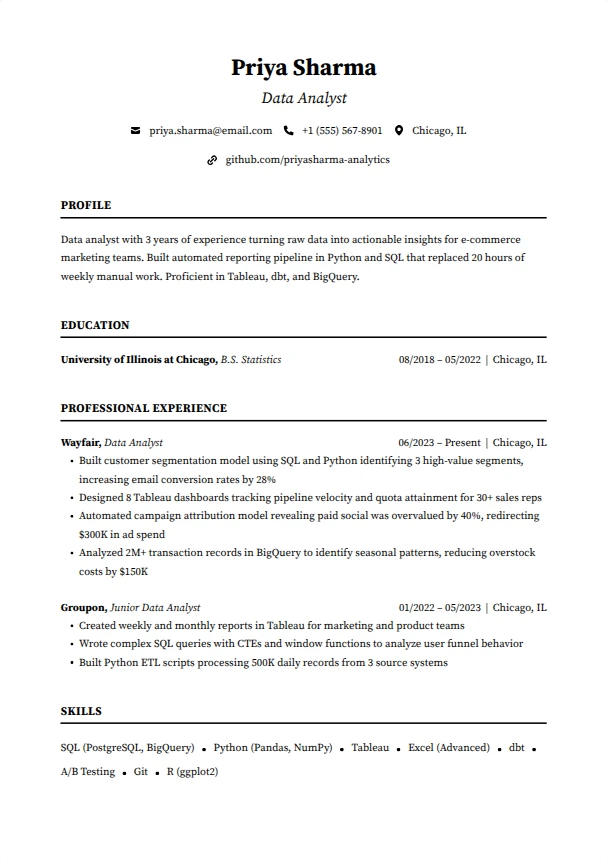
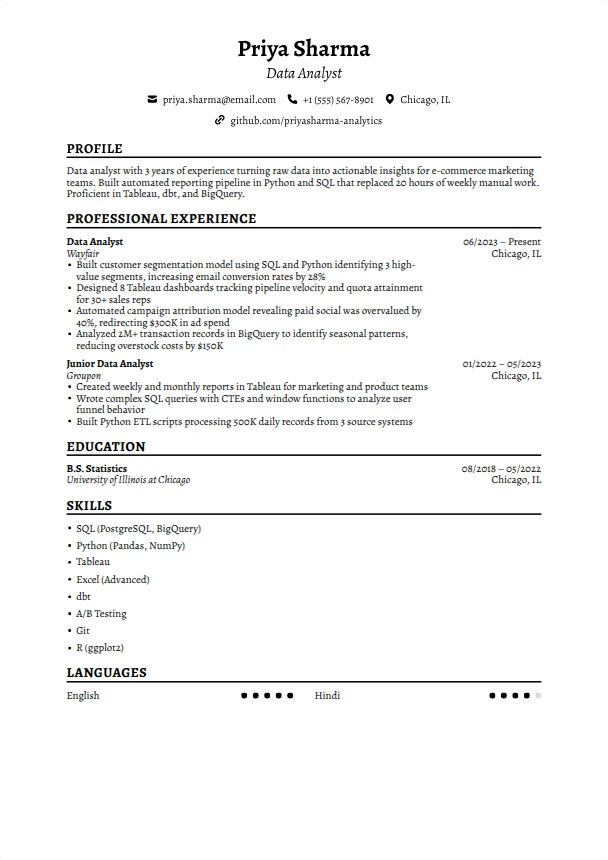
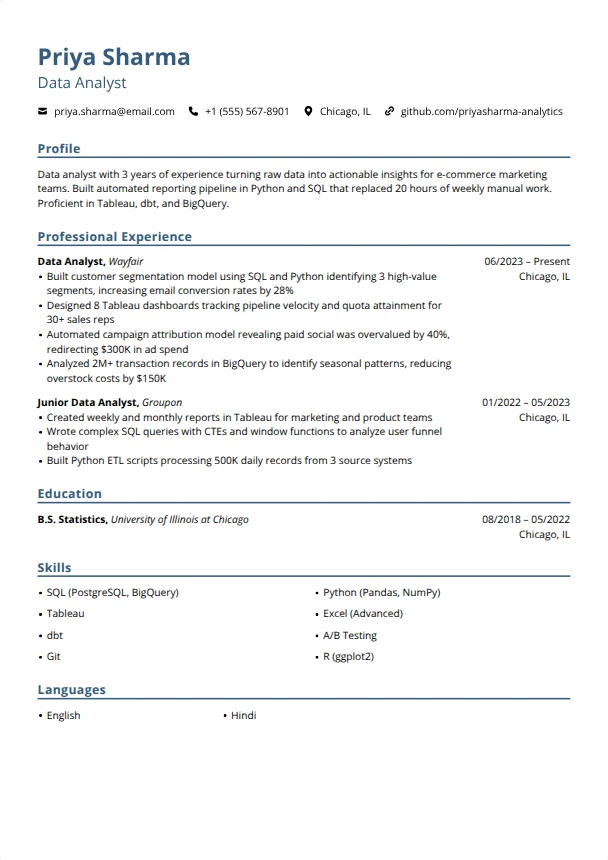
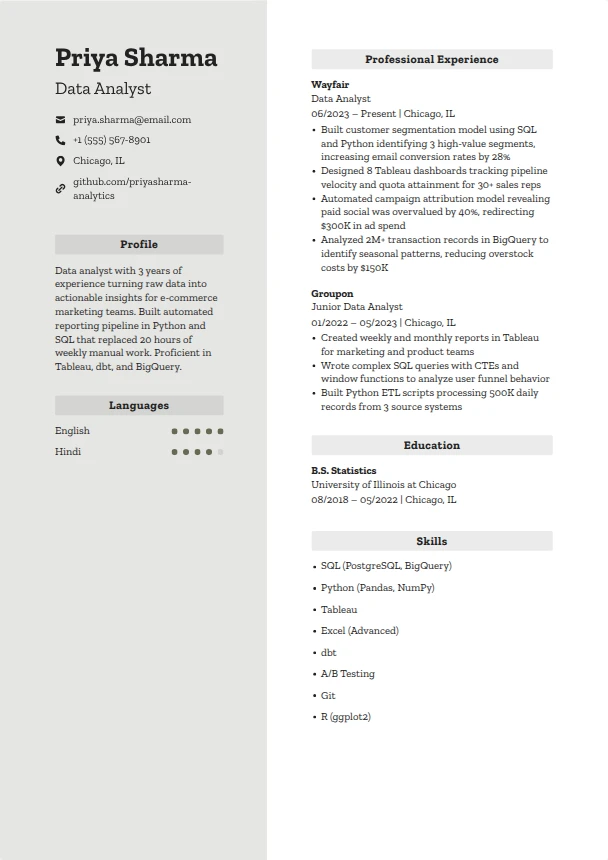
Skip the blank page
Open a complete, filled-in data analyst resume in our free builder. Swap in your own details, keep the wording that fits, and download as PDF, free.
Build your data analyst resume now
Pick a template designed for career changers and entry-level analysts, add your portfolio projects and certifications, and download a polished PDF in minutes. Free, no account required.
Start Building, It's FreeRelated resume guides
Complete data analyst resume guide for all experience levels.
General IT resume guide for career changers entering tech.
Portfolio-driven resume guide for career changers entering engineering.
How to break into web development with portfolio projects.
More resume examples: