What hiring managers actually look for
DevOps hiring managers evaluating candidates without formal DevOps titles look for three signals that prove operational and automation maturity:
-
1
Infrastructure-as-code in your project portfolio. Terraform, Ansible, or CloudFormation code in a GitHub repository is the single strongest signal for a DevOps candidate without job titles. If you can provision infrastructure with code, version it, and automate its deployment, you've demonstrated the core DevOps skill.
-
2
CI/CD pipeline design and implementation. Building a working CI/CD pipelineeven for a personal projectshows you understand automated testing, build processes, and deployment workflows. GitHub Actions, Jenkins, or Git Lab CI pipelines in your portfolio carry real weight.
-
3
Linux and scripting depth from any background. DevOps runs on Linux and scripting. If you come from sysadmin, you already have this. If you come from development, show your comfort with Bash, cron, systemd, and troubleshooting production systems. This foundational skill separates DevOps candidates from cloud users.
If your resume communicates these things in the first 7-second scan, you'll make it to the detailed read. Everything below is about making that happen.
How to structure your resume, section by section
The order matters. Here's what a strong devops engineer resume (no experience) looks like from top to bottom:
1. Contact header
Name, email, phone, city/state, LinkedIn, GitHub. Your GitHub profile should showcase Terraform repos, Dockerfiles, CI/CD configurations, and automation scripts. This is your portfolio.
Alex Petrov · [email protected] · (555) 789-0123 · Austin, TX
linkedin.com/in/alexpetrov-devops · github.com/apetrov-infra
2. Professional summary (2-3 sentences)
Lead with your automation and infrastructure skills, relevant certifications, and the most impressive project you've built. If transitioning from sysadmin or development, frame that background as DevOps-adjacent.
Strong: "Linux systems administrator transitioning to DevOps with hands-on experience in Docker, Terraform, and CI/CD pipeline design. Built a fully automated Kubernetes deployment pipeline using GitHub Actions, Terraform, and Argo CD in a home lab environment. Brings 3 years of sysadmin experience managing Linux servers, automating deployments with Bash and Ansible, and maintaining 99.9% uptime for a 500-user environment."
3. Certifications
AWS certifications, Terraform Associate, Kubernetes certifications (CKA/CKAD), and Linux Foundation certs all carry weight for DevOps transitions. List them prominently.
AWS Solutions Architect Associate (2025) · Terraform Associate (2025) · CKA (Certified Kubernetes Administrator) (in progress) · RHCSA (2024)
4. Technical skills
Group by DevOps domain: Containers & Orchestration, CI/CD, Infrastructure as Code, Cloud, Monitoring, and Scripting. This organization mirrors how DevOps teams think about their toolchain.
Containers: Docker, Kubernetes, Helm, Docker Compose
CI/CD: GitHub Actions, Jenkins, Argo CD, Git Lab CI
Ia C: Terraform, Ansible, CloudFormation
Cloud: AWS (EC2, ECS, EKS, S3, VPC), Linux (Ubuntu, RHEL)
Monitoring: Prometheus, Grafana, CloudWatch, ELK Stack
Scripting: Bash, Python, Go basics
5. DevOps projects & automation experience
This section is critical. Each project should demonstrate a specific DevOps pattern: containerization, CI/CD, Ia C, monitoring, or automation. Include GitHub links.
Strong: "Built an end-to-end Kubernetes deployment pipeline: Terraform provisions EKS cluster on AWS, GitHub Actions runs tests and builds Docker images, Argo CD handles GitOps-style continuous deployment, and Prometheus + Grafana provide monitoring with alerting. Full infrastructure defined in code with 15+ Terraform modules. Documented architecture and setup in a detailed GitHub README."
6. Prior experience & education
Reframe sysadmin, developer, or IT roles with DevOps-relevant bullet points. Any automation you built, deployment you managed, or infrastructure you maintained is DevOps experience with a different title.
Key skills to include
These DevOps tools and practices appear most frequently in junior and mid-level DevOps engineer postings in 2026. Focus on building depth in containers, CI/CD, and Ia Cthe three pillars hiring managers test most.
Tip: DevOps is about breadth across the delivery pipeline. But for your first role, depth in one area (containers, CI/CD, or Ia C) is better than shallow knowledge of everything. Pick one pillar and build a portfolio project that demonstrates real competency.
Resume summary examples you can steal
Use one as a starting point, then swap in your own technologies, numbers, and achievements.
"Linux systems administrator with 3 years of experience transitioning to DevOps engineering. Automated server provisioning with Ansible (reduced deployment time from 4 hours to 20 minutes), containerized 5 internal applications with Docker, and built CI/CD pipelines using Jenkins. Home lab includes a fully automated Kubernetes cluster provisioned with Terraform on AWS. AWS SAA and Terraform Associate certified."
Why it works: Real automation achievements from sysadmin role + home lab showing DevOps-specific skills + relevant certifications.
"Full-stack developer transitioning to DevOps with 2 years of experience building and deploying web applications. Designed CI/CD pipelines for 3 team projects using GitHub Actions, reducing deployment time from manual 30-minute processes to 5-minute automated pipelines. Built personal Kubernetes homelab running 8 containerized services with automated monitoring (Prometheus/Grafana). AWS CCP certified, Terraform Associate in progress."
Why it works: Developer background shows coding ability, CI/CD contributions demonstrate DevOps thinking, home lab proves infrastructure skills.
"Self-taught DevOps engineer with 12 months of intensive home lab experience building automated infrastructure on AWS. Provisioned multi-environment Kubernetes clusters with Terraform, built GitHub Actions pipelines deploying Docker containers to ECS, and implemented monitoring with Prometheus and Grafana. Completed 3 AWS certifications (CCP, SAA, Developer Associate) and Terraform Associate certification during this period."
Why it works: Quantified self-study period, multiple certifications earned, complex home lab demonstrating real DevOps workflows.
"IT support engineer transitioning to DevOps after automating 40% of recurring support tasks using PowerShell and Bash scripts. Built Docker containers for internal tool deployment, reducing setup time from 2 hours to 5 minutes per developer workstation. Completed AWS Solutions Architect Associate certification and built a home lab with Terraform-managed infrastructure on AWS. Brings 2 years of Linux administration and networking experience."
Why it works: Automation achievements from existing role prove DevOps mindset, containerization experience, certification + lab, and IT infrastructure foundation.
Writing strong experience bullets
Every bullet point should answer: "What did you do, and why did it matter?" Use this formula:
Before and after examples:
Helped deploy applications to servers.
Designed CI/CD pipeline using GitHub Actions that automated testing, Docker image building, and deployment to AWS ECS for a 3-person development team. Reduced deployment time from 30 minutes (manual) to 5 minutes (fully automated) with zero-downtime rolling updates.
Set up servers and installed software at work.
Automated provisioning of 20 Linux servers using Ansible playbooks, reducing setup time from 4 hours (manual) to 20 minutes per server. Standardized configurations across development, staging, and production environments, eliminating configuration drift issues.
Learned Kubernetes and Docker in my home lab.
Built a Kubernetes homelab on AWS (Terraform-provisioned EKS cluster) running 8 containerized microservices with Helm charts, Prometheus monitoring, Grafana dashboards, and automated alerting. Documented full architecture and GitOps workflow in a 3,000-word technical blog post.
Strong action verbs for devops engineer resume (no experience) resumes:
Automated · Built · Containerized · Configured · Deployed · Designed · Implemented · Managed · Migrated · Monitored · Optimized · Orchestrated · Provisioned · Reduced · Scripted · Standardized · Streamlined · Terraformed
6 mistakes that get devops engineer resume (no experience) resumes rejected
Listing DevOps tools without showing what you built with them
Writing ' Docker, Kubernetes, Terraform'in your skills section without a projects section showing deployments, pipelines, and infrastructure code is meaningless. Every tool must be backed by a project or automation you can demonstrate.
Applying for senior DevOps roles as your first DevOps job
Target Junior DevOps Engineer, DevOps Associate, Cloud Operations, or SRE Tier 1 roles. These positions expect candidates who are learning. Senior DevOps roles expect 5+ years of production infrastructure management.
Ignoring your sysadmin or developer background
DevOps is the intersection of development and operations. If you have experience in either, you have half the skill set already. Reframe your existing experience: server management becomes ' infrastructure operations,' deployment scripts become ' CI/CD automation.'
Building a home lab without documenting it publicly
A Kubernetes cluster on your laptop that nobody can see doesn't exist on your resume. Push all Terraform, Docker, and CI/CD configurations to GitHub. Write a README or blog post explaining the architecture. Make your work visible.
Focusing only on tools instead of outcomes
DevOps is about making teams ship faster and more reliablynot about knowing 15 tools. Frame every bullet around an outcome: deployment time reduced, manual steps eliminated, uptime improved. Tools are the how, not the what.
Skipping monitoring and observability in your portfolio
CI/CD and containers get all the attention, but production DevOps requires monitoring, logging, and alerting. Add Prometheus, Grafana, or ELK to your home lab projects. It demonstrates operational maturity.
What to do if you have no professional experience
DevOps is hard to break into cold, but here are four proven paths to building a resume-worthy DevOps portfolio:
Build a complete DevOps pipeline in your home lab
Start with: Terraform provisions an EKS or ECS cluster on AWS. GitHub Actions builds Docker images and runs tests. Argo CD or Code Deploy handles deployment. Prometheus + Grafana handle monitoring. Document everything in GitHub with detailed READMEs.
Automate everything in your current role
If you're a sysadmin, containerize internal tools with Docker. Write Ansible playbooks for server provisioning. Build a Jenkins or GitHub Actions pipeline for your team's deployments. These become real DevOps resume bullets with production context.
Get AWS SAA + Terraform Associate certified
These two certifications cover cloud infrastructure and infrastructure-as-codethe foundation of DevOps. Study for 2-3 months each, and immediately build projects using the services you studied. Certification plus project is the combination that gets interviews.
Write technical blog posts about your projects
Document your home lab architecture, explain your CI/CD pipeline design decisions, and write troubleshooting guides. Blog posts demonstrate communication skills and deep understanding both critical for DevOps roles where you'll need to explain infrastructure to development teams.
Frequently asked questions
Can I get a DevOps job without sysadmin or developer experience?
It's difficult but possible. DevOps sits at the intersection of development and operationsmost successful candidates have background in one or both. If you're starting from scratch, build a comprehensive home lab, get cloud and Ia C certifications, and target junior or associate-level roles.
Is the sysadmin-to-DevOps path better than developer-to-DevOps?
Both paths are valid. Sysadmins bring Linux, networking, and infrastructure skills. Developers bring coding, CI/CD, and application architecture understanding. The key is building the skills from the other side: sysadmins need to learn Ia C and CI/CD, developers need to learn Linux operations and monitoring.
Which DevOps tools should I learn first?
Docker first (containerization foundation), then Terraform (infrastructure as code), then GitHub Actions or Jenkins (CI/CD), then Kubernetes (orchestration). This order builds on itselfeach tool makes more sense after you understand the previous one.
How important are certifications for DevOps roles?
Certifications matter most for your first DevOps role, where you lack job titles. AWS SAA and Terraform Associate are the most valued combination. After you land your first role, hands-on experience quickly becomes more important than additional certifications.
Should I include my home lab on a professional resume?
Absolutely. A well-documented home lab with Terraform, Docker, Kubernetes, CI/CD, and monitoring is professional-grade project work. Treat it like a job: describe the architecture, tools, and outcomes in detailed bullet points. Link to GitHub repos.
Skip the blank page
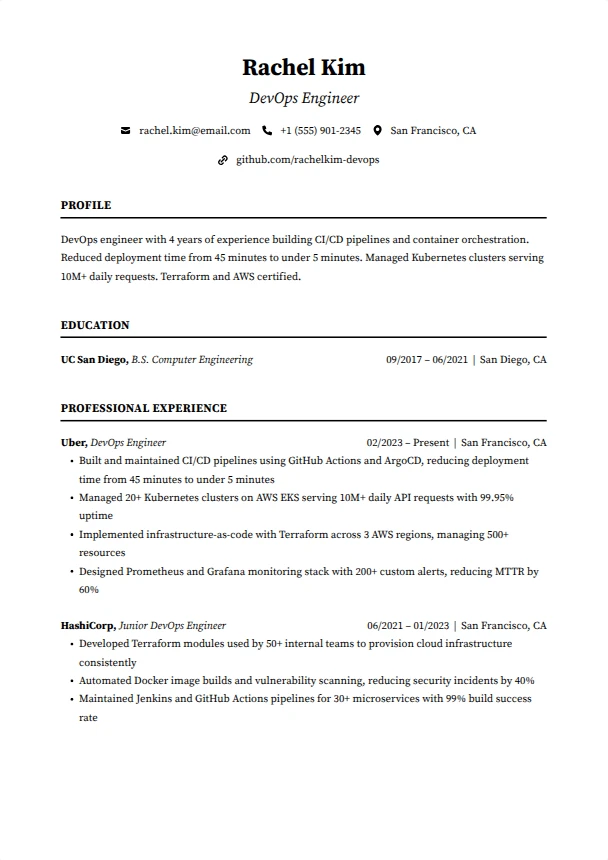
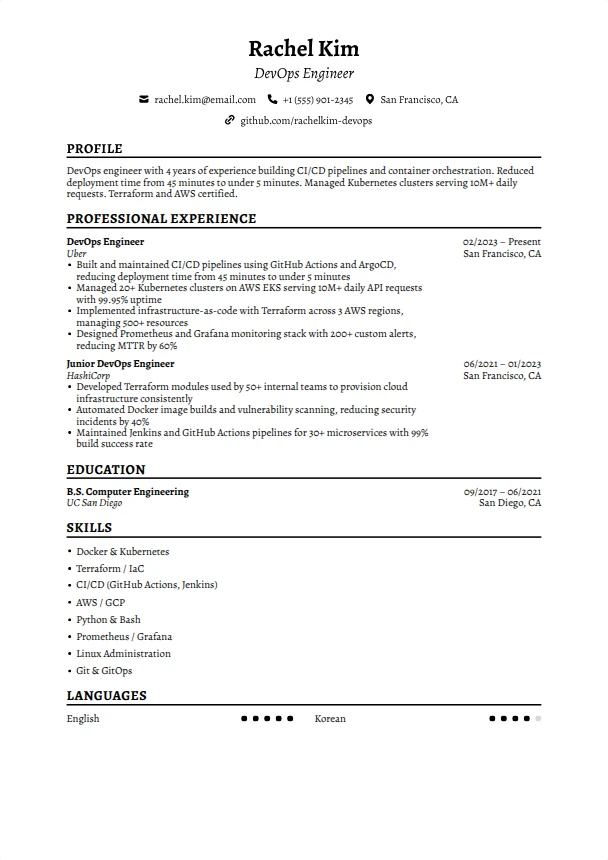
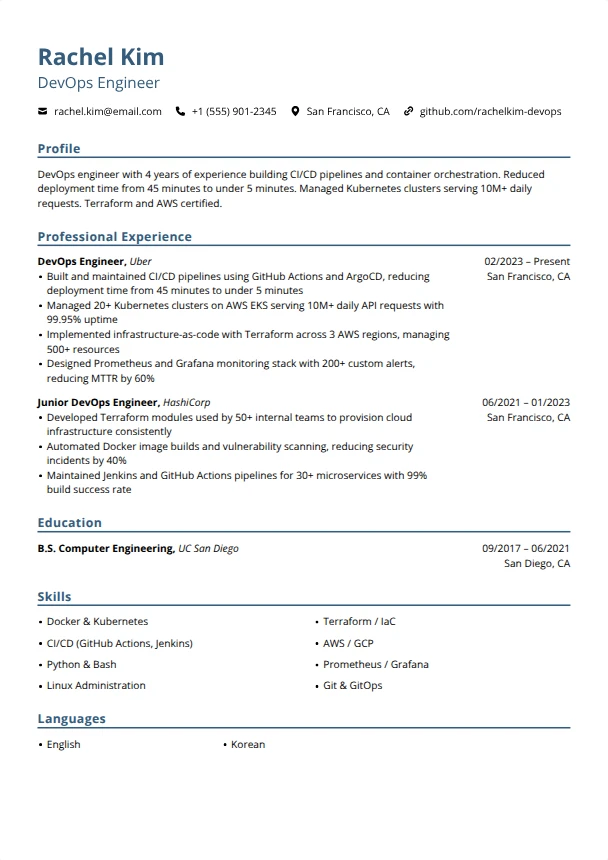
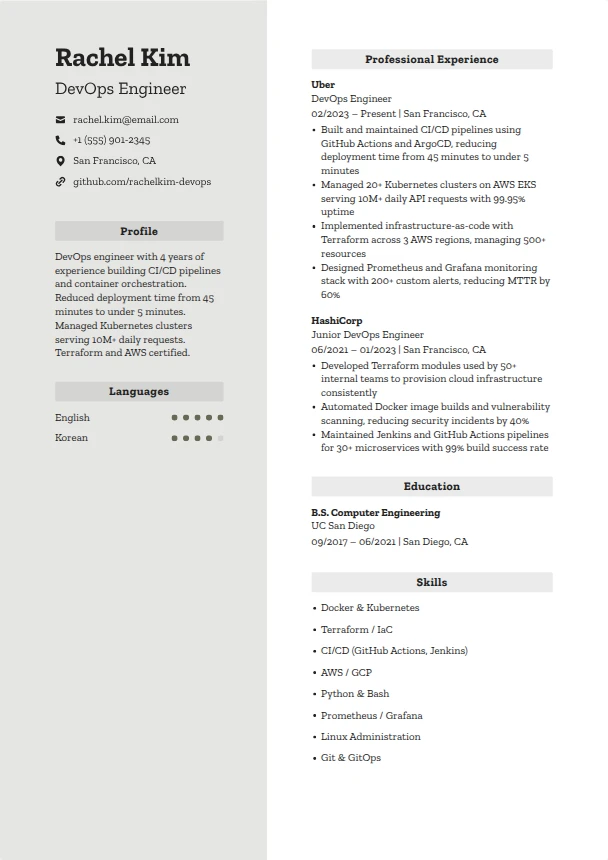
Open a complete, filled-in DevOps / cloud engineer resume in our free builder. Swap in your own details, keep the wording that fits, and download as PDF, free.
Build your DevOps resume now
Pick a template designed for DevOps career transitions, showcase your automation projects and infrastructure code, and download a polished PDF in minutes. Free, no account required.
Start Building, It's FreeRelated resume guides
Complete DevOps resume guide for all experience levels.
Cloud-focused resume guide for career changers closely related to DevOps.
Build AWS credentials from scratch with free tier projects.
Developer-focused resume for career changers building a code portfolio.
More resume examples: