What hiring managers actually look for
Before modeling your CV after these examples, understand what search committees and admissions reviewers look for at each stage:
-
1
Section ordering signals your priorities. For research-focused positions, publications and research experience should appear before teaching. For teaching-focused positions, flip the order. The examples below demonstrate both arrangements so you can choose the one that fits your target role.
-
2
Completeness is more important than brevity. Unlike corporate resumes, academic CVs should include everything relevant. Omitting a conference presentation or a small departmental grant makes your record look thinner than it actually is. Every scholarly activity belongs somewhere on your CV.
-
3
Consistency in formatting builds trust. Committee members read hundreds of CVs during a search. Inconsistent date formats, mixed citation styles, or uneven spacing creates friction and suggests a lack of attention to detail. The examples below use uniform formatting throughout.
If your resume communicates these things in the first 7-second scan, you'll make it to the detailed read. Everything below is about making that happen.
How to structure your resume, section by section
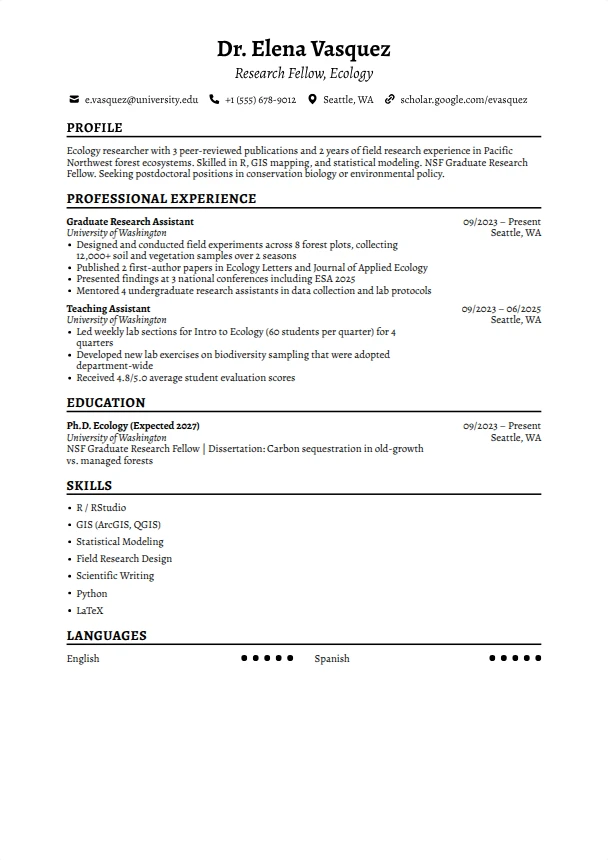
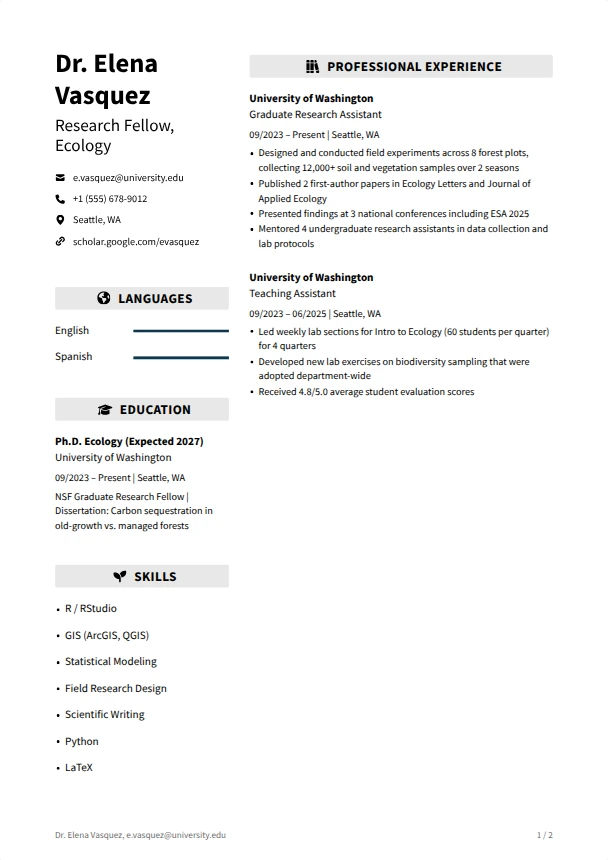
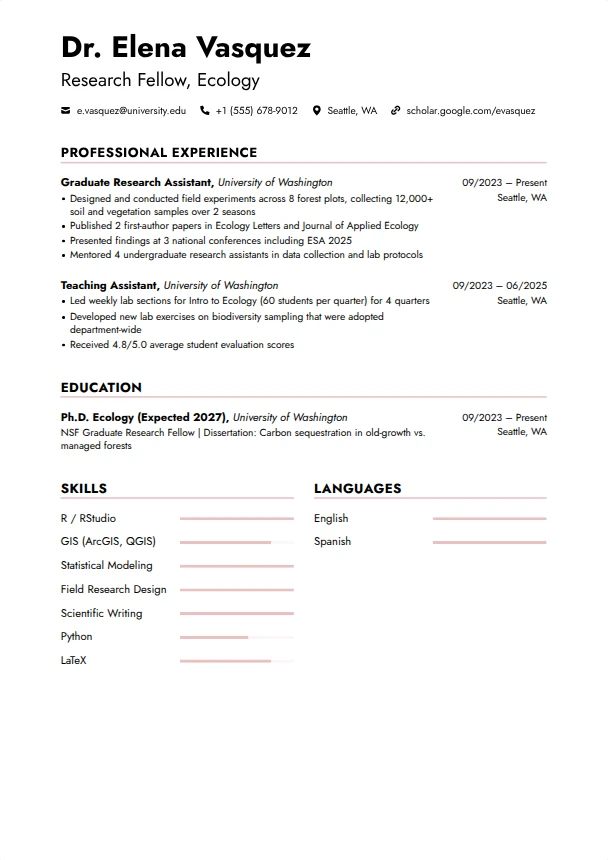
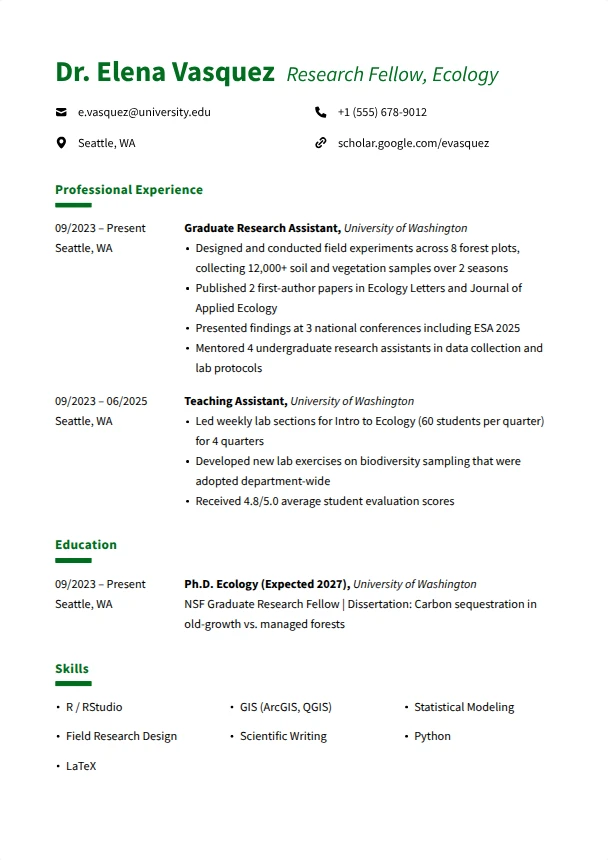
The order matters. Here's what a strong academic resume examples looks like from top to bottom:
1. Contact header
Each example starts with institutional affiliation, email, and scholarly profile links. For graduate students, include your department and advisor. For postdocs, include your current lab or research group.
Dr. Rachel Kim · Postdoctoral Fellow, Department of Neuroscience, MIT · [email protected] · scholar.google.com/citations?user=rkim
2. Research profile (2-3 sentences)
In these examples, notice how each research profile names a specific subfield, methodology, and one key contribution. This section replaces the corporate summary and immediately tells the reader where you fit in the academic landscape.
Strong: "Computational neuroscientist specializing in neural circuit modeling of decision-making behavior. Developed a spiking neural network model that predicted choice accuracy in primates with 92% fidelity, published in Nature Neuroscience. Seeking a tenure-track position at a research-intensive institution with strong computational resources."
3. Education
All examples list degrees in reverse chronological order with institution, field, year, dissertation title, and advisor. Notice how the education section includes specific details that committees care about, such as thesis committee members and honors distinctions.
4. Publications and presentations
These examples separate publications by type: peer-reviewed articles, book chapters, conference proceedings, and manuscripts under review. Follow your discipline's citation format and bold your name in every entry.
Kim, R., Patel, S., & Chen, L. (2025). Spiking network models of evidence accumulation in two-alternative forced choice tasks. Nature Neuroscience, 28(4), 512-528. · Kim, R. & Torres, A. (Under Review). Dopaminergic modulation of decision speed-accuracy tradeoffs: a computational framework. Journal of Neuroscience.
5. Research and teaching experience
Each example describes research positions with lab name, PI, dates, and accomplishment-driven bullets. Teaching entries include course name, enrollment, role, and evaluation data. Study how the bullet points in these examples always include specific numbers.
Strong: "Postdoctoral Fellow, Bhatt Lab, MIT Department of Neuroscience (2023-Present). Developed computational models of reward-based learning using Python and MATLAB, producing two manuscripts (one published, one under review). Mentored two undergraduate research assistants and one rotation graduate student."
6. Grants, awards, service, and professional memberships
The most complete examples include separate sections for each of these categories. List grant amounts, awarding bodies, and project titles. For service, include journal peer review, committee memberships, and conference organizing roles.
Key skills to include
Academic CVs do not always include a dedicated skills section, but early-career scholars benefit from listing technical competencies that search committees can quickly scan:
Tip: As your publication record grows, the skills section becomes less critical because your publications implicitly demonstrate your methodological capabilities. For early-career CVs, keep this section prominent.
Resume summary examples you can steal
Use one as a starting point, then swap in your own technologies, numbers, and achievements.
"Postdoctoral researcher in computational neuroscience at MIT with eight peer-reviewed publications, including two in Nature Neuroscience. Principal investigator on a $50,000 BRAIN Initiative pilot grant. Five semesters of independent teaching experience in computational methods courses. Seeking a tenure-track assistant professor position in a department with computational neuroscience or cognitive science programs."
Why it works: Publication count, journal prestige, independent funding, and teaching volume are all quantified. The target department type is specific enough to show intentionality without being overly narrow.
"Fourth-year PhD candidate in comparative literature at Columbia University with a dissertation on narrative temporality in postwar Japanese fiction. Published two articles in peer-reviewed journals and presented at five national conferences. Seeking a dissertation completion fellowship to support the final year of writing and archival research in Tokyo."
Why it works: The dissertation topic is precisely stated. Publications and conference presentations show scholarly productivity. The specific need (final year, archival research abroad) makes the fellowship request concrete.
"Senior political science major at Georgetown University with a 3.9 GPA, departmental honors, and an honors thesis analyzing voter turnout prediction models using county-level data from 2016 through 2024. Two semesters of research experience in the Electoral Studies Lab. Seeking admission to a master's program in political methodology or quantitative social science."
Why it works: The honors thesis topic and the lab experience directly support the stated program interest. The specific date range in the thesis shows genuine analytical work, not a superficial project.
"Adjunct instructor of sociology at two community colleges with four years of teaching experience across six different courses and a cumulative student evaluation average of 4.6/5.0. Developed three new course syllabi, including an online asynchronous section that enrolled 45 students per semester. Seeking a full-time lecturer or senior instructor position."
Why it works: Teaching breadth (six courses, two institutions), quality (4.6 evaluations), and innovation (online course development) are all demonstrated with specific numbers.
Writing strong experience bullets
Every bullet point should answer: "What did you do, and why did it matter?" Use this formula:
Before and after examples:
Published research articles in my field.
Published eight peer-reviewed articles across four journals, including three first-author publications in PLOS ONE, Neuroscience Letters, and the Journal of Computational Neuroscience, accumulating 145 citations.
Taught several courses at the university.
Designed and taught Introduction to Cognitive Neuroscience as instructor of record for three semesters, serving 90 students per section and maintaining a 4.7/5.0 evaluation average with 95% student recommendation rate.
Got grants for my research.
Secured $85,000 in research funding through two NSF Doctoral Dissertation Improvement Grants and one university seed grant, supporting fieldwork in three countries and one graduate research assistant for 12 months.
Strong action verbs for academic resume examples resumes:
Published · Secured · Designed · Mentored · Delivered · Investigated · Collected · Modeled · Presented · Reviewed · Supervised · Organized · Co-authored · Administered · Developed · Analyzed · Lectured
7 mistakes that get academic resume examples resumes rejected
Copying examples without adjusting for your discipline.
A humanities CV emphasizes book manuscripts and archival research. A STEM CV emphasizes journal articles and lab techniques. Use the structural format from these examples, but make sure the content reflects your own field's conventions.
Omitting works in progress.
Manuscripts under review, invited revisions, and papers in preparation all belong on your CV. Label them accurately and include the target journal. This shows your research pipeline and signals ongoing productivity.
Using inconsistent citation formatting.
If you cite one paper in APA format and another in Chicago, it suggests carelessness. Pick your discipline's standard format and apply it uniformly to every publication entry.
Leaving out mentoring and supervision experience.
If you have mentored undergraduate researchers, supervised lab technicians, or trained new TAs, include it. Academic positions increasingly value evidence of mentorship, especially at the postdoctoral and faculty levels.
Combining all experience into one section.
Separate your research experience, teaching experience, and service into distinct sections. Committees often have different members evaluating each area, and clear section breaks make their job easier.
Forgetting to update your publication metrics.
If a paper moved from 'under review' to 'accepted,' update your CV immediately. Submitting a CV with outdated publication statuses makes you look disorganized and costs you credit for accepted work.
Not including a detailed conference presentations section.
Every talk, poster, panel discussion, and invited lecture you have delivered at a conference belongs on your CV. Include the title, conference name, location, and date for each entry.
What to do if you have no professional experience
If the examples above represent a later career stage than yours, here is how to start building your academic record:
Start with a strong education section and build outward.
List your degree, relevant coursework, thesis title, and academic honors. This foundation supports even a one-page CV when paired with a research interests statement and skills section.
Convert strong seminar papers into conference submissions.
Your best graduate or undergraduate papers can become conference presentations. Many disciplinary conferences have student paper competitions or poster sessions with high acceptance rates for emerging scholars.
Seek co-authorship opportunities with faculty.
Offer to assist a professor with data collection, literature reviews, or editing in exchange for co-authorship on the resulting publication. Many faculty welcome competent student collaborators.
Document everything academic you do.
Attending a workshop, completing a methods certification, or serving as a peer tutor all count. Keep a running document and add to it in real time. You will be surprised how quickly your CV grows.
Frequently asked questions
Can I use the same CV for both academic and industry applications?
No. Academic CVs and industry resumes have fundamentally different formats, lengths, and priorities. Create separate documents for each. An academic CV includes publications and teaching. An industry resume focuses on projects and measurable business impact within one to two pages.
How should I order sections if I have both research and teaching experience?
Put the category most relevant to your target position first. For a research postdoc, lead with publications and research experience. For a teaching-focused lecturer position, lead with teaching experience and course development.
Should I include my dissertation abstract on my CV?
Not usually. Your dissertation title belongs in the education section, and a brief description fits in the research profile. Save the abstract for your research statement, which is a separate document in most academic applications.
How do I handle gaps in my academic career?
Address significant gaps honestly. If you took time off for family, health, or a non-academic job, you can briefly note it or simply let the dates speak for themselves. Committees understand that career paths are not always linear.
Is it appropriate to list reviewer service on my CV?
Yes. Create a 'Professional Service' section and list journals you have reviewed for, conference review committees, and any editorial board memberships. This shows that your expertise is recognized by your peers.
Skip the blank page
Open a complete, filled-in entry-level resume in our free builder. Swap in your own details, keep the wording that fits, and download as PDF, free.
Build your academic resume now
Pick a template, add your details, and download a polished PDF in minutes. Free, no account required.
Start Building, It's FreeRelated resume guides
Full guide to writing academic CVs for research, teaching, and fellowship applications.
Copy-paste resume examples for recent bachelor's and master's graduates.
Resume writing tips for current undergraduates seeking jobs and internships.
How to write a first resume as a high school student.
More resume examples: