What hiring managers actually look for
Analyzing hundreds of successful Amazon resumes reveals clear patterns in what gets callbacks and what gets ignored.
-
1
One page resumes outperform longer ones For warehouse, sortation, and fulfillment roles, one page resumes consistently perform better. Recruiters at Amazon spend an average of 7 seconds on initial screening. A concise resume with strong metrics wins every time.
-
2
Specific Amazon terminology boosts callbacks Resumes that use terms like FC, AR floor, ICQA, stow rate, and pick path get flagged as higher quality by both ATS systems and human reviewers. It signals that you understand the environment.
-
3
Metrics appear in every strong example Without exception, the strongest Amazon resumes include quantified achievements. Units per hour, accuracy percentages, safety records, and attendance streaks appear repeatedly in successful applications.
If your resume communicates these things in the first 7-second scan, you'll make it to the detailed read. Everything below is about making that happen.
How to structure your resume, section by section
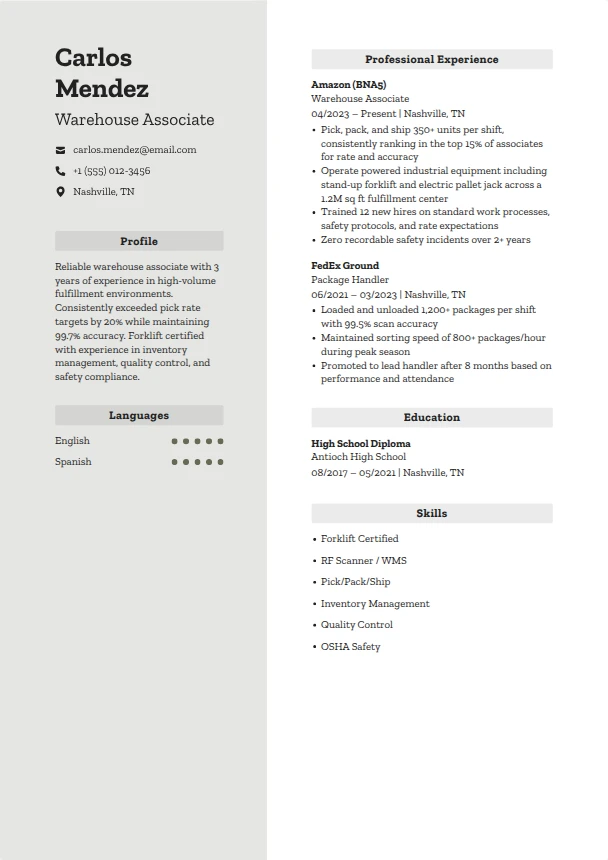
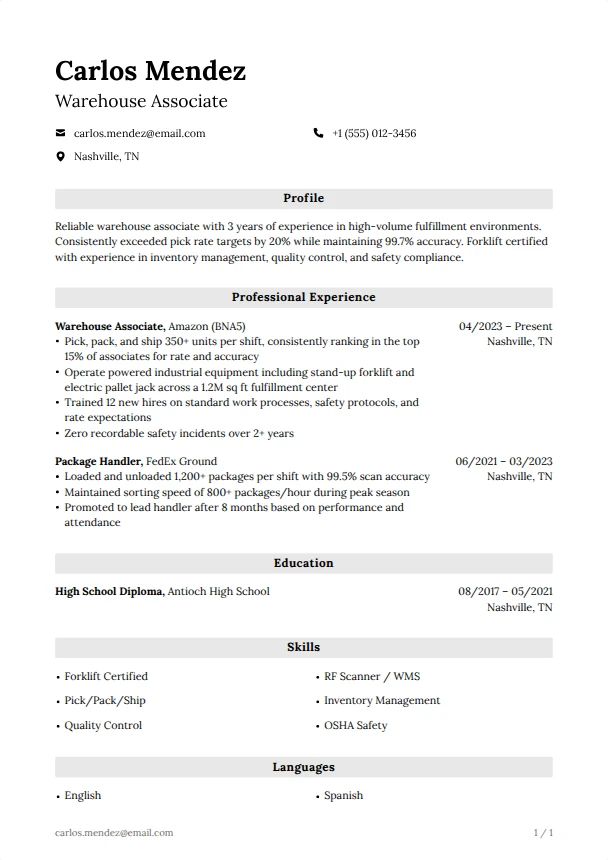
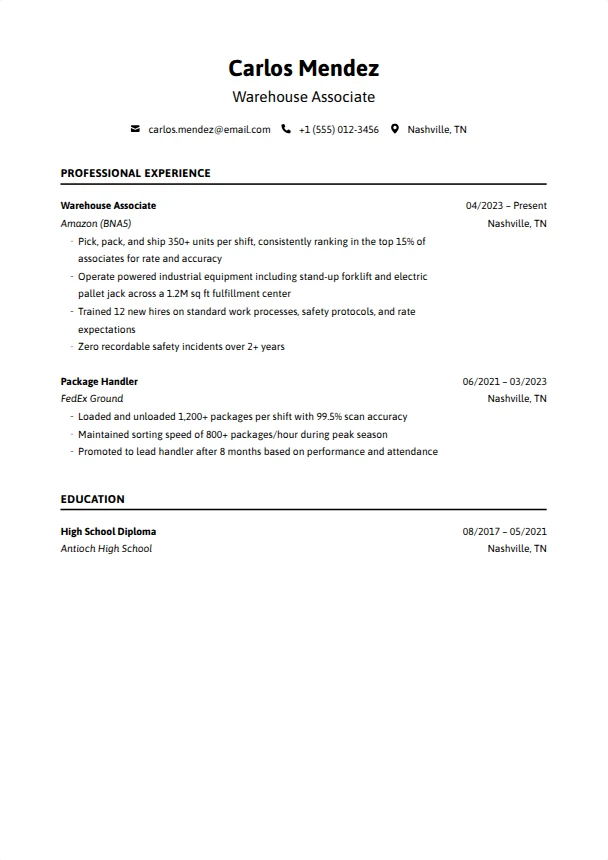
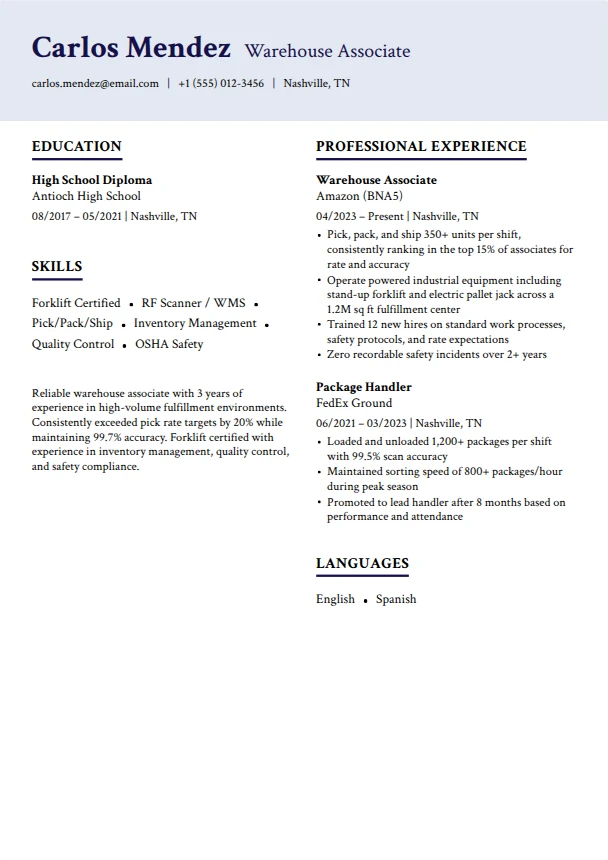
The order matters. Here's what a strong amazon resume examples looks like from top to bottom:
1. Contact header
Keep it to one line if possible. Name, phone, email, and location are all you need.
Taylor Martinez · (555) 678-2314 · [email protected] · Nashville, TN
2. Professional summary
The best Amazon resume examples open with a summary that reads like an elevator pitch. Two to three lines packed with role relevance, key metrics, and a clear value statement.
Strong: "High performing fulfillment associate with 2+ years at Amazon FC (BNA5). Averaged 400 units per shift in pick path with 99.6% accuracy. Promoted to Process Assistant within 8 months based on rate performance and peer leadership."
3. Certifications and training
Successful Amazon resumes frequently list PIT certification, forklift licenses, OSHA 10 or OSHA 30, and CPR/First Aid. These certifications show up in over 60% of resumes that advance past initial screening.
4. Skills
Organize skills in a scannable grid format. The best examples group them into categories when the candidate has 10+ relevant skills.
RF Scanner · Pick/Pack/Stow · PIT Certified · ICQA Auditing · Conveyor Systems · Safety Protocols
5. Work experience
The strongest examples use 3 to 5 bullets per role, each following the action plus result formula. Notice how the best resumes always end bullets with numbers.
Strong: "Maintained stow rate of 280+ units per hour across 3 AR floors, ranking in the top 5% of associates facility wide during Q4 peak season."
6. Education
Most successful Amazon resumes keep education brief. High school diploma or GED with graduation year is sufficient. College coursework is a bonus but not expected for operations roles.
Key skills to include
These are the skills that appear most frequently in Amazon resumes that lead to interviews and offers.
Tip: The most successful resumes match 70% or more of the skills listed in the specific job posting. Always customize your skills section for each application.
Resume summary examples you can steal
Use one as a starting point, then swap in your own technologies, numbers, and achievements.
"Amazon fulfillment center associate with 3 years of experience across pick, stow, and pack departments. Consistently exceeded rate targets by 18% while maintaining 99.7% quality score. Selected for cross training in ICQA and problem solve."
Why it works: Demonstrates versatility across departments, which Amazon values for flexibility, and includes both rate and quality metrics.
"Sortation associate with 14 months of experience processing 1,200+ packages per shift. Zero safety incidents and 100% attendance through two peak seasons. Trained 8 new hires on induct and divert stations."
Why it works: Combines volume metrics with safety and attendance records, plus shows leadership through training responsibilities.
"Amazon Flex driver with 500+ completed delivery blocks averaging 4.9 star customer rating. Transitioning to warehouse operations with strong knowledge of Amazon logistics, package handling, and delivery standards."
Why it works: Leverages existing Amazon experience and customer satisfaction metrics to demonstrate quality orientation.
"Former Amazon seasonal associate at DFW8 with hands on experience in AFE pack and ship dock. Processed 250+ units per shift with 99.4% accuracy during peak season. Seeking permanent placement based on proven performance."
Why it works: Uses the FC site code, department specific terminology, and frames seasonal work as a qualification rather than a limitation.
Writing strong experience bullets
Every bullet point should answer: "What did you do, and why did it matter?" Use this formula:
Before and after examples:
Picked orders in the warehouse using a scanner.
Picked 380+ units per shift using handheld RF scanners while maintaining 99.8% accuracy across single and multi item orders.
Helped keep the warehouse safe and clean.
Conducted 5S audits across 3 zones daily, identifying and resolving 12+ safety hazards per week and contributing to the facility earning zero OSHA recordables for 6 consecutive months.
Trained new people who started at the warehouse.
Onboarded and mentored 20+ new hires on stow and pick procedures, achieving a 90% trainee retention rate through the first 30 days.
Strong action verbs for amazon resume examples resumes:
Picked · Stowed · Packed · Processed · Audited · Trained · Loaded · Scanned · Sorted · Operated · Resolved · Maintained · Exceeded · Coordinated · Inspected
7 mistakes that get amazon resume examples resumes rejected
Copying examples word for word
Use examples as models for structure and style, not as templates to copy verbatim. Amazon recruiters review thousands of resumes and will recognize generic phrasing immediately.
Including irrelevant work history
If you worked as a babysitter 10 years ago and you are applying for a warehouse role, leave it off. Every line of your resume should connect to the job you want.
Using fancy formatting or graphics
Creative resume designs with charts, icons, or colored backgrounds fail in ATS systems. The best Amazon resumes use simple formatting with clear section headers and standard fonts.
Forgetting to include a summary
Resumes without a professional summary miss the chance to frame the entire document. The summary sets the tone and tells the recruiter exactly what to expect.
Listing skills without context
A skills section that says 'hard working' or 'detail oriented' without proof is meaningless. Back up every skill with evidence in your experience bullets.
Not tailoring for the specific role
An Amazon picker resume should emphasize different things than an Amazon stower resume. Review the job posting and adjust your summary, skills, and bullet points accordingly.
Leaving gaps unexplained
If you have a gap in employment, address it briefly. Amazon does not penalize gaps, but unexplained ones raise questions. A simple note about caregiving, education, or relocation is sufficient.
What to do if you have no professional experience
Even the best examples will not match your situation perfectly if you are starting fresh. Here is how to build a resume from scratch that still competes with experienced candidates.
Use the examples as a structural guide
Copy the format, not the content. Match the section order, bullet structure, and summary style of strong examples, then fill in your own transferable experiences.
Focus on volume and consistency from any role
Served 200 customers a day at a restaurant? Stocked 500 items per shift at a store? These numbers translate directly to Amazon's rate driven environment.
Highlight physical readiness
Amazon warehouse work is physically demanding. If you have experience in labor intensive roles, sports, or fitness activities, make that clear on your resume.
Add a certifications section even if it is short
Even a single certification like CPR or a food handler's permit shows that you can complete a structured training program, which is exactly what Amazon's onboarding requires.
Frequently asked questions
Where can I find real Amazon resume examples?
The templates and examples on this page are modeled after resumes that have successfully landed Amazon roles. Each example follows the formatting and content patterns that Amazon's screening process favors.
Should I use the same resume for every Amazon role?
No. Customize your summary and skills section for each specific role. A picker resume should emphasize speed and accuracy, while a stower resume should highlight organization and rate consistency.
How do I know if my resume is ATS friendly?
Use a standard font, avoid graphics and tables, and use conventional section headings like Work Experience and Skills. If a machine cannot parse your resume, a human will never see it.
Do Amazon resume examples work for corporate roles too?
The examples on this page focus on warehouse, fulfillment, sortation, and operations roles. Corporate positions at Amazon require a different resume style with emphasis on Leadership Principles and project impact.
Can I use these examples for other warehouse companies?
Absolutely. The structure, metrics focus, and formatting principles work for any warehouse or logistics employer. Just swap out Amazon specific terminology for terms relevant to the company you are targeting.
Skip the blank page
Open a complete, filled-in warehouse associate resume in our free builder. Swap in your own details, keep the wording that fits, and download as PDF, free.
Build your Amazon resume now
Pick a proven template, follow the examples, and create a resume that competes with the strongest applicants in Amazon's hiring pool.
Start Building, It's FreeRelated resume guides
The complete guide to writing an Amazon resume for any role, from warehouse to delivery.
Focused advice for fulfillment center picking, packing, stowing, and receiving roles.
Resume tips specifically for Amazon fulfillment associate positions.
How to write a resume for Amazon sortation center roles.
More resume examples: