What hiring managers actually look for
A principal screening new-grad applications asks one thing: can this person run a room on day one? Three things answer that.
-
1
A cleared license and the right grade band. A state teaching license, the grade band and subject it covers, and any Praxis tests passed.
-
2
Proof you can manage a real classroom. Student teaching is your evidence, with classroom management routines and PBIS supports.
-
3
Data and differentiation. MAP or DIBELS results, small groups, and differentiation for IEP, 504, and ELL students.
How to structure your resume, section by section
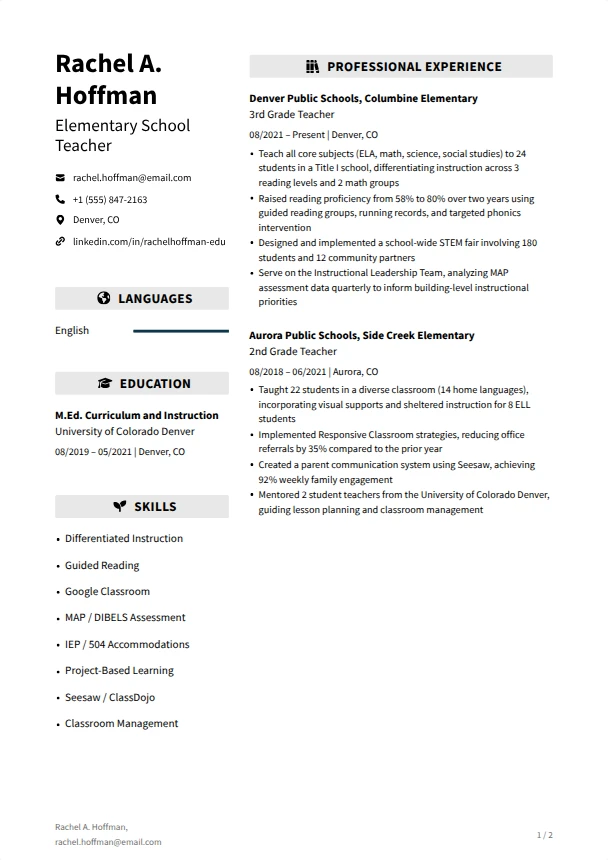
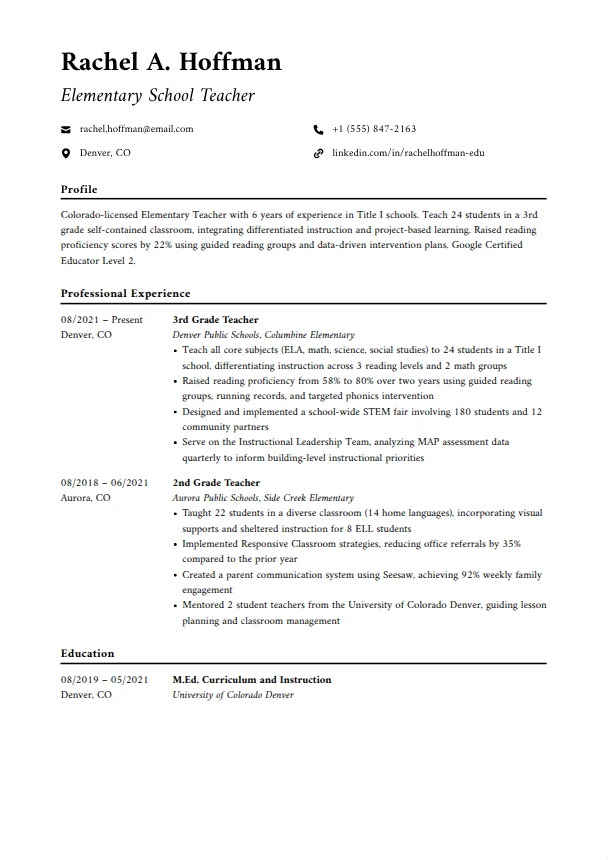
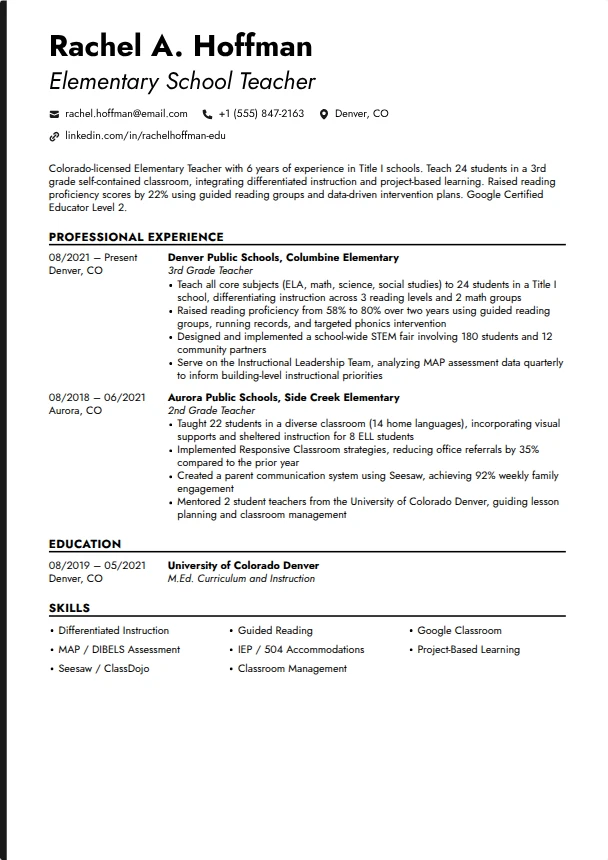
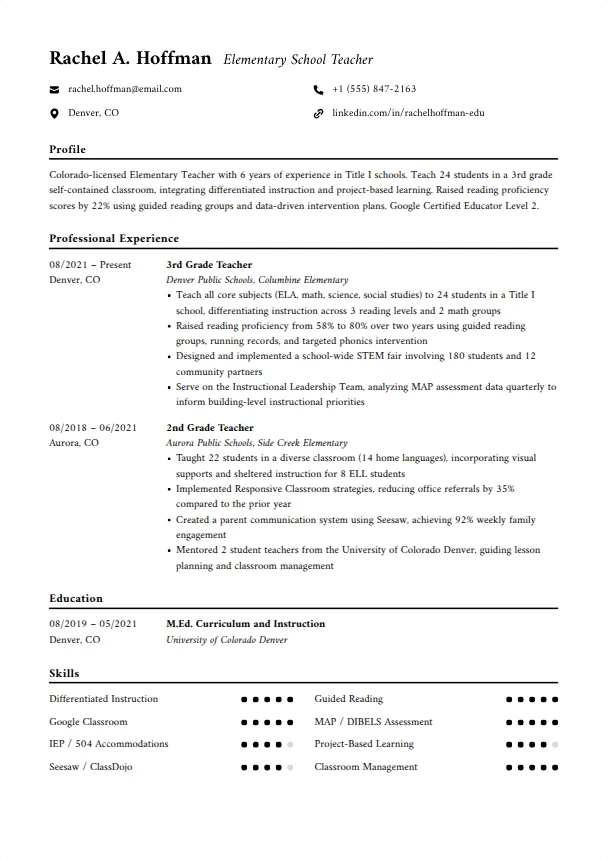
What a strong K-12 teacher resume with no paid experience looks like, top to bottom:
Contact Information
Name, phone, professional email, city and state, plus a license-status line such as "Licensed: Ohio, Grades 1 to 5 (Praxis passed)."
Professional Summary
Three or four lines naming your license area, student teaching grade and subject, and one measurable outcome.
Student Teaching Experience
Your main experience section. List the school, grade, subject, and dates, then three to five bullets on lessons, management, and outcomes.
Certifications
Your state teaching license with grade band and subject, plus Praxis tests passed. If pending, give the expected clearance date.
Education
Degree, major, university, and graduation date. Add endorsements such as reading, ESL, or special education that match a posting's requirement.
Key skills to include
Keywords K-12 hiring teams and applicant tracking systems scan for. Use the ones that match your training:
Tip: Name every assessment tool and EdTech platform you used. MAP, DIBELS, and Google Classroom signal classroom readiness.
Certifications and licenses worth listing
- State Teaching License. Subject and pedagogy exams via the Praxis tests from ETS.
- Google Certified Educator Level 1 and Level 2. Credentials from Google for Education.
- National Board Certification (NBCT). An advanced credential from the National Board for Professional Teaching Standards.
Resume summary examples you can steal
Use one as a starting point, then swap in your own grade, subjects, and numbers:
"Newly licensed Elementary Teacher completing student teaching in a diverse 2nd grade classroom of 22 students. Raised math assessment scores by 15% using differentiated small group instruction."
"Former corporate trainer pursuing a career in secondary education. 5 years of experience designing and delivering training content. Completing alternative certification in Social Studies."
"Special education paraprofessional with 3 years of classroom experience seeking a teaching position. Supported 4 students with IEPs while completing a B.S. in Special Education."
Writing strong experience bullets
Every bullet should answer: what did you do, and why did it matter?
Before and after examples:
Did student teaching
Completed 16-week student teaching placement in a 2nd grade classroom of 22 students, delivering daily core-subject lessons
Used assessments
Administered MAP assessments and used the data to form targeted intervention groups, improving math scores by 15% in a quarter
Strong action verbs:
Designed, Implemented, Administered, Differentiated, Assessed, Collaborated, Facilitated, Mentored, Adapted
5 mistakes that get new teacher resumes rejected
Downplaying student teaching
Student teaching is your experience. Give it a full block, not a single line at the bottom.
Not including data
"Helped students improve" says nothing. Name the assessment and the movement, such as raising a reading group with DIBELS.
Listing certification as 'pending' without details
Spell out the grade band, subject, Praxis tests passed, and expected clearance date.
Forgetting practicum and field experiences
List each placement with its grade level and what you did, especially ELL or special education.
Generic cover letter
Name the school, reference its programs, and tie one student teaching outcome to its needs.
What to do if you have no professional experience
Districts are hiring new graduates and career changers. Here is the path:
Maximize student teaching
Document outcomes, collect assessment data, and ask your cooperating teacher for a reference.
Build a portfolio
Collect lesson plans, anonymized student work, and assessment data in a digital portfolio.
Network at job fairs
Districts hold hiring events every spring. Attend with your resume and the grades your license covers.
Consider high-need areas
STEM, special education, and bilingual roles have the most openings. Highlight any matching endorsement.
On pay, the U.S. Bureau of Labor Statistics Occupational Outlook Handbook (OEWS, May 2024) reports a median wage of about 62,340 dollars per year for kindergarten and elementary school teachers, with figures around 61,430 dollars and 64,580 dollars across the related teaching groups. Most districts pay on a published step-and-lane schedule. See the full figures in the BLS Handbook.
Frequently asked questions
Can I get a K-12 teaching job right out of college?
Yes. Most new teachers are hired straight out of their teacher preparation programs during spring hiring season. Strong student teaching evaluations, a cleared state teaching license, and a clean resume matter far more than years on the job.
How do I list student teaching on a teacher resume with no experience?
List it in your experience section like a real job, with the school, grade level, subject, and dates. Add bullets naming lessons taught and student outcomes, such as raising a reading group's DIBELS scores or cutting off-task behavior with PBIS routines.
Which certifications and licenses should a new teacher put on a resume?
Lead with your state teaching license and the grade band and subject it covers, plus any Praxis subject and pedagogy tests you have passed. Add Google Certified Educator Level 1 or Level 2 if you hold them. National Board Certification comes later in a career.
How much do K-12 teachers earn?
According to the U.S. Bureau of Labor Statistics Occupational Outlook Handbook (OEWS, May 2024), kindergarten and elementary school teachers earn a median of about 62,340 dollars per year, with figures around 61,430 dollars and 64,580 dollars across the related teaching groups. Most districts pay on a published step-and-lane salary schedule.
What makes a new K-12 teacher resume stand out?
Concrete student outcome data from student teaching, a clearly stated state teaching license and subject area, and a clean format an applicant tracking system can read. Principals want evidence you can run a classroom, manage behavior with PBIS, and use assessment data to plan.
Skip the blank page
Open a complete, filled-in teacher resume in our free builder. Swap in your own details, keep the wording that fits, and download as PDF, free.
Build Your Teacher Resume Now
Create a teacher resume that showcases your student teaching and certifications.
Start Building, It's FreeRelated resume guides
The full guide for once you have classroom experience to show.
Build paid classroom hours while you apply for full-time roles.
Sample teacher resumes you can model your layout and bullets on.
Strong transferable experience for a first-time teacher resume.
More resume examples: