What hiring managers actually look for
Cloud hiring managers reviewing AWS resume examples focus on three signals that separate real builders from certification collectors:
-
1
Specific AWS service names in context. Listing ' AWS'as a skill means nothing. Strong examples name the exact services used and how: ' Deployed containerized microservices on ECS Fargate behind an ALB'tells a concrete story that ' experience with AWS'never will.
-
2
Cost optimization and architecture decisions. AWS roles exist to build efficiently. The best resume examples show cost savings: ' Reduced monthly AWS spend by $15K through Reserved Instances, S3 lifecycle policies, and right-sizing EC2 instances.' This signals business awareness.
-
3
Infrastructure as code and automation. Manually clicking through the AWS console doesn't scale. Managers look for Terraform, CloudFormation, or CDK experience in resume examples. Automation skills separate cloud engineers from cloud users.
If your resume communicates these things in the first 7-second scan, you'll make it to the detailed read. Everything below is about making that happen.
How to structure your resume, section by section
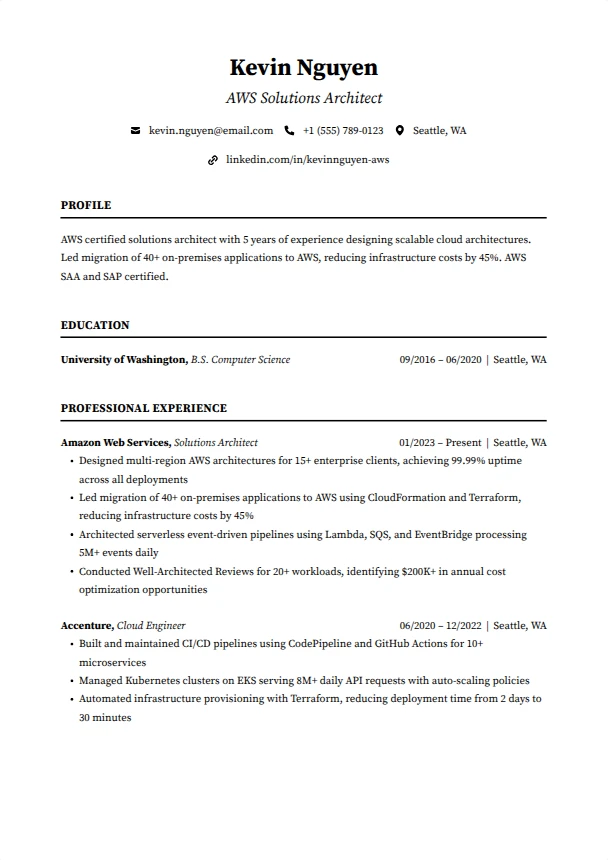
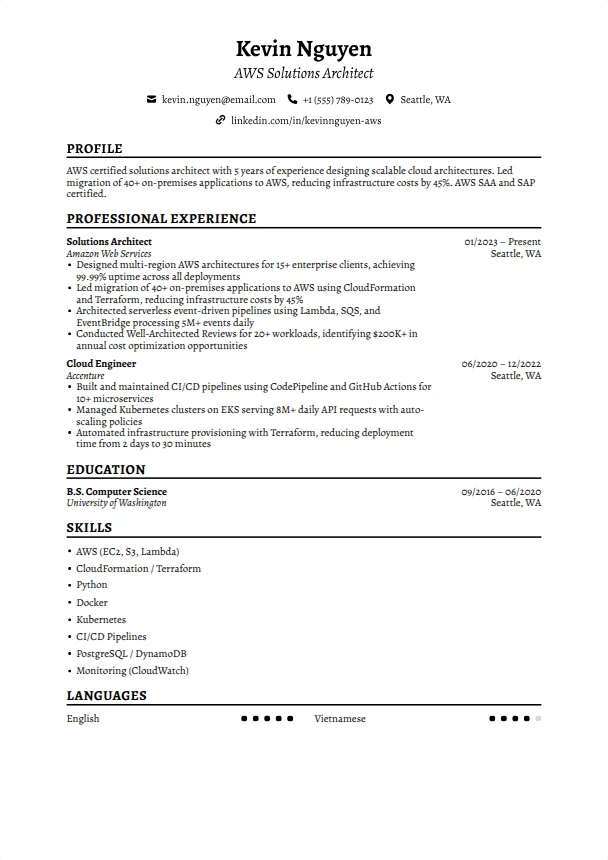
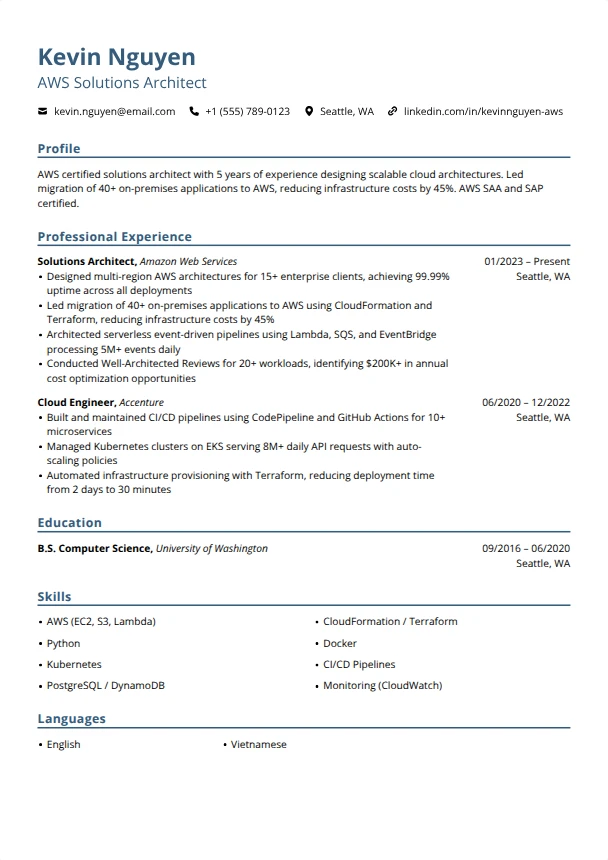
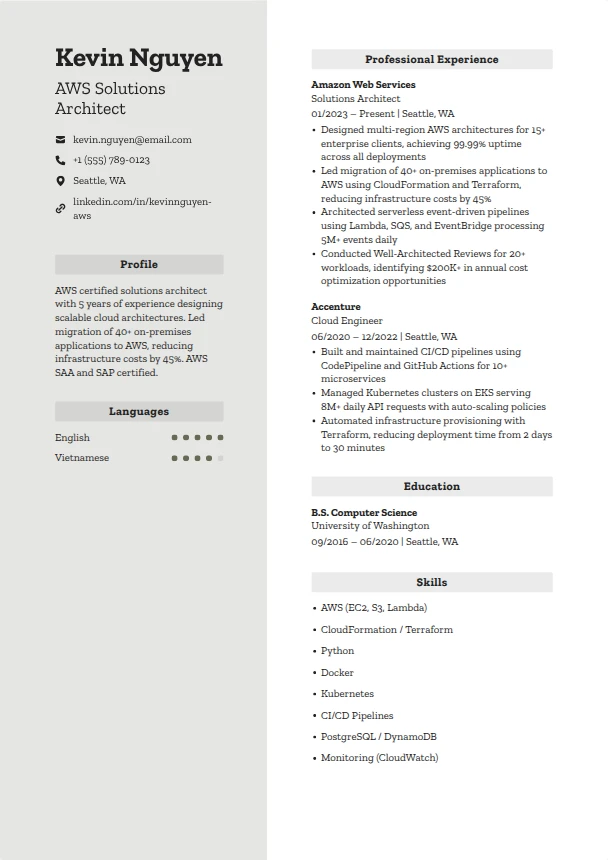
The order matters. Here's what a strong aws resume examples looks like from top to bottom:
1. Contact header
Name, email, phone, location, LinkedIn, and GitHub. If you maintain a cloud architecture blog or have public Terraform modules, link to themthey're proof of hands-on AWS work.
James Okafor · [email protected] · (555) 789-0123 · Atlanta, GA
linkedin.com/in/jamesokafor-cloud · github.com/jokafor-infra
2. Professional summary
The strongest AWS examples lead with certification level, years of cloud-specific experience, the scale of infrastructure managed, and one headline achievement involving cost or reliability.
Strong: "AWS Solutions Architect with 5 years of experience designing and managing multi-account cloud environments serving 2M+ daily active users. Architected event-driven data pipeline (Lambda, SQS, DynamoDB) processing 50M events/day. Reduced annual AWS spend by $180K through Reserved Instances, Savings Plans, and architecture optimization. AWS SAA and SAP certified."
3. AWS certifications
In every strong AWS resume example, certifications appear prominently and in order of relevance. List the full certification namenot just the acronymso ATS systems match correctly.
AWS Solutions Architect Professional (2025) · AWS Solutions Architect Associate (2024) · Terraform Associate (2024) · AWS Developer Associate (2023)
4. Technical skills
Organize by cloud domain: Compute, Storage & Databases, Networking, Security, DevOps & Ia C. This mirrors how AWS teams actually think about infrastructure.
Compute: EC2, ECS Fargate, Lambda, Auto Scaling
Storage/DB: S3, RDS (PostgreSQL, My SQL), DynamoDB, Elasti Cache
Networking: VPC, ALB/NLB, Route 53, CloudFront, Transit Gateway
Security: IAM, KMS, Security Hub, Guard Duty, WAF
IaC/DevOps: Terraform, CloudFormation, CDK, Code Pipeline, GitHub Actions
5. Work experience
Each bullet in the strongest examples names specific AWS services, the architecture pattern used, and the business outcome. Generic bullets like ' managed AWS infrastructure'fail to differentiate.
Strong: "Architected multi-region active-active deployment on AWS (ECS Fargate, Aurora Global Database, CloudFront) achieving 99.99% availability for a payment processing platform handling $50M in monthly transactions. Implemented automated failover with Route 53 health checks and Lambda-triggered DNS updates."
6. Education & additional
Degree, school, year. For AWS roles, certifications and hands-on projects carry far more weight than educational background. Include any AWS community involvement, re:Invent talks, or published architecture write-ups.
Key skills to include
These AWS services and tools appear most frequently in cloud job postings for 2026. Tailor your list to the specific role Solutions Architect, DevOps, and Cloud Engineer postings each emphasize different services.
Tip: Name the specific AWS service, not just the category. ' ECS Fargate'matches better than ' container orchestration'and ' Aurora PostgreSQL'is more precise than ' managed database.' Specificity signals hands-on experience.
Resume summary examples you can steal
Use one as a starting point, then swap in your own technologies, numbers, and achievements.
"AWS Cloud Practitioner and Solutions Architect Associate certified with hands-on experience deploying production workloads on AWS. Built a 3-tier web application (EC2, RDS, S3, CloudFront) serving 10K monthly users as a personal project. Completed 6-month cloud internship managing VPC networking and IAM policies for a 50-person Saa S company."
Why it works: Two certifications, a deployed project with real users, and internship experience with specific AWS servicesstrong for entry-level.
"AWS Solutions Architect with 4 years of experience designing cloud-native applications for B2B Saa S platforms. Migrated monolithic application to microservices on ECS Fargate, reducing deployment time from 2 hours to 8 minutes and infrastructure costs by 40%. Designed multi-AZ architecture achieving 99.95% uptime for 500K+ monthly active users. AWS SAA and Developer Associate certified."
Why it works: Migration leadership, deployment speed improvement, cost reduction, uptime metrics, and user scaleall with specific service names.
"Senior cloud architect with 8 years of experience designing AWS infrastructure for Fortune 500 financial services clients. Architected multi-account landing zone (AWS Organizations, Control Tower, Service Catalog) supporting 200+ development teams. Built CI/CD platform on Code Pipeline processing 500+ deployments per week. Reduced cloud spend by $400K annually through Fin Ops practices and Reserved Instance portfolio management. AWS SAP and DevOps Professional certified."
Why it works: Enterprise scale, multi-account governance, massive deployment volume, significant cost savings, and top-tier certifications.
"Linux systems administrator transitioning to AWS cloud engineering with Solutions Architect Associate certification and hands-on project portfolio. Built serverless data pipeline (API Gateway, Lambda, DynamoDB, S3) processing 100K+ records daily. Migrated personal infrastructure from on-prem to AWS, documenting the full process in a 20-post blog series. Brings 5 years of Linux, networking, and automation experience directly applicable to cloud operations."
Why it works: Certification + deployed project + documentation proves cloud readiness. Sysadmin background positioned as cloud-relevant infrastructure skills.
Writing strong experience bullets
Every bullet point should answer: "What did you do, and why did it matter?" Use this formula:
Before and after examples:
Managed AWS infrastructure and deployed applications.
Managed AWS environment spanning 3 accounts, 15 VPCs, and 200+ EC2 instances serving 1M daily active users. Implemented auto-scaling policies that handled 5x traffic spikes during peak periods with zero degradation.
Worked on cost optimization for cloud resources.
Reduced monthly AWS spend from $85K to $58K through Reserved Instance purchases, S3 Intelligent-Tiering migration, and right-sizing underutilized EC2 instances identified via Cost Explorer and Trusted Advisor analysis.
Set up CI/CD pipelines for the development team.
Built fully automated CI/CD pipeline using Code Pipeline, Code Build, and ECS Fargate, enabling 12-person engineering team to deploy to production 30+ times per week with automated testing, canary deployments, and one-click rollback.
Strong action verbs for aws resume examples resumes:
Architected · Automated · Built · Configured · Deployed · Designed · Implemented · Migrated · Monitored · Optimized · Provisioned · Reduced · Scaled · Secured · Scripted · Managed · Orchestrated · Containerized
6 mistakes that get aws resume examples resumes rejected
Listing ' AWS'as a single skill
AWS has 200+ services. Saying ' experience with AWS'tells a hiring manager nothing. The strongest examples list 10-15 specific services they've actually used: EC2, Lambda, RDS, S3, VPC, IAMnot just the umbrella brand.
Featuring certification without project evidence
An AWS SAA certification alone doesn't prove you can build anything. Managers routinely see certified candidates who've never deployed a production workload. Pair every certification with a project or work experience that uses those services.
Ignoring cost metrics in cloud resume bullets
Cloud engineering is fundamentally about building efficiently. If your resume doesn't mention cost optimization, spend reduction, or right-sizing anywhere, you're missing one of the most valued skills in AWS hiring.
Using console-only language
Phrases like ' configured EC2 instances in the AWS console'signal manual, non-scalable work. The strongest examples reference Terraform, CloudFormation, or CDKshowing that infrastructure is managed as code.
Copying AWS service lists from the certification study guide
If your skills section lists every service covered in the SAA exam but your experience bullets only mention EC2 and S3, the disconnect is obvious. Only list services you can discuss in technical depth.
Omitting the scale of your cloud environment
Managing 5 EC2 instances is different from managing 500. Always include: number of instances, accounts, VPCs, daily requests, monthly spend, or users served. Scale communicates competency level.
What to do if you have no professional experience
Even without professional AWS experience, you can build a resume using these examples as your template. Here's how:
Start with the career changer example template
The sysadmin-to-cloud example above shows exactly how to structure a resume around certifications and personal projects instead of cloud job history. Use that structure as your starting point.
Build 2-3 AWS projects on the free tier
Deploy a 3-tier web app (EC2/RDS/S3), build a serverless API (API Gateway/Lambda/DynamoDB), and set up a CI/CD pipeline (Code Pipeline/Code Build). Each becomes a resume bullet with real architecture details.
Document your architecture decisions publicly
Write blog posts or GitHub READMEs explaining why you chose specific services, how you handled security, and what the cost implications were. This creates a portfolio that proves deeper understanding than certification alone.
Get AWS Solutions Architect Associate certified
This is the baseline credential for AWS roles. Study for 6-8 weeks using Stephane Maarek's course and practice exams. Then immediately build a project that uses the services you studied certification plus project is the winning combination.
Frequently asked questions
Which AWS resume example should I start with?
Pick the one that matches your current level: junior cloud engineer for entry-level, solutions architect for mid-career, and career changer if you're transitioning from sysadmin or IT support. Customize from there.
How many AWS services should I list on my resume?
10-15 specific services that you've actually used. Group them by domain (Compute, Storage, Networking, Security, DevOps). Quality matters more than quantitylist only services you can discuss technically in an interview.
Should I include personal AWS projects?
Absolutely. A deployed serverless API or a multi-tier web application on AWS demonstrates more practical skill than a certification alone. Treat personal projects like work experience: describe what you built, which services you used, and include metrics.
How important are certifications vs.experience for AWS roles?
Both matter, but experience wins. A candidate with SAA certification and 2 deployed projects beats a candidate with 3 certifications and zero hands-on work. Certifications open the door; project evidence closes the deal.
Should I mention multi-cloud experience on an AWS-focused resume?
Yes, briefly. If you have Azure or GCP experience, mention it in your skills section but keep the focus on AWS. Multi-cloud awareness is a plus, but don't dilute your AWS depth by giving equal space to other platforms.
Skip the blank page
Open a complete, filled-in DevOps / cloud engineer resume in our free builder. Swap in your own details, keep the wording that fits, and download as PDF, free.
Build your AWS resume from these examples
Pick the cloud career template that fits your level, add your own AWS projects and certifications, and download a polished PDF in minutes. Free, no account required.
Start Building, It's FreeRelated resume guides
Complete guide to writing an AWS-focused cloud resume.
How to build an AWS resume with free tier projects and certifications.
Multi-cloud resume guide for career changers entering cloud engineering.
How to break into DevOps with home lab and automation projects.
More resume examples: